Showing posts with label 40k. Show all posts

2023/07/07

40k: HamWarmer 24.5 - Imperial Guard

HamWarmer 24.5 is my cobbled-together 40k homebrew. Here's the Imperial Guard faction.


Imperial Guard PDF v 0.1

After 5th edition, every official Imperial Guard rulesset included some type of Orders system, where, on a squad or army level, a player selects an Order each turn that grants units a situational bonus. This design choice was never really appealed. It adds a new subsystem (something HamWarmer 24.5 tries to avoid), it requires balancing (ditto), and there's usually one optimal choice in any given scenario.

These rules rely on simple mechanical benefits granted by the core rules. Instead of a complicated faction-only leadership system, the Imperial Guard use the standard Morale rules, modified slightly by vox casters. Vehicle facing and screening is critical. 

In other 40k news, here are a few recent conversions from the Leviathan boxed set.


A neurotyrant with a helmet. Always remember to wear your helmet.

A Screamer-Killer with a reposed neck and no eyes. All non-syapse creatures in my Tyranid swarm are eyeless.

A winged Tyranid Prime converted to match my other winged Tyranid Warriors with their old Forgeworld wings. I swapped the order of wings and talons and replaced the feet with Genestealer claws.

2022/08/31

40k: Thunderer Siege Tanks, Cargo Vehicles, and a second Mars-Pattern Baneblade

I picked up a second Mars-Pattern Baneblade some time ago. I didn't intend to. It was just one of those coincidences. This one didn't require nearly as much restoration work, but it was still a slog to assemble. The certificate puts this tank in the late 400s of the production run, so plenty of mold errors were present.


I didn't convert this Baneblade at all, though I'm tempted to make a dozer blade in the style of this obscure pic from an Imperial Armour.
IA Vol 1 2nd Ed

As far as I know, this is the only picture of this conversion. It's easy enough to replicate (four 2nd Ed dozer blades and some plastic tubes), but it's an interestingly painted and weathered vehicle. I've never seen this tank in any other books (except as a copy of this photo) or in a Forgeworld display. If anyone has any information on it, post it in the comments.


I picked up three Thunderer Siege Tanks for the Moribundan 1st Armoured Regiment. I'm not a huge fan of the design, and I'd be much happier with three more Laser Destroyers, but there was a chance to get all three at once, just after I'd found 3 Vindicator dozer blades. I suppose it was fate. The tanks needed a lot of restoration work, but some blue stuff casting helped replace the damaged bits.


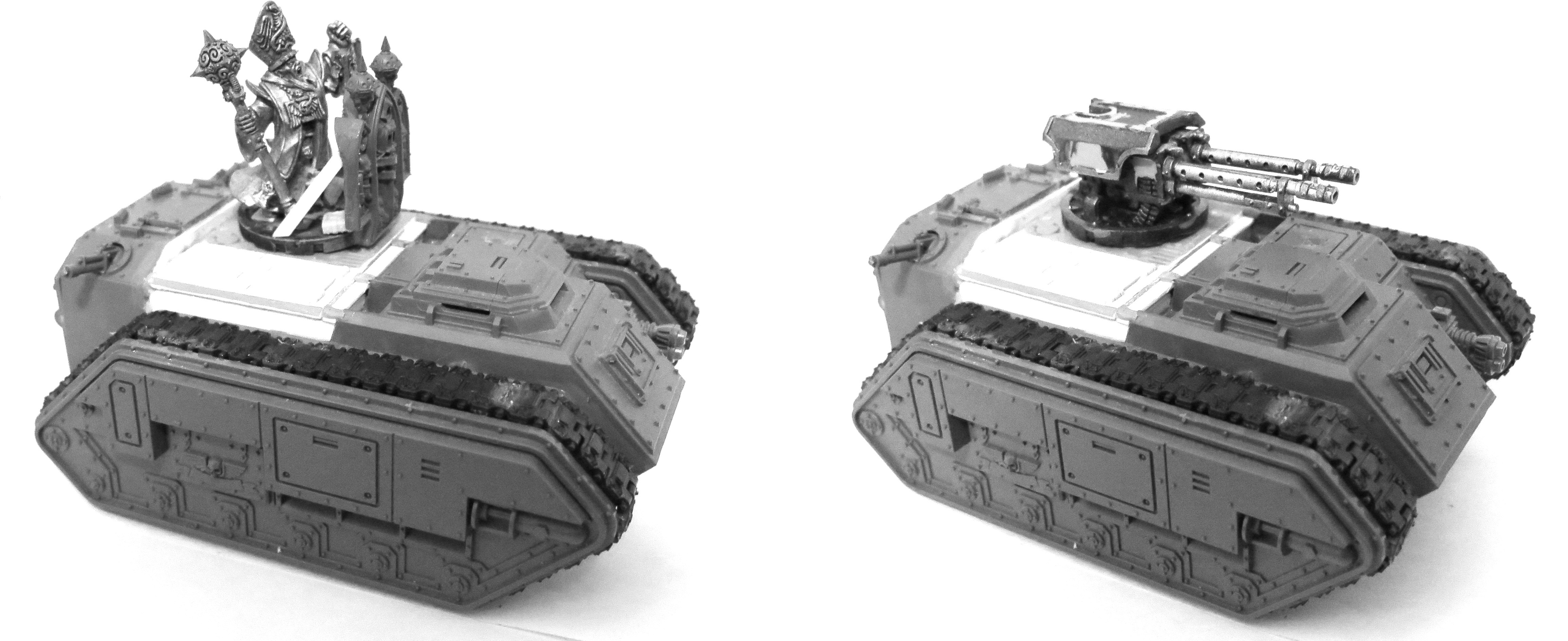
The Chimerarch-pattern Mobile Pulpit is a modification of the ubiquitous Chimera chassis. It is designed to carry one member of the Ecclesiarchy into battle and protect them with a temperamental refractor field.

In situations where a preacher is not available, or where crowds are likely to become unruly, the Chimerarch is sometimes fitted with a twin reaper autocannon turret. 

Cargo Vehicles

Civilian vehicles are pure self-indulgent fun. At least a Baneblade has rules; other than very expensive terrain or custom scenarios, these models don't serve any real function. But that's part of the fun. 40k doesn't have to be all about giant guns and piles of skulls.


The Arvus-pattern Lighter is used throughout the Imperium as a shuttle and light transport. If the passenger bay is removed, the shuttle can be used to haul a standard Munitorum Armoured Container. The handling characteristics of the Arvus are significantly altered by this variant. Given the choice, pilots prefer to fly fully loaded, as an empty Arvus can flip end-over-end if the throttle is adjusted too quickly.


The Hyracon-class Traction Shovel is an ungainly but necessary vehicle. In the Gloaming Severity of Dark Posterity, someone still needs to clear all that gothic rubble. The Hyracon shuffles forwards, bent in half like a pensioner shoveling snow. It's a de-chaos-ified version of u/TarasTeeNL's "Miley".

The Marah-pattern Rigid Cargo Dirigible is capable of lifting a full Munitorum Armoured Container and transporting it with efficiency and grace. The gas bladder contains Cavorite-IV gas, which is (by some alchemical quirk) lighter than vacuum. Question not the mysteries of the Machine God.

The blimp was a fun speedbuild. One evening to build, one evening to paint. Hopefully it can evade the Sump Pirates.

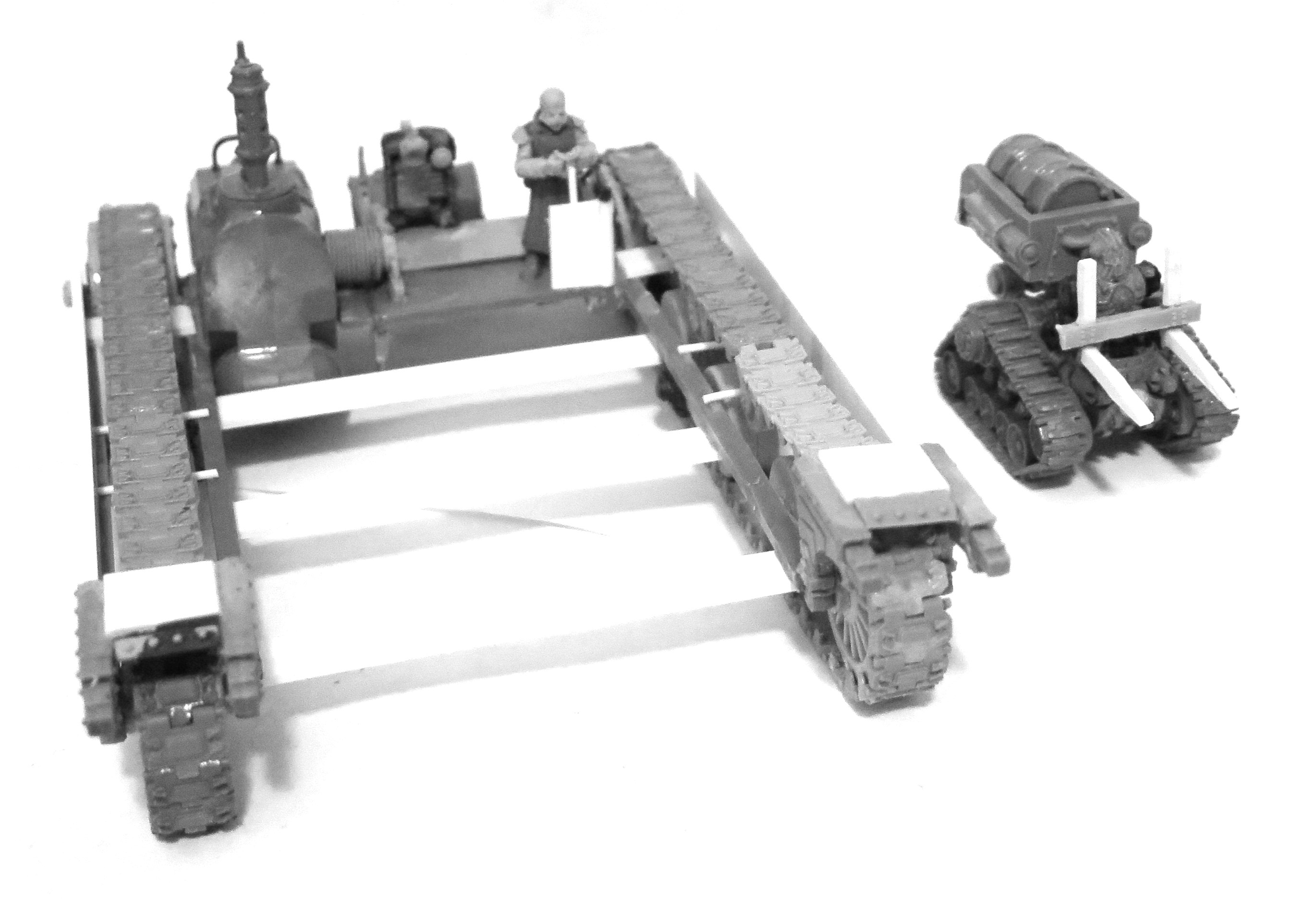
These two vehicles do not follow a known STC pattern. The leftmost vehicle is a simple cargo crawler, designed to winch and transport large containers or wrecked civilian vehicles. It has controls facing in both directions of travel. The second vehicle is a light servo-hauler, currently transporting a fuel barrel.

2022/04/13

40k: Deconflagrators and Sump Pirates, Painted

Sump Pirates

The Sump Pirates of Necromunda, as previously stated, do not exist. They are an underhive story to frighten children. When they appear, it's as if a mythical beast has suddenly and inexplicably burst into the mundane world. When they retreat, their victims invent explanations for the destruction and death they inevitably cause.

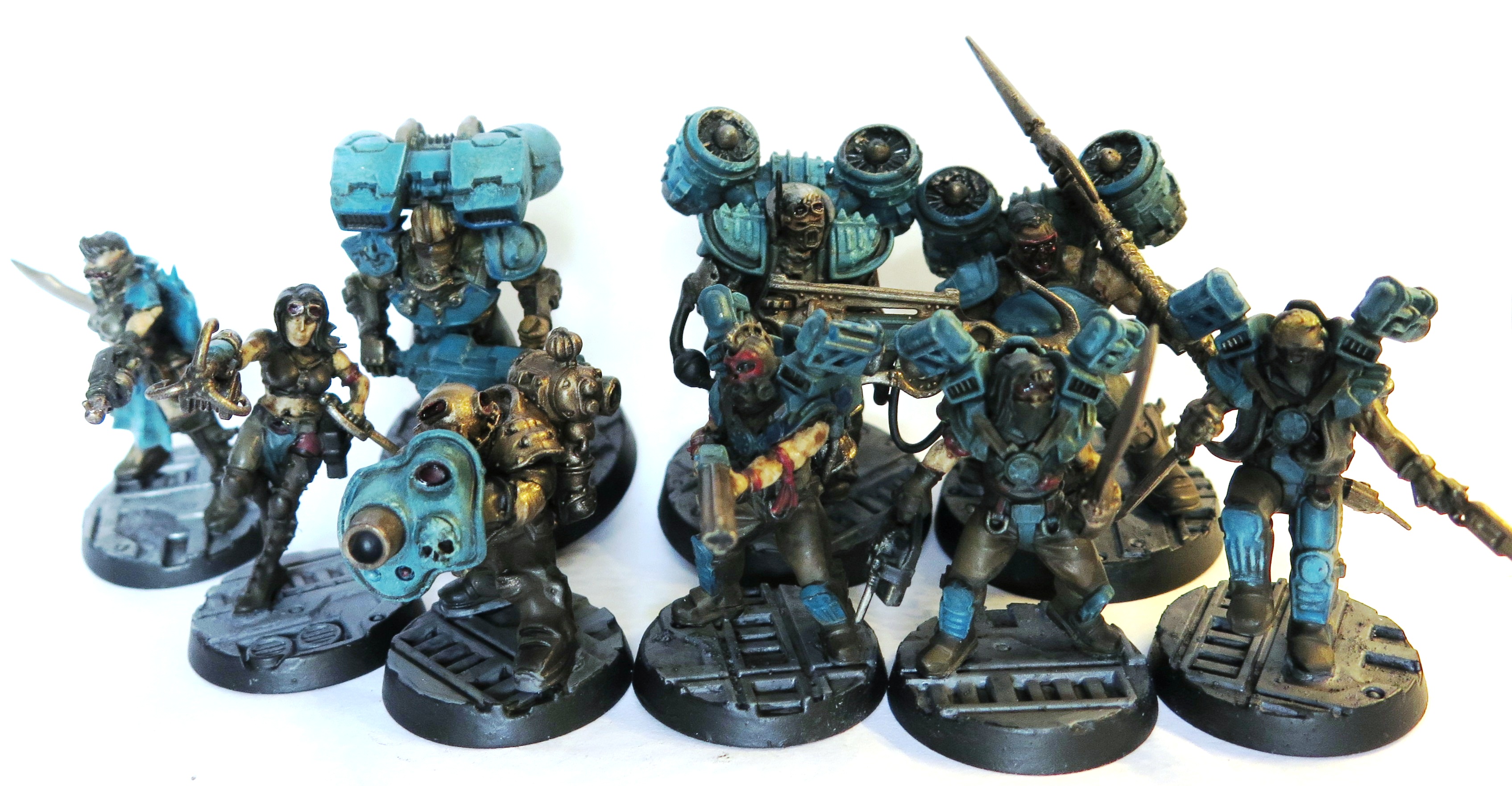
Members of the gang often wear masks, whether to filter out sump toxins, shield their identities, or to protect from a hypothetical memory-altering gas. Jump packs and grappling hooks are common.
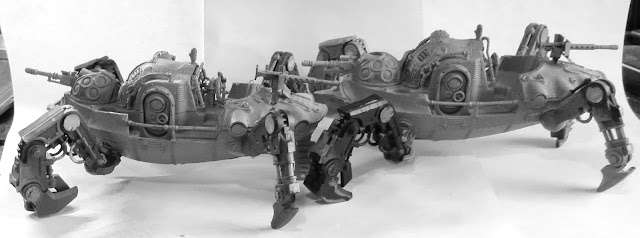
Sump Spiders allow the Sump Pirates to raid across the Hive and beyond. While slower than many wheeled or tracked vehicles, it can climb walls or paddle through toxic rivers. It also carries an autocannon, a terrifying weapon in any gang conflict, as well as a rear-mounted heavy stubber.
The unusual camouflage pattern on Sump Pirate vehicles may serve to conceal their hull shapes during raids, or it may be mere tradition.
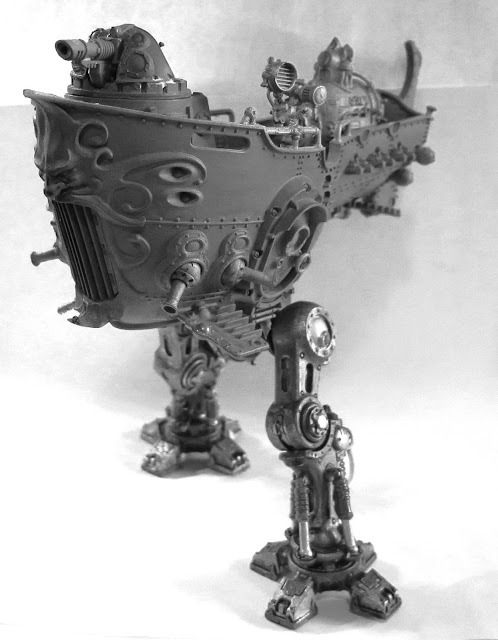
The Sump Strider is the capital vessel and roving war-base of the Sump Pirates. Festooned with weapons, the Sump Strider allows the Sump Pirates to raid with impunity.

Its terrifying war-mask bears a mysterious vent.

Kits: The Sump Pirates are a mix of various Necromunda gangs and spare parts. The Sump Spiders are Age of Sigmar Arkanaut frigates with 40k Defiler legs. The Sump Strider is an Arkanaut Ironclad with Knight legs. Buying these kits new and mashing them together is probably not a good plan. I just happened to stumble across them (or parts of them) at a convenient time.
 

How do the Sump Pirates maintain their cloak of unnatural secrecy? Are they the ancient remnants of a marooned Navigator house? Warp-touched pskyers? The owners of some mysterious artifact or source of mind-altering sump gas? Who knows.

The Deconflagrators

In the Dark Grimness of the Future Imperfect, things still catch on fire that should  not be on fire. The Deconflagrators rush to the blaze, connect hoses to ancient skull-shaped hydrants, and pour foam and water onto the flames. They are respected by citizens and outlaws alike, for the brief life of a Deconflagrator is spent in constant service.

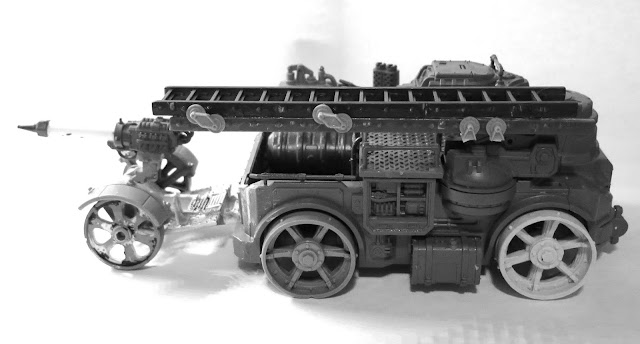
Rubber melts and cloth burns, so the Deonflagrators ride on iron wheels and shroud their bodies in hissing cryosuits. With suitable ritual preparations, a Deconflagration Wagon can survive the heat of an alchemical fire or promethium spill. 

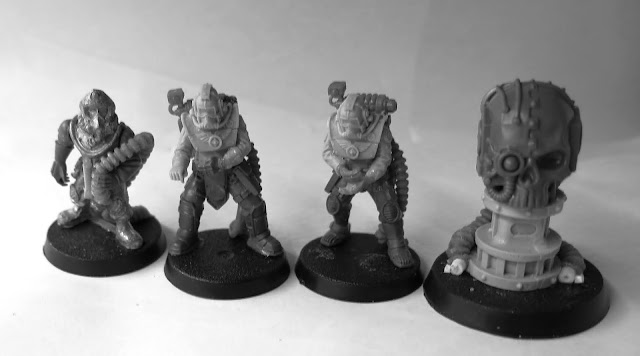
Kits: The Deconflagrators are based on Forgeworld Titan crew. The wagon is a modified Goliath Truck with wheels from (of all things) the Forgeworld Malcador Infernus. The foam cannon is based on an old Ork cannon.

Other Underhive Denizens

Two other models for Necromunda/Inq28 games: an Inquisitor on a bike from Wargame Exclusive and a humble water-seller. Pretty soon I'll have enough vehicles to run a Necromunda-themed 28mm Gaslands race.

Side Note: It's really odd that The Great Race (1965) predates Wacky Races (1968). It feels like it should be the other way around. The Great Race has all the hallmarks of a misguided adaptation, yet it's the origin. Oh well.

2022/01/17

40k: HamWarmer 24.5 Update - v0.4

Here's another round of updated HamWarmer 24.5 PDFs. Testing will continue until I lose interest, civilization collapses, or I achieve perfect balance.

I'm reasonably happy with the results so far. Alternating activation makes the game feel much more dynamic. It's trivial to put together a list.

Patchnotes:

  • Units no longer collide during the Fight Phase, then mutually decide to flee in the Morale phase.
  • Tau do more Tau Things for the Tau Empire.
  • Psykers made slightly less scary.
  • Units can now Infiltrate on Turn 1.
  • Carnifexes move at a sensible speed.
  • Synapse ranges tweaked.
  • Many points cost changes.

And finally, here are a few pics from a test game.

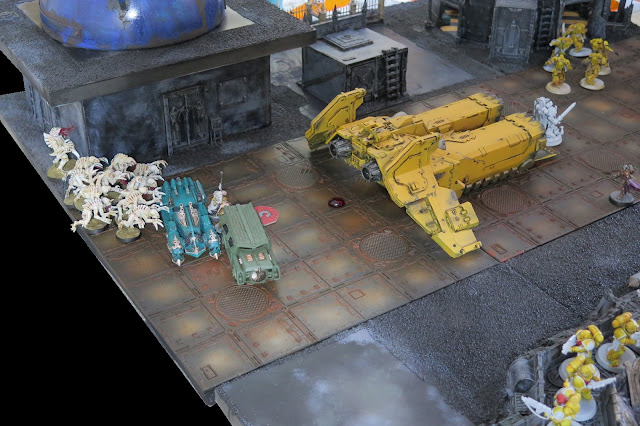
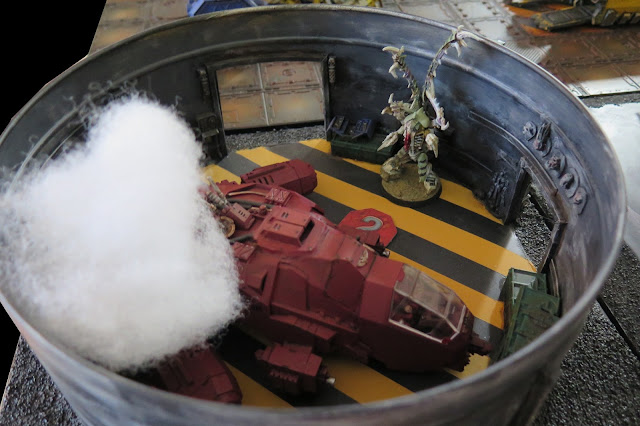
The scenario pit the Imperial Fists against a Tyranid invasion force. Four groups of civilians were trying to escape a doomed spaceport. The Imperial Fists scored points for each shuttle or vehicle that successfully launched, and the Tyranids scored points for each civilian devoured.

Sneaky Genestealers attempt to seize an objective, but the civilians escape just in time, exposing the Genestealers to devastating bolter fire.


Meanwhile, Spore Mines rain down on the battlefield, inflicting a few superficial injuries but ultimately doing little to deter the Astartes.

A Lictor destroys one shuttle, but it is a minor victory for the Hive Mind. The majority of the precious biomass in the spaceport escapes... for now.

2022/01/15

40k: Tyranid Swarm Completed

The Tyranid project I started in late 2020 is finished.

The prospect of an upcoming game (in person! With a real living human!) spurred me to finish the last few squads in two marathon sessions.

Every model in this army was purchased second-hand. The vast majority (including all the 'gaunts) had to be stripped and repainted. Still, the final results are worth it.

The original scheme was inspired by Marco Schulze's Hive Fleet Ouroboros, as seen in Forgeworld's book The Anphelion Project.


120 Termagants, 3 Pyrovores, and 1 Tervigon.

20 Gargoyles, 2 flying Hive Tyrants (one based on the old Forgeworld kit, one in plastic), 3 Lictors, and 8 Zoanthropes (including 6 Alien Brain Larva from Trollforged Miniatures).

60 Hormagaunts, 1 Tervigon.

32 Genestealers, 2 Broodlords, 1 Carnifex.


9 Raveners, 1 Trygon, 1 Slitherer (Red Terror), 3 Venomthropes, 1 Toxicrene, 3 Biovores, 24 Spore Mines, 1 Barbed Hierodule.

3 Hive Guard, 6 Mucolid Spores, 2 Carnifexes w. Crushing Claws, 2 Carnifexes w. Quad Devourers, 2 Carnifexes w. Twin Venom Cannons, 3 Tyrant Guard, 9 Ripper Swarms, 20 Devilgants, 1 Hive Tyrant w. Venom Cannon, 1 Hive Tyrant w. Quad Boneswords, 1 Warrior Prime, 9 Tyranid Warriors.

Painting Recipe:

  • Black primer.
  • Airbrush chitin in Vallejo 71.023 (Hemp). Highlighted up with a few drops of green and white
  • Airbrush carapace in Vallejo 71.075 (Sand Ivory). Highlighted up with a few drops of white.
  • Ink with Vallejo 73.300 (Sepia wash).
  • Drybrush carapace with Pallid Wych Flesh.
  • Touch up chitin with a 1:1 mix of Pallid Wych Flesh and Castellan Green.
  • Tongues and biomorphs in Xereus Purple, Pink Horror, and a dilute layer of Flesh Tearers Red.
  • Teeth, eyes, and biomorphs receive a wash of Gloss Nuln Oil.
  • Base in a 1:1 mix of Vallejo 26.809 Industrial Thick Mud and Vallejo 28.807 European Mud.
  • Touch up base rims.
If you can't paint so hot, paint a lot.

2022/01/10

40k: HamWarmer 24.5 - Tau

HamWarmer 24.5 is my wobbly homebrew ruleset for Warhammer 40k games. Here's my take on the Tau faction.

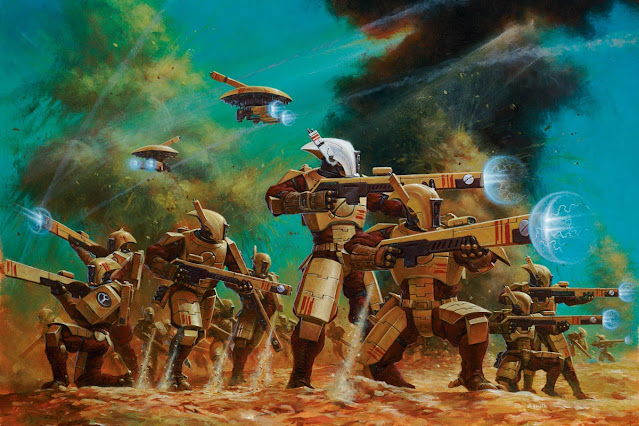
Adrian Smith

Tau PDF (v.0.1)

The goal of this project, aside from simplifying the rules, is to make every army feel "right". Space Marines should feel like armoured posthuman warrior-knights. Tyranids should feel like a horde of ravening space bugs. Tau should feel like a combined arms force that bends (or outright breaks) conventions.

With HamWarmer 24.5, I'd like armies to rely on positioning and tactics to mitigate weaknesses. Screen. Redeploy. Use allies to tie up advancing units. Or, if that fails, just shoot everything before it gets to your lines.

As usual, testing is ongoing. Alternating activations makes Markerlights (and Tau shooting in general) much more interesting for everyone. Markerlight-heavy units tend to fire first (but can't benefit from their own Markerlights), followed by heavy weapons and seeker missiles, followed by everything else. 

I've also integrated some long-forgotten Kroot units into this list. Daniel Cockersell's sculpts deserve better.

If you spot any errors or omissions in the rules, let me know.

2021/12/10

40k: Deconflagrators, Trenchers, and Sump Pirates

Here are a few of the 40k projects I've been working on.
A Deconflagration Wagon and towed Surfactant Cannon.

The Deconflagrators

Fire is a constant threat in any hive or voidship. At the banshee wail of a conflagration alarm, citizens rush to the scene, some to help (by custom, by altruism, from fear of punishment, or for the sensible fear that their own dwellings may be next), some to loot, and some to watch. In organized districts, ancient companies of Deconflagrators arrive to smother flames in toxic foam. Sheathed in coolant-suits, they stride into the fire to rescue citizens, vital documents, or relic-engines. 

Some, corrupt or addled, set fires themselves, either to extort pump-tithes or from boredom. Some worship the Emperor Pyrolyzed in secret ceremonies. But most are hardy, true, and battle-scarred. Frostbite from coolant breaches fuse with blisters from combusting parchment and chem-stacks. Ears and fingertips go first. "A ten-finger jack" is their cant for novice, a "elbow-jack" for a veteran, as their skin all-over resembles the wrinked folds of an elbow.

A Ten-Finger Jack, two Elbow Jacks, and a Hydrant Imperialis.

Deconflagrators shun plasteel, synthrubber, and any material that melts with heat. Iron weave and ceramic are their allies. Some wear wax purity seals designed to burn and release prayers and healing incense. Some cast seals in precious tungsten. 

Positions are hereditary, but deaths are exceedingly common, so foundlings and by-catches are frequently inducted and adopted. Moral hypnoconditioning drives many mad; criminals hoping to escape their past behind an anonymizing helm and a reputation for selfless deeds sometimes find their refuge worse than any prison. Hardened gangers and degenerate mutants still give the Deconflagrators a degree of respect. They care not from whence the fire sprang, only that it dies.

Krieg-Pattern Mk. II Trenching Support Vehicle

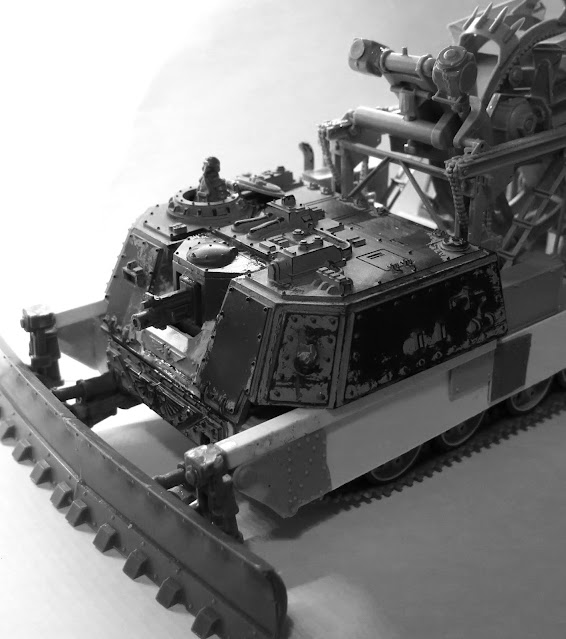
Designed to rapidly create a deep and sturdy trench, the Krieg-Pattern Mk. II Trenching Support Vehicle (sometimes known as a Bullock) is based on the ancient Land Crawler chassis. The tempermental machine spirit of the bucket-wheel excavator must be constantly propitiated by Enginseers and lay-brothers alike, giving the entire machine a shrine-like aura in the minds of many Krieg soldiers.

With a single front-mounted heavy bolter and minimal armour, the Krieg-Pattern Mk. II Trenching Support Vehicle is not designed for front-line combat.

Necromundan Sump Pirates

Necromundan Sump Pirates do not exist. There is no law that specifies their non-existence (for any such law would have to refer, however obliquely, to the Sump Pirates), nor does it appear to be a custom or ancient rite. It is simply taken as a fact. Their appearance in an underhive settlement provokes bewildered panic, as if fairies and trolls had invaded the a modern Atheists conference. They can't be here. They can't exist. And yet, here they are, stealing your housewares and moveables, then clambering into the gloom. In their wake, explanations proliferate like fungi on a corpse. The survivors blame anyone but the Sump Pirates, who, of course, do not exist. 

These vehicles are still in the early WIP stages.
Sump Striders are the most common vehicles the Sump Pirates possess. Capable of climbing hive stacks, swimming through ash lakes or toxic ponds, or scuttling along buried roadways, these vehicles allow the Sump Pirates to raid anywhere in the hive.
The enormous Sump Strider is the capital vessel of the Sump Pirates. Some burglars loot upper stories with ladder and rope. The Sump Strider provides a more direct method of horizontal wealth transfer.


2021/08/09

40k: Bighead and the Pale Pinks of Hieronymus Bosch

I'm working on a new miniature painting project. I'd like to create an army based on the works of Hieronymus Bosch and Pieter Bruegel the Elder. It's not really a 40k project. I'm not sure these miniatures will ever be used for a game, but it's a fun experiment.

The Miniatures

The core of the project is Mike Darpa's Chaos Army sculpts from Eureka Miniatures.


Supplemented by a few sculpts from the Pond Wars range.

And some miniatures from Ana Polanšćak (best known for Gardens of Hecate).

Along with a few odds and ends from the bottom of the bits box.

 Rejected Minis:

-The Triumph of Death by Skull and Crown. Right theme, wrong genre.

-The Nightfolk by Northumbrian Tin Soldier. They're nice sculpts, but a little too stylized for this project. They've got comically squashed proportions.

-Bruegelburg by Lead Adventures. I like the other lines Lead Adventure has, but this line has always felt a bit odd. Lots of squashed proportions and extraneous detail. The focus is on Bruegel's comic/allegorical/pastoral scenes in any case.

-Medieval Demons by Antediluvian Miniatures. The line is a curious mix of 12th-14th century marginalia and 16th-17th century daemonology, like The Lesser Key of Solomon and similar works. I like a good multi-faced demon, but they feel predictable and formal alongside the chaotic anti-symbology of Bruegel and Bosch.

-Medieval Marginalia by Old School Miniatures. The concept is nice, but the sculpts are a bit crude.

Spooky Scary Skeletons

Despite employing every element from the natural and manufactured world, there is one classic symbol missing from the hells of Bosch and Bruegel. Human skeletons never appear. 

In the medieval code of symbology, the Skeleton-as-Death is a fixed property. Animal skeletons (particularly horses and birds) appear, but humans, even when mangled, eviscerated, or contorted, are still pink and whole. The medieval skeleton, skin stretched over ribs, would be as symbolically inappropriate. 

In contrast, Warhammer demons have skulls all over the place. Even Ana Polanšćak can't resist putting a skull on her demonic snail. I've tried to avoid skulls and skeletal limbs on the majority of the converted figures.


Picture of just the Eureka Miniatures pieces, plus a few extras.
The 3 Chaos Giants (back row) were sold as "Big Nose", "Big Head", and "Big Chin", so I thought "Big Stick" (Lord Buckethead) was an appropriate theme for a 4th giant or general or something.

Sculpture Groups

I've chosen to use square bases for this project to help force the miniatures into a coherent sculpture group. The idea of an utterly chaotic army - in size, colour, and composition - neatly stacked in rows appeals to me. It also makes them easier to store.

I'd like to make a special wall cabinet for this army, with a painted background and some gold leaf, like a little icon case. I'm not sure if I'll adapt an antique or make one myself.


Detail and Elaboration

French-Burgundian culture of the waning Middle Ages counts among those cultures in which beauty is replaced by splendor. Late medieval art reflects the spirit of the late Middle Ages faithfully, a spirit that had run its course. What we had posited as one of the most important characteristics of late medieval thought, the depiction of everything that could be thought down to the smallest detail, the oversaturation of the mind with an endless system of formal representation, this, too, constitutes the essence of the art of that time. Art, too, tries to leave nothing unformed, unpresented, or undecorated. The flamboyant Gothic is like an endless organ postlude; it breaks down all forms by this self-analyzing process; every detail finds its continuous elaboration, each line its counterline. It is an unrestrainedly wild overgrowth of the idea by the form; ornate detail attacks every surface and line. That horror vacui, which may perhaps be identified as a characteristic of end periods of intellectual development, dominates in this art.
-Autumn of the Middle Ages, Huizinga  

Bosch and Bruegel, while still reveling in the joy of details and overgrowth, reject the formal and stagnant symbolism of high medieval art. Their demons are anti-symbolic, a hideous mix of humans and assorted animals, of funnels and casks, fish, frogs, and musical instruments. The elements invite interpretation without adhering to any code known to the viewer.

Some classic symbols creep in. The Beast of Revelation, with seven heads and seven crowns, is buried beneath the avalanche of assorted demons in Bruegel's Fall of the Rebel Angels. Inversions abound; a man kissed by a lecherous pig in a nun's habit, a knight devoured by his hounds, etc. But what can we make of a pair of ears, pierced by an arrow, and sprouting a knife? The strange man-tree-eggshell with boats for feet? Pink stone towers with crystal rods? Are these dream-images or features deliberately chosen for their lack of clear symbolic connection?

This anti-symbology, combined with inversions, can lead to elements of farce. The demons are disconcerting but rarely frightening. They're a sort of divinely sanctioned wunderkammer; a mix of curious animals, vegetables, and minerals. Anything strange in nature can be included.

There is one area where the addition of ridicule to the most serious matters seems garish: the dark arena of the belief in devils and witches. Although the fantasies about devils were directly rooted in the deep fear that nourished this belief, the naive imagination nevertheless rendered such figures so childishly colorful and so familiar to everyone that they sometimes lost their terrifying aspect. It is not only in literature that the Devil appears as a comic figure; even in the gruesome seriousness of the witchcraft trials Satan’s company is frequently fashioned in the manner of Hieronymus Bosch and the hellish smell of sulfur blends with the fluff of the farce.

-Autumn of the Middle Ages, Huizinga 

Paint

I'm going to try to paint the figures with oils, using only colours available to Bosch and Bruegel. If you think my techniques with acrylics are a bit slapdash, just wait until you see what I do with oil paints. It'll be a glorious disaster.

  • Flake White (not the real stuff, but replacements are available. Seems weird to paint actual-lead figures in not-lead paint, but that's the age we live in).
  • Bone Black
  • Burnt Sienna
  • Raw Sienna. (Nobody can cook Sienna properly. Why is that?)
  • Yellow Ochre
  • Madder Lake
  • Azurite 
  • Lead Tin Yellow (Ok, actually Naples Yellow, but since art historians couldn't tell the difference for decades it's probably a decent substitution).
  • Carmine
  • Verdigris. I tried making my own verdegris pigment, but it faded almost immediately and didn't react well to blending. When a tutorial says it's too much trouble to attempt, listen to the tutorial. I'm using phthalo green instead.

Basing

The ground in the works of Bosch and Bruegel is typically very flat, designed to highlight the figures. There are tufts of grass and distinct trees, but meadows or earth are almost featureless. Distance is implied with a gentle gradient; tricky to do with miniature basing unless you arrange the figures in the same configuration every time.

I'm going to try a layer of fine sand mixed with very fine flock to create a slightly textured but mostly flat layer. I need to put something on the base to cover up the pewter slots and injection marks. I think I'll mostly stick to earth tones.

An example of painted Eureka miniatures from Analogue Hobbies.

Final Notes

I've primed the miniatures and I'm experimenting with painting techniques. Oils are fun but difficult. It's been many years since I've worked with oil paints, and it definitely shows.

If anyone knows of any other ~28mm miniatures that would work for this project, let me know.

2021/04/06

40k: Crassus Command, Sentinel Powerlifters, and Other Assorted Tanks

The Moribundan 1st Armoured Regiment, despite its cabinet-straining bulk, has a few gaps in its roster. Well no longer!

Crassus Command Vehicle


As originally discussed in this post, the Crassus Command Vehicle has a fully detailed and totally useless interior diorama.

The end result is fairly close to what I'd originally planned. Fitting all the models into the space was tricky, but they're all in there and in appropriate medieval tableaux poses.

Here's a WIP shot with the models still in test positions. Plenty of detail, greebling, and grime.

Sentinel Powerlifters


After a long search, I finally found 3 Sentinel Powerlifters in decent enough condition to refurbish (casting new bits where I had to). They've been out of production for years.

Side Note: 40k Physics
Forgueworld had 2 in-house Sentinel Powerlifter models. One, used for most photos, the official sketch, and the instructions, had the rear counterweight attached to the chassis:
The second model had the weight attached to the cab.
Now, if the weight is on the cab, the waist joint acts as a pivot point. The weight of anything held in the lifter arm is balanced across it. But if the weight is attached to the cab, the waist joint is subject to terrific opposed forces.

If the counterweight is on the cab, the sentinel can't pivot from side to side as much, but that seems fairly sensible given its role as a walking forklift.


The Malcador Castigator


The Malcador Castigator carries a hull-mounted Castigator Boltcannon. The Macharius Vulcan carries only 20 seconds of ammo. The Malcador Castigator carries considerably more, thanks to its dedicated ammo trailer, and can be reloaded in the heat of battle. Unfortunately, its main weapon has a very limited field of fire, and the crew tend to be "thoroughly agitated" after a few seconds of firing. Like the Malcador Primus, the Malcador Castigator is an unpopular and often overlooked vehicle.
 

Malcador With Battle Cannon


A standard tank without any significant conversion work, other than the track guards.

Engineering Chimera


A support vehicle similar to a Trojan Support Vehicle, this modified Chimera can be used to transport 2 Cyclops Demolition Vehicles, a mobile field hospital, or a Techpriest Enginseer. The magnetized top mount can support a crane or a searchlight.

Final Notes

Just a handful of vehicles remain! Soon, all the red boxes in this post will be filled. I've obtained, but have yet to paint, 2 Medusa Siege Tanks, 3 Solar Auxilia Basilisks, and 1 Minotaur Artillery Tank. And then it's done! Hooray!


EDIT 2020/10/04

Rather than create a new post (and split several dozen views over 2 approximately equally useful posts), here are the final images from the project.


All 3 Solar Auxilia Basilisks are complete, with magnetized weapon options. Basilisk cannon on the right, M
edusa mortar on the right, and a Neutron Laser (for shooting at... very tall things? Aircraft?) in the middle.
 
Side Note: eyeball math time. If the minimum elevation on the Neutron Laser is 22.5 degrees and the maximum elevation is 45 degrees, and the average Titan has some useful bits about 30m off the ground, then the tank has to drive between 30m and 60m to land a hit. In 40k-scale, that's not too bad, but it is a bit silly in real-world scale. Maybe they bounce the laser off aircraft-mounted mirrors...
 

The Final Cabinet


(Left to right, front to back)
Shelf 1: Malcador Battle Tank, Stormhammer Battleship, Crassus Command Tank, RT-era Land Raider (hidden), 3x Hydra Flak Tanks, 3x Hellhounds, 4x Sentinels with Lascannons, 4x Sentinel Powerlifters, 4x RT-era Eggy Scout Sentinels.

Shelf 2: Malcador Castigator, Stormhammer Land Battleship, 3x Dracosan Transports, Infantry Squads + Command Squad + Psyker Squad, 3x Chimera Transports.

Shelf 3: Malcador Primus, Shadowsword, 2x Cyclops Demolition Vehicles, Ratling Squad, Valdor Tank Hunter, DOOMBLADE, Infantry Squads, Land Speeder, 2x Destroyer Tank Hunters, Power Generator Trailer, Fuel Tank Trailer.

Shelf 4: Commissar Command Leman Russ, 2x Centaur Tractors, Baneblade, Command Car, Macharius, Macharius Omega, 3x Leman Russ (Vanquisher turrets), 3x Leman Russ (Exterminator turrets), 3x Leman Russ (Demolisher turrets).

Shelf 5: Converted Chimera Recovery Vehicle, Atlas Recovery Vehicle, 2x Trojan Support Vehicles, 3x Minotaurs, 3x Solar Auxilia Basilisks (Neutron Lasers equipped), 3x Medusas, Solar Auxilia Carnodon, Chimera Engineering Vehicle, Salamander Scout Tank.

Huzzah! No idea what the total points value is.