2019/06/13

OSR: Horrible Burgher NPC Generator

Burghers are town-folk; members of the third estate who live and work in towns or cities. Some are richer than any lord. Some are more wretched than any rural peasant. Medieval urban centres were deathtraps. Mortality rates far exceeded birth rates.* Higher wages, greater security, and a greater availability of goods and luxuries drew new arrivals into cities.
*Infant mortality and plagues were the main contributing factors. If you made it to 20 in a city, you were nearly as likely as someone in the country to make it to 50.

Boccaccio, Des cas de nobles hommes et femmes (French version of De Casibus), France c. 1470

1d100 First Name Profession Guild? Demeanour
1 Richard Alchemist
Devout
2 Richard Apothecary
Devout
3 Charles Architect G Devout
4 Charles Banker G Devout
5 Louis Bookbinder G Devout
6 Louis Bureaucrat
Devout
7 Robert Chirurgeon
Devout
8 Robert Clock-maker G Devout
9 William Engineer G Devout
10 William Falconer
Devout
11 John Goldsmith G Stoic
12 John Herbalist
Stoic
13 John Illustrator
Stoic
14 Claude Land-merchant G Stoic
15 Thomas Lawyer
Stoic
16 Adam Poet
Stoic
17 Jean Sea-merchant G Stoic
18 Hugh Spice-merchant G Stoic
19 Joseph Storyteller
Stoic
20 Michael Tax Collector
Stoic
21 Raymond Armourer  G Ruthless
22 Roland Astrologer
Ruthless
23 Matthew Bag-maker G Ruthless
24 Gilles Baker G Ruthless
25 George Barber-Surgeon
Ruthless
26 Greggory Basket-maker G Ruthless
27 Edmund Belt-maker G Pragmatic
28 Phillip Blacksmith G Pragmatic
29 Geoffrey Brewer G Pragmatic
30 Henry Bridle-maker G Pragmatic
31 Gadifer Bronze-caster G Hopeless
32 Oliver Broom-maker G Hopeless
33 Stephen Butcher G Hopeless
34 Andrew Carder G Hopeless
35 Huguet Carpenter G Hopeless
36 Francis Cartwright G Hopeless
37 Peter Chandler G Hopeless
38 James Cheese-maker G Hopeless
39 Gilbert Clerk
Hopeless
40 Arthur Cobbler G Hopeless
41 Jules Cook
Lazy
42 Andre Cooper G Lazy
43 Jerome Copyist
Lazy
44 Guy Debt Collector
Lazy
45 Jacob Dyer G Lazy
46 Isaac Embroiderer
Gluttonous
47 Mark Farrier G Lustful
48 Nicholas Felt-maker G Greedy
49 Victor Fishmonger
Prideful
50 Roman Fletcher G Slothful
51 Alice Furbisher G Wrathful
52 Alice Furrier G Envious
53 Joan Gambler
Incompetent
54 Joan Glassmaker G Blasphemous
55 Agnes Glove-maker G Petty
56 Agnes Goatherd
Ambitious
57 Margery Gongfarmer  G Ambitious
58 Margery Gravedigger
Ambitious
59 Isabel Hat-maker
Ambitious
60 Isabel Inn-keeper G Ambitious
61 Mary Jailer
Ignorant
62 Mary Jeweler G Ignorant
63 Mary Leatherworker G Ignorant
64 Mary Locksmith
Ignorant
65 Margaret Mason G Ignorant
66 Emma Mercer G Diseased
67 Juliana Miller G Diseased
68 Christine Minstrel G Diseased
69 Katherine Miracle Play Actor G Diseased
70 Beatrice Needlemaker G Diseased
71 Elizabeth Lead Servant
Skeptical
72 Ellen Ointment-maker
Skeptical
73 Mary Pack Handler G Skeptical
74 Amice Painter G Skeptical
75 Sibilla Parchment-maker G Skeptical
76 Cecily Pewterer
Frantic
77 Sara Plasterer G Frantic
78 Avice Porter G Frantic
79 Isolda Potter G Frantic
80 Lucy Poultry-keeper
Frantic
81 Mariota Rat Catcher
Frantic
82 Ann Rope-maker G Frantic
83 Annabel Salter G Frantic
84 Anastasia Scullion
Frantic
85 Avelina Sculptor G Frantic
86 Letitia Servant (Domestic)
Surly
87 Agatha Servant (Military)
Surly
88 Eustacia Shipwright G Surly
89 Sabrina Siege Engineer
Surly
90 Susanna Stonecutter G Surly
91 Andrea Swineherd
Surly
92 Anna Tailor G Surly
93 Bianca Tanner G Surly
94 Colette Thatcher G Surly
95 Flo Toll-keeper
Surly
96 Lucia Weaponsmith  G Rebellious
97 Goody Weaver G Rebellious
98 Charity Woodcarver G Rebellious
99 Faith Woodcutter G Rebellious
100 Hope Woolwinder G Rebellious

Generally, membership in a guild was limited to men, but every system has an exception, and the sources sometimes show guildmaster's wives giving wise advice, interfering, supporting, or occasionally wreaking havoc.


1d10 Guild Troubles
1 Supplies of a vital material or resource are running low.
2 The treasurer absconded with the guild's savings.
3 Feud with a rival guild is nearing a bloody climax.
4 Desperate drive to recruit new members.
5 Preparations for an annual procession paralyze guild.
6 Factions within the guild fight for power and control.
7 Disaster cripples both guild members and guild finances.
8 Guild has earned the wrath of local rulers.
9 Rival town seeks to undermine and bankrupt guild.
10 The lower ranks of the guild are in open revolt.
Bible Historiée, France c. 1250

Quotes

Concentration of wealth was moving upward in the 14th century and enlarging the proportion of the poor, while the catastrophes of the century reduced large numbers to misery and want. The poor had remained manageable as long as their minimum subsistence could be maintained by charity, but the situation changed when urban populations were swelled by the flotsam of war and plague and infused by a new aggressiveness in the plague’s wake.

As the masters became richer, the workers sank to the level of day labor, with little prospect of advancement. Membership in the guilds was shut off to the ordinary journeyman and reserved under complicated requirements and fees for sons and relatives of the master class. In many trades, work was farmed out to workers in their homes, often at lower wages to their wives and children, whose employment was forbidden in the guilds. Obligatory religious holidays, which numbered 120 to 150 a year, kept earnings down. Although forbidden to strike and, in some towns, to assemble, workers formed associations of their own to press for higher wages. They had their own dues and treasuries and connections across frontiers through which jobs and lodgings could be secured for members, and which doubtless served as channels of agitation.


[...]

They worked at fixed wages, often below subsistence level, for sixteen to eighteen hours a day, and their wages might be withheld to cover waste or damage to raw materials. The alliance of the Church with the great was plain enough in a bishop’s pastoral letter declaring that spinners could be excommunicated for wasting their wool. Workers could be flogged or imprisoned or suffer removal from the list of employables or have a hand cut off for resistance to employers. Agitators for the right to organize could be hung, and in 1345 ten wool-carders had been put to death on this charge.

-A Distant Mirror, Tuchman


Naturally the merchants, whose rise preceded the coming of industries to Siena, lead the way in the formation of a general society planned to protect their common interests... But the crafts were not slow to follow suit, and presently the masons, carpenters, inn-keepers, barbers, butchers, millers, and other classes of workmen and artisans were organized as arti, with the usual apparatus of constitution, officers, regulations, prohibitions, and fines... Among many excellent regulations which concerned themselves with obtaining for the consumer a full measure and an honest product, were to be found others which, by paralyzing the free activities of the workers, must have caused grave harm. Thus the statues of the wool guild required that only one pieces of cloth be woven at a time, that it be neither longer nor shorter than a certain standard, and that only native wool be put on the looms; and all guilds alike pursued a selfishly exclusive policy, imposing a heavy tax on all candidates for admission, and positively forbidding the exercise of their respective occupation to all but guild members in good standing. Add minute regulations regarding the hours and quantity of labour and the observation of so many church festivals that about one hundred and thirty days of the calendar year were devoted to enforced rest, and we get some idea of the mischievousness of that spirit of over-regulation which characterized both the guilds and the government.


[...]
The proletariat of [the wool] industry, concentrated largely in the quarter of Ovile, numbered several thousands. In the recurrent periods of industrial depression or in time of high bread prices, their condition must have been terrible. That they organized in 1371 and sought redress by violence proves that they were growing desperate; decimated for their pains by a cowardly massacre... they and other workingmen of a too independent leaning were expelled, to the number of four thousand, from the city. This almost ludicrous act of party fury may be taken to mark the end in Siena of capitalistic production on a large scale.

-Siena, Ferdinand Schevill


Other Useful Tables

Horrible Peasant NPC Generator  
1d100 Peasant Grievances  
Horrible Baron NPC Generator
1d100 Baronial Grievances
If you want a more refined sort of person, from a different age, try the Dickensian NPC Generator. If not, try the Table of Camp Followers.

2019/06/11

OSR: Siena's 6-Mile Hex

It's tempting to think of medieval cities as islands in a vast sea of farmland or wilderness. Look at a certain modern medieval-ish TV series. Cities sit in splendid isolation.
But in the real world, every medieval city had satellite towns within walking distance. Take Siena.
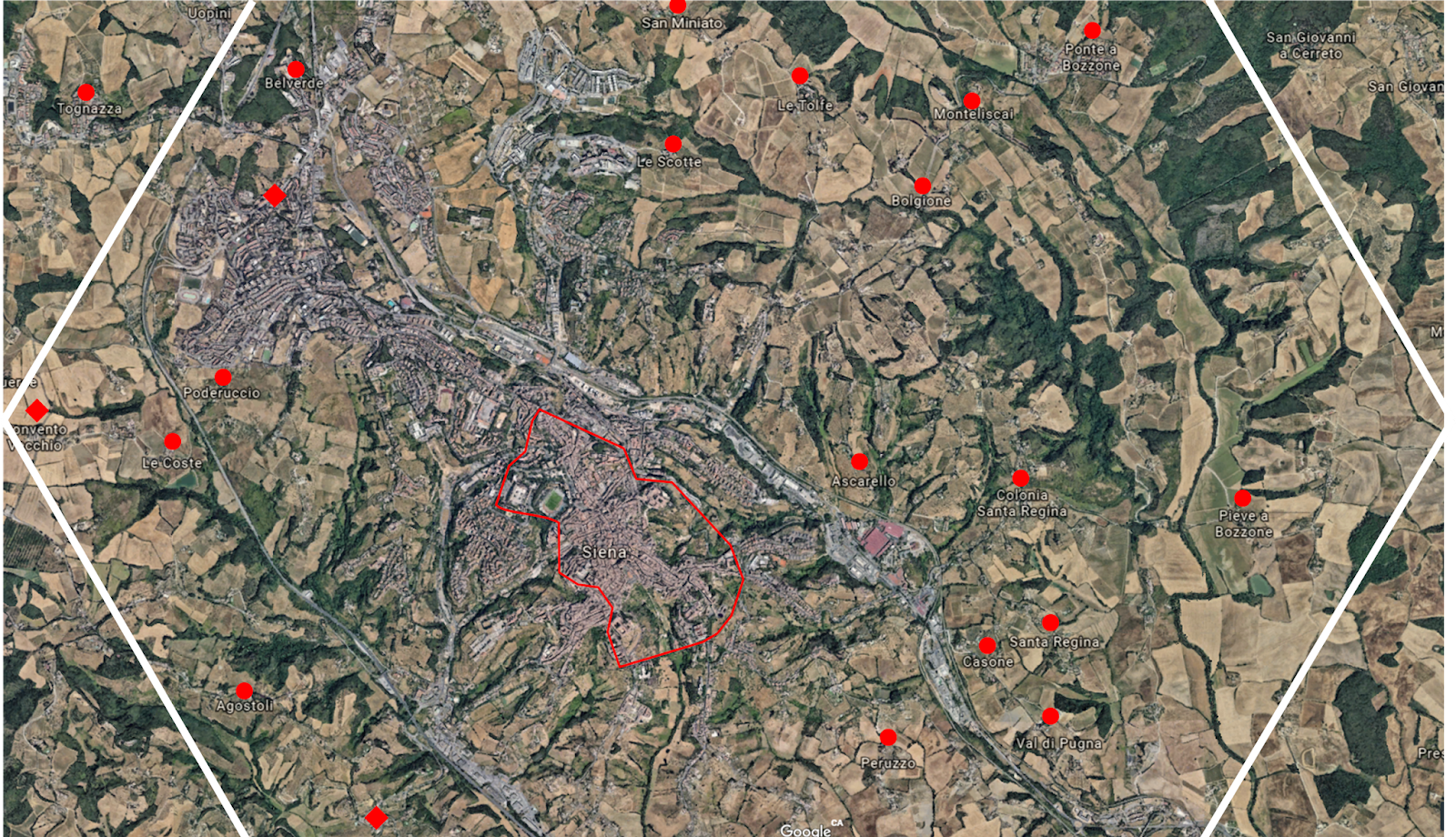
The red line covers (approximately) Siena's medieval walls. Red dots are towns or villages. Red diamonds are monasteries. The white outline is a standard 6-mile hex. I've covered how huge 6-mile hexes are before, but here's another example.

Thanks to the magic of Google Earth, you can even zoom in to see how far away, in 3D, those cities and towns are. The (slightly wonky digital) view from the top of Siena's Torre del Mangia shows dozens of sites in relation to the city's walls. Mercenary armies camped there. Rulers fled, monks plotted, bishops pronounced doom, fugitives hid, and rebellious factions raised banners.

[The annual festival of the Virgin Mary] fell on the 15th of August, the day of her assumption to the side of her Son. To evoke that wonderful festival is not only to set before our eyes in material form the strange fusion achieved by the medieval mind of the life terrestrial and the life spiritual, but also to realize one of those gay and colored spectacles for which the modern world has no equivalent, and which are like the moving page of some blithe and exquisite romance.

A general animation became apparent in the city as the middle of August drew near. The town crier, sounding his trumpet before him, passed through the streets announcing the programme for the festival; at the same time he made proclamation concerning the great fair of three days, which, with characteristic prudence and in keeping with the homely character of the celebration, the government did not hesitate to associate with the season of thanksgiving. On the eve of the looked-for day fell the opening public act. All the citizens from the age of eighteen to seventy, forming in procession according to parishes and under the leadership of the parish priests, marched to the cathedral. For the greater glory of Our Lady each celebrant carried in his hand a lighted taper, and before the citizens went the magistracy, attended by the carroccio or car of state, upon which were conspicuous the official offering of candle and banner. Thus before sundown of August 14th, Siena had renewed its vows to the goddess of its choice and love.

But the next day came a procession of another kind, one which swelled the hearts of the old burghers with patriotic felicity. The castles, villages, towns, and monasteries, conquered outright or subdued under the euphemistic name of an alliance, knocked, as it were, at the gates of the city, and in the person of the proprietors or of elected delegates proceeded in solemn state to the duomo to repeat the oath of allegiance to the victorious commune. A scene more splendid and, at the same time, more feudal cannot be imagined. The free town was a perpetual protest against the feudal system, but when the problem presented itself as to how the shattered elements of feudalism were to be organized under the new sovereignty, the city leaders chose a solution which proved they could not emancipate themselves from the domination of current legal forms. They simply assumed towards the nobles and corporations of the county [the contado] the familiar position of suzerain.

The morning of the fifteenth, therefore, saw the procession of Sienese vassals march to perform an annual act of homage. In that procession were the proud descendants of the ancient counts of the city, mitered abbots or their mandataries, the representatives of villages and towns; and in their hands they bore, in honour of the Virgin, each one a lighted candle. Through dense and exultant crowds they made their way up the marble steps of the cathedral until they stood within the portal, before the desk of a secretary of the commune. To the humble scrivener, seated before a solemn ledger, they consigned their offerings, all destined for the service of the Supreme Lady and consisting of candle-wax, or banners of brocade, or money, according to the articles of submission.
-Siena, Ferdinand Schevill

Siena had, for a time, a huge and prosperous contado. This gif shows the tumultuous and somewhat baffling expansion process. It would be impossible to map all these locations. Instead, I'm going to rely on robust generators and scribbled notes on existing maps. The major cities and walled towns will be detailed ahead of time. Small towns, villages, and castles will pop into existence as needed.

Side Note: Sometimes I get lazy when researching a topic and skim wikipedia to get my bearings. I really need to remember to check Italian wikipedia for this project. English wikipedia doesn't even mention that L'armata Brancaleone's dialogue is a mish-mashed italian/latin doggerel. Online translation services are so good these days (and wikipedia's articles are so dull) that you can usually find valuable information.

Anyway, here's the current renamed map for the pointcrawl.

The black square is 10x10 miles. Red lines are major roads. Travel times (in days, on horseback, in good weather) are in red.

EDIT. If you want a fun project...

Step 1: Ask yourself "how many castles can there be in a 6-mile hex?" 
Step 2: Download Google Earth Pro (free)
Step 3: Download and open this KML file. Backup.
Step 4: Go, "Oh, that's a lot of castles."
Step 5: You can use this hex grid overlay to put a section of 6-mile hexes on the map.

Using this hex grid overlay:
And that little region northwest of Siena isn't even a densely castled region!

2019/06/10

OSR: Mercenary Pointcrawl in 14th Century Italy, Preliminary Notes

Italian history is... complicated.
They can't keep getting away with it!
The War of the League of Cambrai took place a century after the time period I'll be examining, but the story still works:
  1. To curb the power of Venice, the Pope creates the anti-Venice League of Cambrai.
  2. The League is initially successful. Venice is in full retreat.
  3. The Pope concludes peace with the Venice. Venice privately decides to break the terms as soon as possible.
  4. France, invited into Italy by the Pope, is gaining power rapidly, and threatens the Papal States. The Pope allies with Venice against France.
  5.  The Pope creates the Holy League to combat French influence. Holy Roman Empire, Spain, etc. join.
  6. France negotiates peace with Venice. They agree to split northern Italy in half.
  7. The Pope, The Holy Roman Empire, etc. are aghast. Scotland, encouraged by France, declares war on England.
  8. The war quietly decays into a tangle of treaties. A new war starts up four years later.

The 14th century isn't much better. Most popular historians just give up and give some variant of "everyone fought everyone else". Academic historians focus on one city or a brief period. Records are poor. Some wars happened on paper; some treaties were signed by one side only and later used to justify another conflict. Factionalism in the cities made rulers disarm their citizens and turn to mercenaries; fickle and untrustworthy mercenaries switched sides, refused to fight, and extorted enormous concessions from their masters.
The interrelationships of Venice, Genoa, Milan, Piedmont, Florence, and assorted despots and communes of northern Italy were constantly shifting. As soon as one power joined another against a third for that season’s advantage, all alliances and feuds changed partners as if in a trecento square dance. Venice feuded with Genoa, Milan played off one against the other and feuded with Florence and the several principalities of Piedmont, Florence feuded with its neighbors, Siena, Pisa, and Lucca, and formed various leagues against Milan; papal politics kept the whole mass quivering.

-A Distant Mirror, Tuchman
The hills are full of brigands and wild dogs. The roads are lined with ruins. Villages burn, towns are surrounded by mutinous troops, and mercenary armies arrive and depart with the seasons. Ambitious kings starve. Antipopes appear. Exiled nobles plot and write endless letters. The sons of peasants become the rulers of cities. The settled order of the world is overturned.

The Plan

I'm still waiting on a few books to arrive before I start putting together full historical posts. Unfortunately, real life moves faster than writing. I need something for Monday. The distant war has finally lured a foolish group of PCs into its all-consuming maw. Time to think fast and write faster.

Wait...

Step 1: Map

  • Take Italy in ~1360. File off the serial numbers.
  • Hexcrawl? Nah. Instead, points (fortified towns or cities), with random encounter tables that include villages, factions, etc. Let the encounter tables do the heavy lifting.
  • Luckily, I've already got a decent pointcrawl map of Italy from 1100. 
The black square is 10 mile x 10 miles. Travel times are for individuals or merchants on horseback, not armies. Historical accuracy is extremely dubious. I'm trying to create a framework that can survive editing as I get my notes in order, not something that's perfect from day 1.

I anticipate the campaign will mostly take place in the north, with the not-Papal States intriguing from below and not-France from above. Genoa, Pisa, Milan, Bologna, Venice, Siena, and Florence.

Step 2: the PCS

  • The standard GLOG hack I'm using works fine without any major changes, but there are lots of updates I'd like to make.
  • How can a group of PCs form a lance? I've noted before that soldier, archer, page => fighter, wizard, thief. Are there alternate structures, especially if the group has few fighters but many spellcasters or thieves? Who will act as the captain?
  • Camp followers and loathsome peasants abound. 
  • Mission generator? "Fix this, scout that, deal with this wizard business, kidnap this person, etc." 
  • Rather than paying taxes to a feudal lord, the PCs will (probably) end up working for a mercenary leader or a city. Turning over a percentage of their loot is inevitable, but getting the most out of their "taxes" is the fun part.

Step 3: Tabulate

I'll need to go through some relevant books and make some useful tables, like the Byzantine Table of Rulers.


Step 4: Consolidate

Put it all into a free PDF.
Osprey #155


Film References

Flesh+Blood (1985). One of the OSR-est films out there. Mercenaries rape, murder, and pillage their way through an unspecified fictional war. It's definitely got, err, HBO sensibilities, but it's got a lot of character. The greasy unnamed "Cardinal", the statue of St. Martin, the recurring characters and cunning schemes; it's full of useful content.

The Decameron (1971). A selection of stories from the Decameron, lightly edited and portrayed with untrained but enthusiastic actors. It's light, cheerful, bardy, colourful, and charming.

L'armata Brancaleone (1966). Another classic OSR film. The dialogue is straight out of a D&D session. The costumes are ludicrous.

Hard to Be a God (2013). The swirling chaos of this beautiful film covers the darker side of human existence. It's a difficult film. I might do a full Film Notes on it.

The Last Valley (1971). Wrong time period and region. Right attitude.

Final Notes

Don't worry. Magical Murder Mansion is done and waiting on print proofs. Magical Industrial Revolution is ticking along steadily.

2019/06/06

Film Notes: Die Nibelungen: Siegfried (Fritz Lang, 1924)

One of the reasons I started a Patreon was to fund long-form unusual projects. This is a trial run. I'm not an expert on film studies, so don't expect deep analysis. This is still an elfgame blog.

Tears of Envy clued me in to the 2012 Master of Cinema Blu-ray release of Die Nibelungen. It's gorgeous. Someone's uploaded the whole thing to youtube here but the full blu-ray is definitely worth it: buttery smooth, tinted for easy viewing, stabilized, and with a wonderful crisp score. This post will include way too many screenshots, with enough resolution to see all the details. I've included a jump after Part 1. You've been warned.

Following the links in this article (and, in particular, this essay) should give you the appropriate background. This isn't Wagner's tale. I've got nothing against Wagner, though I have to take short breaks while listening to his operas (from five minutes to six months or more). Lang wrote his own version of the story with his own morals and his own code.


Part 1: Meet Our Hero

Isn't he gorgeous~. To quote Anna Russell, "And he's very young and he's very strong and he's very brave and he's very handsome and he's very stupid.  Just look at those shots though. All from the first 10 minutes of the film. It's 1924. The camera can't move, so every shot needs to be framed, and nobody framed like Fritz. Just look at the shadows! The smoke!
In fact, hair is a huge part of this film. Everything has texture. Take Mime, the master blacksmith to whom Siegfried is apprenticed. Apparently he's done well, because the first speech of the film is Mime wearily saying, "Ride home to Xanten, Siegfried, King Siegmund's son. Even I cannot each you any more!"

Mime and the rest of the mountain-men all walk like they're wearing concrete shoes. Siegfried floats. They're all hanging out eating fat carp and sharing stories like a bunch of dads after a long weekend when Siegfried, the hero, pets his shining white horse. He's about to ride home to Xanten when one of the mountain-dads starts talking about Worms on the Rhine, and the Kings of Burgundy who dwell there.
Look at that shot! It's the antithesis of a Disney castle. Blunt. Bold. Impossible. It's a sort of Valhalla. This is mythic history, not Gregory of Tours history, as described by a mountain dad. Siegfried's never heard of the Burgundians but he's entranced.


And for the first time we see the geometric armour and cloth that will dominate this film. Mountain-men and barbarians are half-clad rags and fur; the civilized Burgundians are fully draped in Carl Otto Czeschka full Vienna-Succession-Style robes.

Mountain dad also describes the beautiful and pious Princess Kriemhild. As tradition demands, Siegfried falls instantly in love (see Anna Russel's comment above). Siegfried says he'll set out for Worms and win Kriemhild. The mountain men are... skeptical. Just look at that collection of facial features.
Siegfried flies into a rage and shakes the route to Worms out of them. "Show me the way to Worms or you shall lose your life!" What a guy.

This tension between Siegfried as a heroic figure and Siegfried as a violent bully runs through the entire film. Was this deliberate? Was the beautiful but brutish hero meant as criticism of interwar culture or could
“only a Teuton with a Teuton’s failure of tact” see the character as purely noble and inspiring?

Siegfried gives his aged master a last hearty teutonic slap on the back and rides off.

2019/06/04

OSR: A General History of the Notorious Sea-Robber and Murderer Known as Handsome John

Here's a piratical rumour table (of sorts). It's a ramble overheard at a tavern or pieced together over the years. Is any of it true?

Handsome John?

It's a strange tale, laddie, a strange and twisted tale. Pass us a drink. Handsome John was a bosun in the Wexlish navy. He served in the wars and fought bravely but was terribly scarred by fire and shot.
       I heard he was born that way, and that the war just made him hard and cruel.
He turned mutineer and pirate. Killed his captain and officers, rallied the crew, and sailed under no flag. The navy caught him.
      Some say he was betrayed.
             I heard he tried to sack Portsham.
At his trial, he showed no remorse or fear. When sentence was passed he said only this. "My life is not yours to take."
     No no, I heard he said, "I will live longer than any of you. As long as free men sail the sea I cannot die."

            Liar. He said, "Why do you call me a criminal and condemn me to death? Because I killed butchers of men, because I chose to sail under my own orders instead of filling the pockets and dying at the command of fat lords and armchair admirals. Hang me then and be done with it! This world is full of wickedness."

They sentenced him to hang. As a mutineer and pirate, for three days and nights he hung from the scaffold. But when the hangman came to cut him down, Handsome John wasn't dead!

     He hanged the hangman from his own scaffold. Killed the admiral who sentenced him and anyone who gave evidence. 
He vanished from Wexland. Appeared in the Merebaha Islands with his ship the Petition. Sailed for ten years, a true monster on the waves. They say he'd take his prey at night, by the light of a crescent moon. Sail right up, fire a warning shot, and force a surrender before the crew could get to their guns. He'd hang the officers and crew from the 'arms. No survivors, unless he wished to take on fresh crew.
        You could see the ships for miles. The birds, you see, feasting on the hanging bodies.
               And if he run out of rope, he used the guts of the crew.

Ten years he sailed. He sacked Longport and burned New Imbria to the ground. And then he died. His crew dispersed, his ship left as a memorial or sunk, his treasure lost.
       He died at the hands of his own quartermaster. Poison.
              No, it was Captain Louxbury who caught him. They fought a duel on the deck of the Petition as she burned. Louxbury took Handsome John's head and held it up for the crew to see.
                    But he didn't die! The head kept mouthing curses and rolling its eyes. Captain Louxbury locked it in a chest. They say it's in a monastery now on some lonesome island, where ten monks pray night and day to keep Handsome John's words from reaching the Devil.
                           Some say he's not dead at all.

What did he look like?

Horrible. That's the only word for it. He was broad and tall, stronger than any man I've seen. He could tear a coco-nut in half without straining or pick up a cannonball as you or I might pick up a walnut.
       A huge beard, burnt in places, patchy in others where scars met on his jaw. And two tiny blue  eyes, the purest blue, like the sea itself in some tranquil lagoon.
                He wore the noose that hung him 'round his neck always.
                        And he carried a burning sword. That's what they say, at least. A sword of fire.

His crew?

The scum of the earth. Convicts, exiles, madmen.
       I heard his crew weren't living men at all, but hanged men too, hanged men the Devil raised up to follow his servant.
             To join, a sailor needed to commit a murder in cold blood, take a woman by force, trample on a holy book, drain a pint of brandy, and fight another man for a position in the crew. They fought with daggers; the one who survived kept both.
And once you joined his crew your soul belonged to Handsome John. Not to God, not to the Devil, but to he, and only he could send you to your rest. 


His ship?

The Petition. An old slaver ship, low and broad.
       I heard it was a frigate from the last war that'd carried prisoners of war. The captain made sure they never reached their prison. "Illness claimed them", he'd say, though the decks ran with blood. 
              No, it was a slaver. When Handsome John took her he burned the slaves alive and caulked the hull with their ashes.


His treasure?

They say he buried it on the Island of Tears, not marked on any chart or map. Only Handsome John could tell someone how to find it.
     No, that wasn't it. If you had a tattoo made from the black sand of the island, you could always return. 
              The treasure's at the bottom of the sea and the Petition with it. Or else it was carried back to Wexland in secret.

2019/06/03

OSR: The Biggest Aspidistra in the World V2

I've updated this old one-page dungeon with new photo-composite art. You can download the PDF here.
It's less of a dungeon and more of a social challenge. The real fun is a) getting three uncooperative people out of a tree and b) figuring out exciting new ways to make money from the situation.

2019/06/01

OSR: Reasons to Visit Endon


General Reasons

Endon is the place to:
  • Buy the latest fashions
.
  • Buy the most potent weapons
.
  • Meet the most elegant, refined, beautiful, seductive, poetic, educated, etc. people.
  • Meet people from any part of the world.

  • Sell magic items for the most money
.
  • Get leads on the most profitable ventures.
Sean Andrew Murray

Classes

Alchemists/Artificers/Tinkerers

  1. Your skills are in high demand in Endon.
  2. Your obscure traditions might provide new insights.
  3. Your projects could take an enormous leap forward by standing on Endon's shoulders.
  4. A mentor, tutor, or ally has asked for a report on state-of-the art magical industry.

Barbarians/Warlords

  1. Endon has the best swords.
  2. If you play your cards right the people of Endon will treat you like a foreign prince.
  3. It's a good idea to scout a city before you raise a horde and burn it to the ground.
  4. All the comforts of the world can be bought in Endon.

Bards 

  1. It's not just a city, it's the city! The Big Gryphon! The City That Sleeps With One Eye Open! If you can make it there, you can make it anywhere.
  2. Your style of music might become fashionable.
  3. Perhaps you could infiltrate the Monarch's social set and find a royal patron.
  4. Enchanted instruments and music are underdeveloped in Endon.

Clerics/Exorcists//Mystics

  1. You received a divine apocalyptic vision. The details were fuzzy but Endon was definitely involved.
  2. Endon is largely without faith. You could make many converts.
  3. Holy books have a lot to say about cities that aspire to godlike powers. Someone ought to warn them.
  4. A senior religious figure from your order was invited to participate in an ecumenical debate on necromancy. You were sent instead.

Druids 

  1. The balance between nature and civilization has gone to hell, to put it mildly. Endon is to blame. You're sure it will all end in tears.
  2. The unhappy spirits of rare animals are drifting across the land. How did they get here?
  3. Some wizards dug up your order's ancient standings stones and carted them away to use as magic-resistant gravel. Get revenge.
  4. If there's one place a new kind of urban druid could emerge, it's Endon.

Fighters 

  1. Endon's army is notoriously professional. Joining them, even on paper, would enhance your reputation.
  2. For a price, wizards in Endon will forge custom weapons of awe-inspiring power.
  3. A local ruler, worried about a rising power, asked you to send reports on Endon's progress.
  4. It's never too early to work on a comfortable genteel retirement.

Monks

  1. Where better to test your detachment from material wealth than the wealthiest city in the world?
  2. Some eccentric wizards believe the human body is capable of unconscious spellcasting. 
  3. Endon is twisting the hidden fabric of fate. Something momentous will happen here.
  4. Your order has ancient and powerful enemies. Could they be hiding in Endon?

Paladins

  1. Something is wrong with the system. Endon prospers; her people suffer. Right wrongs.
  2. You received direct divine orders. Something will happen in Endon. Not right away, but soon. Stand by for further instructions.
  3. Powers in opposition to your faith seek to use Endon's prosperity for their own purposes. Thwart them. 
  4. Charity goes far in Endon, yet Endon's power could raise the living standards of the whole world.

Rangers 

  1. Rare animals and their handlers are fashionable in Endon.
  2. Your quarry hides in the most turbulent city in the world. 
  3. If you need a very specific kind of weapon or poison, Endon can supply it.
  4. The spells you learn are rarely studied or industrialized. Perhaps there's an opportunity to revolutionize a field.

Sorcerers

  1. Paltry wizards and bookworm mages have no idea what true power is. You can show them.
  2. Endon's industries are slowly drawing raw magic out of the rest of the world and dumping it into the local environment. Sorcerers feel it first. 
  3. The air in Endon is saturated with raw magic. Your abilities may be enhanced.
  4. You are a living and stable magic battery. You can find employment anywhere.

Thieves/Rogues/Assassins

  1. There's a lot to steal in the richest city in the world.
  2. Assassinations are unfashionable in Endon but someone will always want someone dead.
  3. Using the minor magic items Endon produces in unexpected ways could make someone very wealthy.
  4. It's a good idea to make contact with potential buyers before you raid a tomb or dungeon.

Warlocks

  1. You are drawn to power; Endon is very powerful. Any need can be satisfied.
  2. Many desperate or ambitious souls in Endon can resist anything but temptation.
  3. Your patron may want to nudge Endon towards a spectacular end or steer it away from an unripe apocalypse.
  4. If you regret your pact, the key to breaking it may lie in Endon.

Wizards/Magic-Users

The reasons should be obvious, but just in case:
  1. Study at Loxdon College, now the most famous magic university in the world.
  2. Learn peerless spells, breed new ones, or conduct magic experiments.
  3. Develop entirely new magical industries.
  4. Become famous or infamous.