2023/03/12

Sci-Fi: Decadent Textures

The Bright Conference needs an aesthetic. For justifiable reasons, I'm going with maximalist sci-fi. 

Forget smooth silver hulls, used future pipes and grease, NASA white tiles, and concrete. Forget tasteful. Embrace "four hundred skilled workers devoted months of their lives to sew this dress" and "I need to walk but my shoes are impractical."

Alex Jay Brady

There are limits to impracticality. Mass is important. Without magic thrusters, the rocket is still a tyrant. One way or another, you need to pay for everything you carry.

Ostentatious spaceship designs are therefore a sign of wealth, power, and confidence. In the level playing field of hard vacuum and null gravity, you can get fairly creative. A pressure vessel will still look like a pressure vessel, and a nozzle will still look like a nozzle, but you can arrange them in all sorts of interesting and sub-optimal ways. "Look at my gyroscopes. I'm so wealthy I can make my spaceship asymmetrical."

If you can't afford to haul around extra mass, haul around extra paint. Spacecraft are frequently white or reflective for good sensible reasons, but I think it's safe to assume temperature management technology has some of room for improvement (though, of course, there's no magic heat-to-energy machine).

Actively projecting signals is probably considered noise pollution, and generally frowned upon. There's no enforcement, but if the goal is cooperation why make yourself a nuisance? 

But since light is going to bounce off your ship anyway...

Chris Foss

Side Note: The Visual Spectrum

Stars emit light in a predictable range of wavelengths. Since light sensitivity has evolved multiple times independently on Earth, it's safe to assume it's so useful that it will turn up elsewhere.

Human eyes and human brains have a number of tricks for turning incoming light of various wavelengths into internal signals. These tricks don't nessesarily translate to other species (even on Earth), but wavelength differentiation will. So if you paint your starship in bands of (what humans call) red, blue, and green, then chances are good that a species that has a sight-like ability with some form of wavelength differentiation will see the pattern. It might even be easier if you use a slightly glossy red, a matte blue, and a polarized green.

Of course, humans can't see all the wavelengths available, or see polarized light, so a false-colour filter might be wise until the Mark 1.1 Eyeball comes along.

Coronation of Nicholas II by L.Tuxen

Form:

  1. Painting
  2. Frieze
  3. Statue / Figurehead
  4. Banner / Sail 
  5. Bicolour Radiator / Solar Panel
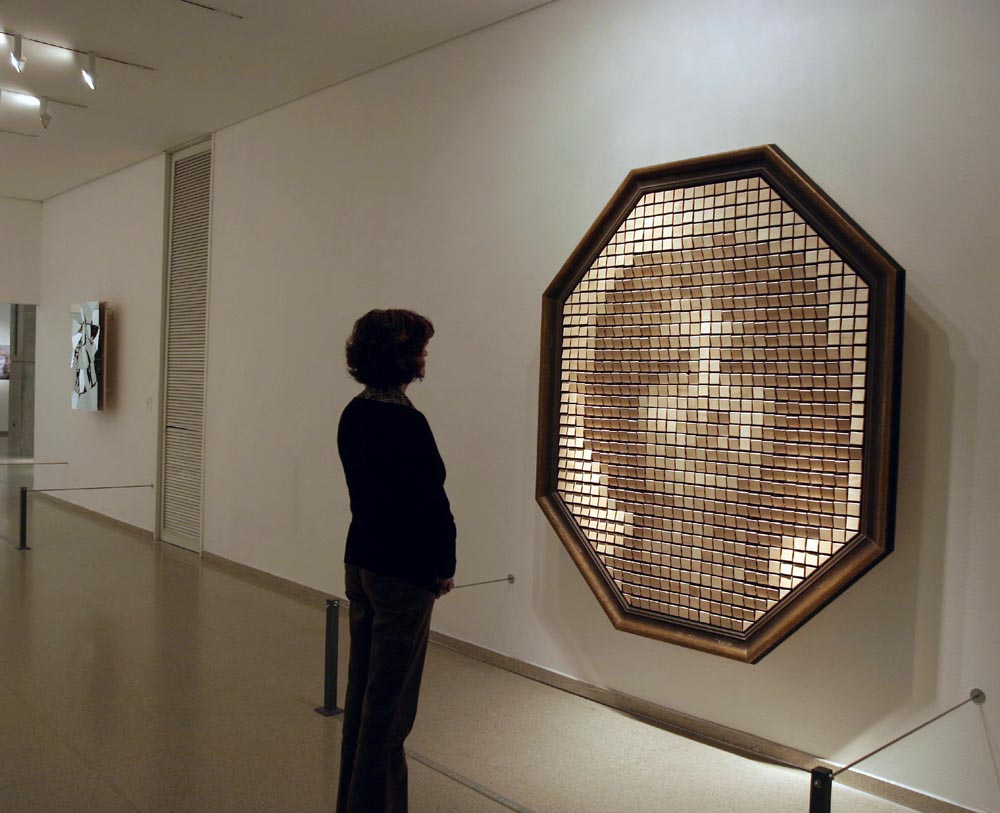
  6. Adjustable display panels. Can be reconfigured to show different symbols, scenes, or directions.

Showing the Species:

  1. In their home environment.
  2. Committing violence (?). A warning or a depiction of a meal?
  3. Before they adopted their new space-adapted form.
  4. Progressing through history.
  5. Their glorious leader / religious figure / ideal form.
  6. Assisting your species. That was quick work... or was it?

Additional Starship Decorations:

  1. Chains / hair. Carefully balanced, but a ludicrous thing to attach to your ship. Anything that keeps moving when you stop moving is asking for trouble.
  2. Spines. Could be aerials, could be "do not bump into me" signals.
  3. Mass balancing arms. The centre of mass of a spacecraft might change as it burns fuel or loads cargo. Adjustable weights or fluid tanks can be made decorative.
  4. Excessive windows. Windows are great, terrariums may be useful, but no ship needs this many glass domes.
  5. Inflatable bladders. Extra volume without extra mass. Could also be used as a form of temporary temperature control.
  6. Rotating structures. Possibly for gravity, possibly for stabilization, but possibly just because it looks neat. Pinwheels, Moiré fans, etc.

Geometric Figures Representing:

  1. A nation / faction / religion / sponsor. Do you have a flaaaag?
  2. A pleasing mathematical concept.
  3. Galactistandard warning labels.
  4. The atomic structure of favoured / vital elements. 
  5. A map of star systems visited. Cultural or personal.
  6. Fractal complexity. Every panel has designs, every design is made of smaller designs.

Well We Think it's Impressive:

  1. A display of every reasonably stable element. You think your species had trouble filling out the periodic table? You should see where we come from. At least you had a solid surface and metals.
  2. Hunting trophies. It's a status thing. Would you descend into the depths of the sea to fight a giant squid bare-handed? And if you did, wouldn't you want to tell your peers?
  3. A local unique product (e.g. wood). Can your species make it? Didn't think so.
  4. Testimonials, gifts (given or received), and glowing quotes. Nobody believes them.
  5. A relic / corpse / chrysalis. Explore the stars even in death.
  6. A projection / model of the surface of our homeworld.
Boyard Costume of Prince Felix Yusupov

Spacesuits and Costumes

How would you visually represent your culture/nation, your goals and aspirations, the essence of what makes you you and humanity humanity? It's the same problem faced by Olympic uniform designers (and not always solved successfully). 

Species that are not fully vacuum adapted require environment suits. Should the outer suit resemble the inner creature? Ideally, want humans to recognize other humans, and other species to recognize humans quickly. But can humanity enforce a standard? Is the spacesuit a mask, a display, an artificial self (what Hochschild might call "the public face of an emotional system"), or the true self piloted by a thinking organ?

Aliens aren't going to build us space suits. A few fancier polymers, a few more efficient catalysts, possibly a few off-the-shelf modules, but no instant industries. Suits are built by the same military-industrial chains that build our current space suits. Their contents will be discussed in another post.

Chris Foss

High-Effort Materials

“It’s hard to be an ornithologist and walk through a wood when all around you the world is shouting: ‘Bugger off, this is my bush! Aargh, the nest thief! Have sex with me, I can make my chest big and red!”
― Terry Pratchett, Monstrous Regiment

From birds to baboons, colour proteins signal quality. If your chest is big and red, it's because you've eaten well, aren't sick, haven't been eaten by predators, and should therefore have desirable genes.

What is the equivalent in space? There are many ways to create a colour. Lightfastness and stability are important, but it's possible that deliberately fragile pigments could be used to signal competence. "Look at us, we can afford to replace the skin on our ship every few cycles."

Fancy polymers and crystals may also signal competence. Things found in nature, but not by chance. Would NASA start a hummingbird farm just to decorate a spacesuit? Possibly. "We've developed a self-replicating bioreactor to make this material."

On the flip side, plain materials may signal a detachment from display concerns. The robe of a monk next to the brocade of a king. Some species can get away with mass and design alone, if they've got sufficient reputation.

2023/03/09

Sci-Fi: An Optimistic Setting Sketch


Part 1: Whither Utopia?

Where has all the optimistic science fiction gone? Where are the utopias of yesteryear? Gone, eaten by the end of history, by moneyball, by the McMansion, by the Hubble telescope and the Dark Forest.

The best we can invent are dystopias to overcome, or a bucolic solarpunk cottagecore reset.

There are plenty of used future/transhuman/horror sci-fi RPGs: Mothership, Eclipse Phase, Across A Thousand Dead Worlds. Plenty of Traveller-type space operas. Plenty of games that let you imitate the optimistic stories told half a century ago. Plenty of pulp games with rayguns and heroic jawlines and loadbearing tropes.

I've always maintained that if you want something done, and no one else is doing it, you have to do it yourself. Here's my optimistic sci-fi pitch. Not utopia, but a future that's at least no worse than our present. Very few of these ideas are truly original, but there's nothing new under the sun.

If I was sensible, I'd package these ideas as a Hugo-winning novel, but I'm sure everyone has read a sci-fi novel that's just a concept with some characters bolted to it. It's the equivalent of a meeting that could have been an email. I also should have invented a catchy name for it. The best I've got is "The Bright Conference."

The Dark Forest

The Dark Forest is a possible explanation to the Fermi Paradox. If life is out there, why haven't we seen it? Because it's hiding. Because not hiding makes you a target.

The Dark Forest suggests life is a threat to life. If aliens exist, they will hide (so they don't get killed) and/or kill us before we can kill them. The usual suggestion is a relativistic kinetic missile; a big rock at a good fraction at the speed of light will definitely mess up a planet. von Neumann probes are sometimes considered, or gamma ray bursts. Kill or be killed. Only the strong survive.

I ran a hard(ish) sci-fi game a few years ago based on the Dark Forest concept. It's an interesting idea, but it's not the only solution.

Pay No Mind

Dark Forest stories often suggest consciousness, as humans experience it, is an evolutionary mistake, a dead end, a transitory step. If we meet alien life, it is not only unlikely to think like us, it is unlikely to think in any way we can comprehend. Solaris on one end of the scale, The Blob on the other, and The Thing somewhere in the middle.

Artur Szymczak

Part 2: Robust Solutions

These are not nessesarily true solutions, but sufficiently robust that a sensible person can't poke holes in them immediately. Not just fridge logic, but get-up-at-night-to-check-a-reference-book logic. There have to be incentives and the incentives have to be justifiable.

The easiest solution to the Fermi paradox is that life is rare and we're effectively alone. Atomic Rockets. Last and First Men.

The second easiest is that life is rare but that a handful of alien species exist. Alien. All Tomorrows. Blindsight.

A third, more difficult solution, is that life is relatively abundant, but we just haven't seen it yet because we've only been looking for a handful of years using very small telescopes. 

Most sci-fi that picks the third option swings immediately into bumpy-forehead humanoid alien territory, both for budget reasons and for comprehensibility reasons. One starfish alien is as good as hundred, if you're using starfish aliens to explore a concept.

But I'd like to explore the idea of a vast array of alien species. A Stanisław Lem kaleidoscope of uncertainty.

The Dark Forest -> Best Not Miss

Assume that the goal of any species is to avoid extinction. You probably can't acomplish any of your other goals if you're dead.

If you see a shape in the Dark Forest and you shoot it, you had best not miss. And you had better be certain that whoever you shot doesn't have friends. And you'd better make sure you kill them with your first shot, because they might be armed too, and they're not likely to negotiate. As St. Murphy wrote, "tracers work both ways." 

You are trading a set of unknown risks for a different set of unknown risks, except now violence is obviously an option. No attack is 100% untraceable. No attack can be guaranteed ahead of time to be 100% effective.

On the defensive side, strategies are much more interesting. Spread. Increase chance of unpredictable consequences. Make connections. 

If you want to kill a species you have to kill all of them. Sever the web of connections completely. If any of them are left alive, or if anyone they talked to is left alive and wishes to make a point about your actions, then you are in trouble. They can track you down and spend disproportionate resources to kill or inconvenience you.

It's like a spoiler in a strategy board game. A spoiler can't win, but they can ensure whoever attacked them loses. Irrational vengeance is hard to predict or defeat.

Pay No Mind -> Law of Large Numbers

The chances of any two species overlapping in any way (being able to communicate meaningfully, having similar goals, being interesting and not trivial/inscrutable, etc.) are low, but those chances go up as the web of connections grows. If there's a network, you may want to grow and maintain the network increase your chances of making a useful or meaningful connection. 

Not Zero Sum

Space is big. Every element is relatively abundant. Aliens aren't coming for Earth's water, iron, or uranium: there's plenty to be had elsewhere, in enormous quantities.

Aliens aren't coming for our gasoline or epinephrine either. If you can travel between the stars, you can do synthetic chemistry locally. Our precious bodily fluids are only precious to us.

Unique products of life (wood, art, music, feathers) could be interesting, but not crucial.

Chances are that a species' goals can be accomplished without interfering with any other species' goals. If the risk of contact is unacceptable to a species, they can hide. It's not easy, but if a species really wants to avoid contact and detection, they can.

The Longest Game

If you are playing the long game, it pays to be generous, transparent, and cautious. The best possible deal now is not the best possible deal over an extended timescale. Your liability is not limited. In diplomacy, space travel, and home repair, saying "Eh, it'll be someone else's problem" inevitably results in the someone else being you.

A disparity in power might not last. Cut a deal with the faction that's currently in control? In a few years, they might not be in control, but you want the deal to be good enough that the new faction will accept it without alteration. No matter the situation, you ideally want the other party involved to look back on the deal as acceptable. Betrayal and exploitation invites reprisals and discourages future cooperation. Bet on rational self-interest. It's always a risky bet, but what's the alternative?  

Soft power is very resilient. Hard power, in the form of empires, strict alliances, hegemony, etc. is brittle. Empires breed rebels. Borders invite trespassers. To play the long game, remain as flexible as possible.

The Level Field

If we're assuming life can evolve on many worlds in many different ways, there's only one environment that every species has access to: hard vacuum and null gravity.

Planets are precious and unique, but they're a lot of work and risk to visit. They are zoos. Terrariums. If you can't survive off your planet, you can tap at the glass and hold up signs, but you can't really participate. Hard vacuum and null gravity are evolutionary pressures.

Solutions:

  • Some species may have evolved in environments that make hard vacuum and null gravity a non-issue. Probably rare, but not impossible.
  • Probes or robots. But the more adaptable and sophisticated you want your probe to be, the closer it is to an entirely new species. Remote control is possible, but lag time makes it inconvenient.
  • Engineering a new species or variant. Other species can provide general advice, but it has to be a self-run process. "Genetic engineering" is a human thing; the chances of anything outside of earth sharing our biochemistry, or having the expertise to manipulate it, is effectively zero.
  • Spaceships and spacesuits. The line isn't clear.

Can a story where everyone interacts in spacesuits be fun? Maybe.


Sufficiently Advanced Technology -> No Shortcuts

"Sufficiently advanced technology is indistinguishable for magic" is lazy. Fun, but lazy. Science fiction has always felt free to invent machines, confident that science would eventually catch up. Unfortunately, science has caught up. We've got helicopters but not flying cars. We've got a vague map of the possible. 

I'm not going to use the following:

  • Plenty of earth-like planets (which suspiciously resemble gravel quarries, the California desert, or the forests of British Columbia).
  • Force Fields. Glowing walls, invisible shields. With or without hexagons.
  • Teleportation.
  • Convenience Engines. Reactionless drives. Hoverbikes.
  • Antigravity and Artificial Gravity. Not counting the normal Newtonian methods, obviously.
  • Telepathy and ~Woo~. Energy ghosts. Mind melds.
  • Hidden or Higher Dimensions. The Warp, Foldspace, The Multiverse, etc. 
  • Nanotechnology. No magic swarms of robots to turn sand into computer chips or fat into muscle.
  • Scanners. No magic information at a distance. No instant answers.

And, for humans specifically, I'm not going to use:

  • Brain Uploading. Not for some spiritual reason, but because brains are soup. Ever tried to unmake soup? Humans are too messy and glandular to encode with fidelity.
  • Cybernetics. Beyond a reasonable extrapolation of currently available tech. Yes to cochlear implants, no to full-sim brain interfaces.
  • Political and social unity where everyone magically agrees to get along. Cannot assume that human nature will suddenly change.   

In this setting, everyone plays by these rules. There's no Ancient Precursor species with mysterious floating obelisks, or if there is, the obelisks float by sensible and currently available means. It's a universe of mere matter. 

On the other hand, there are a few speculative technologies I'm willing to allow.

  • Artificial Minds. Not the chatbots and image-dreamers we have now, but a programmed or generated mind that operates in a comparable way to ours (or to another species). It's hard to turn everything into paperclips without magical technology. AI with independent goals have to play the same game as everyone else.
  • Useful biochemistry. Nanomachines might not exist, but you can currently feed CO2 and sunlight to a tiny self-replicating organism and get all sorts of interesting products. Technology might include a sealed cask of alien goo.  
  • Faster than light travel. This is a big reach. It's done for storytelling reasons. It might be possible for someone else to tell a compelling story on a multi-generational civilization-level scale, with no human-scale characters... but I can't, so I won't.

Technology Optimization

Information is effectively free. If you want to learn how to build a general-purpose hard vacuum null gravity system for any given technology, some species will eventually tell you how. They've had time to test and optimize it. There's no centralized trustworthy library, but the long-term consequences of providing bad information may outweigh the benefits of sabotage.

If you want to convert a blueprint to your specific requirements, available technology, and existing practices, you need time and specialists. It's not useful to know how to build a steam engine if you can't smelt iron. The links in the chain of optimized technology might not connect to the chains you already have. First contact will not solve your problems, just like knowing how to build the Large Hadron Collider would not have helped the Emperor Hadrian.

It is said that 30% of any given spaceship is adapters. You can optimize a technology in many equally valid but slightly incompatible ways. Species A wants their systems to run without maintenance, Species B is concerned about waste heat, Species C has a deadly reaction to titanium, etc.

This assumes that it's not efficient to move an entire standardized industrial chain to a new star system. You have to build it from scratch (or nearly from scratch), and, since technology is distinguishable from magic, you have to build it slowly. Post-scarcity takes time, but it is achievable.

Probing the boundaries of physics requires even more investment. Even if resources are abundant, it's hard to invest time and effort to construct a particle accelerator the size of Saturn just to add a few decimal points to a measurement or see if a particle really is what the generally accepted theory says it is. Some species still do it though. Maybe, inside the latest layer of the onion, there's an exit to the maze.

David Jones

Part 3: Principles in Practice

Let's expand on some of these ideas.

FTL Travel

FTL has to require some level of investment or we'd have done it already. In a Dark Forest scenario, FTL travel can be easy. Nobody is visiting, or if they are, they're not paying a social call. But in the scenario in this post, FTL has to be expensive or limited, or they'd have done it already.

FTL travel is a shortcut. As discussed above, it's a way to make a human-scale scenario work. Otherwise, you'd need to add "can hibernate for centuries" to the evolutionary pressures list, and add "bewildering social changes" to a scenario that already has a chaotic whirl of concepts.

To make FTL work, I'd like to suggest the dodge used in my Faster than the Dark game. FLT travel works, but attempts to use it to break causality always fail. Is the universe a simulation? Is it the hand of God? Does violating causality destroy the universe, leaving only universes where the attempt failed? Is it a cover-up? Or is it just a spectacular run of bad luck?

I don't want to make the FTL technology beyond human comprehension. It's comprehensible, but ludicrously expensive.

I'm going to use gates. Humanity's first extrasolar vessel might be a Soyuz capsule.

First Contact

Build a few thousand large telescopes and put them in deep space. Network them and start looking.

If you find a world that's a likely candidate for life, launch a probe at a decent fraction of the speed of light. Aim to obviously and transparently miss. You don't want the locals to think it's an attack. Beam signals along the probe's path, just in case.

The probe arrives, brakes in an obvious "this is not a missile" way, enters a distant orbit, and starts trying to make contact. It's easier to teach the locals to speak Probe than it is to learn the local language.

If the locals consent, use all remaining energy reserves to build a tiny gate and send a larger gate-builder through. Build a full-sized gate. Welcome the latest addition to the network. Possibly build another telescope network, if your current array of arrays isn't large enough, and keep looking.

If the locals refuse, ask when the probe should check in next or set conditions for reactivation, then hibernate.

If there's no intelligent life in the system, either build a gate anyway, hibernate until life evolves, or quietly decay. Waiting is probably only an option if life looks like it could reach a contactable stage in the immediate (100-1,000 year) future. 

Galactic Parliament -> A Myriad of Myriads

The existence of gates creates a few interesting pressures. First, if the gate-builders communicate in one format, then others might as well communicate in the same format. 

Second, since gates are expensive and shields don't exist, violence near the gate is discouraged. If you're going to fight, fight elsewhere.

Third, the gate-builders can turn off the gate and disconnect a planet from their network, so they should be kept happy. The gate-builders can't make too many demands though or species will make their own networks. A light touch, or no touch at all, is best. If you're building telescope arrays, near-c probes, and gates anyway, there's probably not much you want. Building gates, for a gate-building species, is probably its own reward.

Energy costs might be important. It's safe to assume gates aren't free to operate.

The first aliens to turn up after a gate opens are:

  • Surveyors, hoping to trade information on a system to others.
  • Fame-seekers. You might be nobody special in your home system, but you're the first alien this species has ever seen.
  • Diplomats, trying to explain their cause and goals and find allies.
  • Proselytizers for a worldview, a philosophy, or a religion.
  • Altruists.
  • Perverts, collectors, and the curious.
  • Other recently contacted species trying to quickly form connections. 

No rules, only agreements and pressures. 

Principia Discordia

Prime Directive -> Not My Circus

Let individuals and species do their own thing. It might offend you, disgust you, or confuse you, but it's not your problem, it's their problem. If you want them to change, you can ask or apply pressure, but you should be very cautious of the long-term consequences. It's less about morality and more about the long game.

Sort It Out Amongst Yourselves

Groups vote by volume. The loudest voice speaks for a group. Don't like it? Take it up with the loudest voice. Here's a simplified explanation.

A probe might ask a planet, "Do you consent to a gate in your system? Yes / No. Time period X.", using photons in the radio wave region (because the planet was already beaming out radio waves). Everyone with a transmitter can beam back an answer, but the probe will only check for answers in the yes or no format specified, and only listen to the loudest answer within the specified time period.

The probe then transmits, "I have received a "Yes" answer. Confirm answer within time period Y." Time period Y gives the planet a chance to reconsider, destroy the transmitter, start a nuclear war, hold a vote, etc.

Ideally, the transmission should be in a form everyone with a stake can receive and comprehend. A probe orbiting Earth in 1700 would probably try light, blinking on and off. In theory, if anyone could carefully note the pattern, a large custom-built lighthouse could blink back. In practice, the probe would probably hibernate until it detected some significant activity.

It's also important to know with whom you're negotiating with, and in what capacity. An individual? A faction? The ambassador of a species?

Hitchhiker Waivers are common for newly contacted species. They absolve the other party and their species of any liability.  Sign one and agree to be transported through a gate, and the alien can turn around and boil you alive or let you starve to death in a tube, and the assumption is that nobody will do anything about it. That's the cost of a free ride. Waivers are transmitted and recorded. In a busy system, everyone is transmitting everything all the time. It's a network of noise, of checks and counter-checks. The fanciest algorithmic contract can't save you from social engineering.

Kuldar Leement

Part 4: What Do The PCs Do?

The question I was unable to answer for Space: 1977. It's not an important question for a novel or a film, but it's vital for an RPG.

The answer could be "explore, make friends, and solve mysteries."

What information is real and what is bluff, subterfuge, mistranslation, and misdirection? What is the secret motivation behind an offer to buy Jupiter? What is the real motivation of the gate-builders? What happens to species who don't play by the implied rules? How will you represent humanity?

The absence of the Dark Forest does not mean an absence of danger. Immediately post-contact, when a species has few connections and the consequences of extinction can be easily predicted, it might be better to wipe out a potential source of trouble. Humanity is (possibly) racing against time.

What's It All About?

Maybe it's about tourism, and the pressure a culture faces to make itself palatable, exaggerate marketable elements, and minimize differences. The power of capitalism's ability to absorb all critiques. The reemergence of a multipolar world. Trust in a low-trust environment. Social media, and being trapped in a decaying network.

Maybe it's about absurdism, a mirror of the Dark Forest's implied nihilism. Maybe it's about the limits of rationality in a world of noise and unlimited information. Lem's Futurological Congress held in Koolhaas' Generic City.

Maybe it's about what it means to be human, and what it means to disagree with someone over what it means to be human. 


2023/02/28

OSR: The Mystery of Uriah Shambledrake Session 13 & 14 - The Iron Tower

 In the Previous Installment, the PCs:

  • Traded some horses.
  • Radicalized some rats.
  • Imploded some snails.

The PCs are:

Tom Shambledrake
Electric Wizard and heir to the bankrupt Shambledrake estate. Inventor of the Lightning Accumulator and the Lightning Inverted, which, when combined, should revolutionize magical charge production in Endon.

Jonty Earl
Dandy. Assistant Professor at Loxdon College, and accidental inventor of the Jonty Suit.

Dr. Augustus Hartwell

Biomancer. A foreign doctor and self-described "quack", currently employed at Blumsworth Hospital. Ally of speaking rats, workers, and other vermin.

Lizzy Ramchander
Potion Wizard, former cook, former brewer, and current secretary to Doyle Wormsby.

Doyle Wormsby
Civic Wizard, Private Investigator. Motivated by truth, justice, and tobacco.
Nathanael Whale

Doyle slipped into the Hasselby Court Mechanics' Society, paid his penny into the collection tin, slipped his flat cap a few inches lower, and slouched in the back row of the lecture theater. He'd been attending these meetings for months, disguised as his alter-ego  "Michael Conan", a printer's assistant, general labourer, and taciturn misanthrope. The Societies were springing up like mushrooms all over Endon, offering quiet reading rooms, libraries, lectures, tea, and biscuits for a very moderate price. Far too moderate, Doyle had calculated, to support their expenses. Someone wanted these clubs to exist, and Doyle suspected the Project.

The Project, attentive readers will recall, is a mysterious alliance of wizards. Professor Tallerand, disgraced biomancer, and Edward Konivov the eccentric time wizard are certainly involved. Their scheme seems to be the conquest of death itself via time travel, memory extraction, and the creation of new and imperishable bodies. 

And Edward Konivov was a lecturer at the Mechanics' Societies. While other lecturers spoke on practical subjects such as housekeeping, mathematics, and natural philosophy, Konivov's lectures tended towards abstruse philosophy. The audience seemed to tolerate him because he was frequently seen with Benjamin Fits, the notorious labour agitator. Fits commanded the room whenever he appeared. 

Once, after following him and his cadre of scowling cronies to a tavern, Doyle saw one of Fits' attendants reveal a mysterious glass jar before Fits hastily signaled for him to hide it. The jar seemed to contain another, smaller jar, both full of a clear liquid. Doyle was intrigued, but could not find any further evidence of the jar's meaning. 

It wasn't a memory extracted by Tallerand. Those, Doyle knew, glowed blue, and judging by the burn scars on the scalps of several devotees of the Mechanics' Societies, Tallerand was hard at work behind the scenes, moving skills from one worker to another, and probably duplicating them along the way.

Reza Afshar
Meanwhile, Jonty embarked on a complex scheme to raise the group's finances from frustrating middle-class paralysis to the lofty realms of high capital. He spent several weeks discreetly investigating stock-traders and promoters by day and reading the relevant laws by night. Within a month, he considered himself one Endon's authorities on shady practices, stock-jobbery, and financial wizardry.

He proposed two companies. The first would support the calculating golems of John Huffman and Ana Hartwell. The second, a far larger concern, would support the development of the Lightning Accumulator and Lightning Inverter... and far more besides.

"It'll put magic accumulators out of business," Jonty said excitedly. "Instant magic! Just add lightning."

"But lightning strikes are arbitrary," Lizzy pointed out. 

"We could build a tower," Tom said, his eyes glowing more than usual. "A tower of iron! Lightning strikes the highest point available, and if we build the tallest building in Endon." Tom quickly sketched something on bit of newspaper and showed it to the group.

"It's the letter 'T'," Dr. Hartwell said. 

"It's a tower! Tall middle bit, and two arms. And then I can stand on top, where the head is, and look down upon Endon while casting my spells! Mwahaha!" Tom chortled, miming vigorously.

"What about when it's windy?" Lizzy said, flapping her arms up and down. "Boing boing snap oh many casualties, infamy, etc, etc." 

"Fair," Tom replied, sitting down and scratching his chin. "We should probably hire an engineer."

"One engineer? We'll need a whole fleet. We'll need a warehouse or two for the magic batteries and Lightning Inverters, and a large area on which to construct the tower."

"Needle Circus makes sense to me," Tom said. "We could even buy up the old Nortgreen & Louton Gel Refinery. I'm sure Nero would appreciate it."

Lizzy's eyes lit up. The things she could do with a proper laboratory space and some decent refining equipment..

"We'll sell magic by the kilothaum. No, wait, better. We'll charge up magic batteries and deliver them around the city, like milk," Jonty said. "A fleet of carts, with our livery painted on, delivering safe and reliable magic to your front door."

"A few charges, sure, but there's no way we could safely cart a really large magic battery around the city," Tom said. "They're wider than some of the streets."

"What about piping it like water?" Jonty suggested. "Thick warded cables to local firms that need dozens of charges a day, and delivery carts for households and smaller industries."

"Can you pip raw magic like that?" Doyle asked, then, before Tom could speak, added, "Safely, I mean."

"Proooobably," Tom replied. "Copper cables with a ceramic coating ought to work."

"What about the rain?" Dr. Hartwell said. "This will require a lot of storms."

"It already rains in Endon most days of the year," Jonty said smoothly. "Why worry? I'm sure it will be fine."

And so, Iron Spike Thaumaturgy Limited, with a nominal capital of 50,000gp, divided in to 20,000 shares, was quietly formed. Jonty added Professors Turnspit and Aster, the summoners from Loxdon College who were working on the Jonty Suit, as subscribers, and assigned them a generous 100 shares each. The fictitious Nigel Crustacean Ramchander, Lizzy's non-existent brother, received 2,000 shares, as did the very real and slightly bewildered Nero Krahlhammer. Dr. Hartwell and Jonty took 2,000 shares each, while Tom, as the originator and vital component of the scheme, took 4,200. The rest were sold to a variety of investors by Jonty, or held for later sale, or otherwise tied up in his convoluted financial chicanery.

"So... we're rich?" Lizzy said, a few days later.

"On paper, yes. I've had to allocate some of the capital to real estate projects. Advertisements. Miscellaneous expenses. But yes, we are rich." Jonty said.

"I would like 500gp for a special project," Lizzy said, extending her hand. Jonty stared at it, then cut her a cheque from Iron Spike Thaumaturgy's account.

One week later, in her newly appointed laboratory, she took careful aim at a vat of translucent green gel and cast a powerful spell. When she opened her eyes, she was beside herself in both the figurative and literal senses. 

"Hooray!" both Lizzy Ramchanders said. Dissatisfied with the limited duration of her duplicate self spell, Lizzy had worked out a way to use a gel matrix to stabilize the resulting flesh double, turning the spell's duration from minutes to hours and letting her get twice as much work done in a single day. The spell didn't duplicate clothes, and the process was likely to nauseate any spectators, but Lizzy worked out a sort of quick-change system for basic laboratory clothing and installed a very good lock on the door.

Doyle spent a week going quietly mad as his secretary appeared in two places at once. Eventually, Lizzy had to tell him. "At least it's not time travel," Doyle sighed.

Rio Skywalker
 
Jonty decided to see if the Minister of Trade, The Right Honourable Barbosa Crummies, could offer insight into clay deposits around Endon. Iron Spike Thaumaturgy might require a great deal of ceramics.

The Ministry of Trade seemed to consist of the Minister, an overworked secretary, and a stratified mesa of paperwork, maps, letters, and petitions that filled their adjoining offices. 

"Don't talk to me of ceramics," Kenwigs moaned. "I found out last month we've been importing all our plates and cups from Foreign Parts. We just passed a bill that increased the tariff a hundredfold. Didn't make the papers or anything, despite quite a good speech on my part. Now I find out we've got no domestic pottery industry to speak of. Nothing to protect, you see. And all the importers have already cancelled their orders. By this time next year we'll be eating soup out of our hats."

"My goodness," Jonty said sympathetically. He knew the Gumperts, the current ruling party, were widely predicted to lose the coming election, but this scandal could be the final nail in the coffin. The most prudent of rats, Jonty knew a sinking ship when he saw one, and politely excused himself. On his way out, he confidently pilfered a map of Endon's catacombs and a few assorted folders from the stacks of paper in the Minister's office. 

He pinned the map to the wall of his study. When Doyle saw it three days later, he let out a strangled gurgle, hailed a cab, and returned an hour later with a folder full of newspaper clippings. Each one was a strange cryptic advertisement placed by Edward Konivov in a newspaper. He started tacking them to the map. The lines and intersections of the catacombs of Endon occasionally lined up with the incomprehensible lines of the advertisements.

"Got it," Doyle said. "They're marking something. A supply cache? An experiment? A meeting place?"

"Not all of them line up with the map though," Lizzy pointed out. 

"It's not a complete map. Nobody has a complete map, probably. This is just the official government survey. See, it's concentrated around the Auld Grey Cathedral, but there lots of blank bits... and some passages marked with skulls. Ominous." 

"Those could mark... good places to find skulls?" Lizzy said, without much hope.

Varguy

Tom, meanwhile, had been offered a suspiciously good deal on raw iron for his tower. Daniel Kenwigs, broker for the the Thaumaturgic Mining Guild, had eagerly agreed to meet with the "Lightning-Tamer". Tom's reputation, enhanced by his flaming eyes and his grand plans. Rumours of an "Iron Tower", the "Tallest building in Endon, and therefore the world" were spreading like wildfire.

After some preliminary small talk, Kenwigs opened with a very unusual offer. "400 tons of cast iron per Gel Knight?" he asked. "I understand you and your partners fund Nero Krahlhammer and own the old Nortgreen & Louton works."

"Gheht?" Tom gurgled, his face an impassive mask.

"500 tons? And how many Gel Knights can we expect?"

"How soon do you need them?" Tom replied, happy to be back on almost familiar ground. He wasn't sure how much iron the tower would need. Chastity Flintwich knew, of course, and she'd quoted some immense sum to him, but he couldn't visualize it. The more iron the better, he decided.

"As soon as possible," Kenwigs replied, starting to sweat slightly.

"Any special modifications or requirements? Livery? Functions?" Tom was also sweating. Some scheme was afoot, and he didn't like it.

"General-purpose guard duty. No livery or markings. In fact, if they could be, err, conditioned to attack recklessly on command, that would be for the best." 

"I think we can manage an order of 10 within the week," Tom bluffed. He had no idea how many Gel Knights were available, but 10 seemed sensible.

"Excellent, excellent," Kenwigs said. "We're running a railway line to Needle Circus in any case, so we can deliver the iron directly to your building site."

"Splendid," Tom said. He'd heard of the railways, of course. Engines powered by coal and water (not magic; far more efficient to use natural means) criss-crossing the countryside, but they had yet to reach the metropolis itself. Too many issues with land ownership, too many new suburbs.


Half an hour later, Tom burst into Doyle's office and relayed the very odd conversation. Doyle slouched into action. According to rumour, many iron mines and foundries in the hills west of Endon had suddenly closed. This should, Doyle knew, drive the price of iron up, and yet Kenwigs was practically giving it away. 

Dinner with a few commercial travelers and labour advocates provided half the picture. Kenwigs feared a rising tide of unemployed, unhoused, and hungry miners would see him and his company - correctly - as the source of their misfortunes, and presumably wanted Gel Knights to protect his interests.

The rest of the pieces fell into place when Doyle used Nero's scrying orb to locate the origin of a bit of iron scraped from a fresh shipment of girders. After an hour of fiddling with the knobs and dials of the orb, Doyle eventually got the device to work, but was dismayed to see that all it showed was a glowing red eye. He stared back at the symbol. After a few moments, it faded, revealing inky blackness.

"You've got it set underground," Tom said helpfully, peering over Doyle's shoulder. "Here, let me try."

"I can control the horizontal and the vertical perfectly well," the Private Investigator said, fiddling with the dials again. The orb flickered, briefly showed gravel and grass, then revealed a desolate landscape. Mine works stood silent. Smokestacks conspicuously failed to smoke. Octagonal iron pillars emerged along a ridge.

"Industrial-grade control metal or a related spell," Tom said. "Some sort of slow but persistent enchantment, I think. Enough to draw iron out of the earth and purify it. No need for miners or foundry-workers. Just a handful of men to fell the iron like wood."

"Did many people work in the mines?" Doyle asked. He already knew the answer, and didn't wait for Tom to guess. Endon was already crowded. If a space had a wall and something to keep off the rain, someone was living in it, or working in it, or painting it a dismal shade of greyish beige and trying to rent it as a studio apartment. Even the most menial position attracted scores of applicants.

Doyle didn't know much about mining, but he had the vague notion it was an organized, regimented, deadly business, with crews and leaders and camaraderie. A thousand out-of-work famers could trickle into Endon with nothing more in common than a shared accent and astonishment at urban prices, but a thousand miners could march. Ten thousand miners? Who knew how many?


That evening, while skulking through one of Endon's shadier alleys, Doyle ran into Victus Crane, the mysterious Copper employed to solve magical crimes. The two men evaluated each other with considerable frostiness. "The forger you caught escaped," Victus eventually said. "Disappeared from his cell. Did you do it?" 

"Why would I catch a forger only to break them out of the most secure prison in Endon? Don't you have the place warded against teleportation magic and all that?"

"We do. And yet he's gone. And according to my superiors, it's not a magical crime, and I cannot investigate it. I think someone is setting me up for a fall. Setting us both up," he hastily added.

Doyle considered this. It seemed far too plausible. But was Victus looking for an ally or a scapegoat? Did he truly believe that Doyle and his unsavoury friends were innocent?

"What do you want me to do about it?" Doyle said.

"Finish the case. Find the forger."

"Can't you scry for him?" 

"No results. He's powerfully warded. Conventional tinker-tailor wards we can break, but scrying is never infallible. Now that you mention it, did you use a scrying spell earlier today?" Victus asked politely. 

Doyle shrugged. Victus reached into his coat and pulled out a blurry iconograph of Doyle's face, distorted as if seen through a fishbowl. "Scrying is currently legal," the Deeker said, "emphasis on the word 'currently'. New legislation. This is just a friendly warning."

A range of unfriendly replies flickered through Doyle's mind. "A friendly warning in return. The iron mines are closed. New method. In a week, iron will be cheaper than the new whale steaks."

"What do you want me to do about it?" Victus said, slightly taken aback.

"Put a bed in your airing cupboard and rent it to a family of four. That's what everyone else will do." Doyle lit a cigarette and pointed at the door. "That, or prepare for mob violence on a scale never-before seen in this or any other city."

Designs for the Great Tower for London. Whitepointed files here.

"What do you mean, memorize it?" Tom said, pointing at the blueprints spread across the table.

Chastity Flintwich gave him a look that could curdle milk at fifty paces. "Memorize it. You need to be able to visualize the tower completely, in every detail, if you want to raise it with control metal."

"It's very complicated," Tom said plaintively. "What if I get something wrong? Can't I just correct any errors are the tower rises?"

"Possibly. The errors will compound and the tower will collapse like soft clay and kill hundreds of people."

"Ah," Tom said.

"Memorize it," Chastity said forcefully.

"Do you have any helpful suggestions as to how I might do that?" Tom asked. 

Chastity thought about it for a moment. "Be less stupid," she said forcefully. "And work harder." On a chart of socially graceful creatures, Chastity Flintwich rated near the bottom, alongside scorpions, earthworms, and some of the smellier types of algae. She went through at least one assistant a week. All of her words were fighting words, and, as the first and only Loxdon College Female Ambush Boxing League Champion, she was more than happy to back up her words with deeds.

"I have a better plan," Tom said slyly. 

Chastity stared at him. "Doubtful," she said.


Tom's plan was eventually admitted to be better. He hired an illusionist, had them memorize the plans (with their illusionist training). All Tom had to do was control thousands of tons of iron to match the illusionary form projected in the air. "Trivial," Tom assured his friends, with more confidence than he felt. Wizards of old had raised castles and towers instantly, but no one - as far as he knew - had attempted a tower of iron. He'd need to balance a mind-melting thaumic charge with a delicate concentration-based spell. 

"So you don't want an audience," Jonty said.

"Ideally, no."

"Ah. That may be difficult..."

"Jonty's sold tickets," Lizzy said in a smug sing-song tone. "It will be the social event of the Season. I'm going to buy a new dress."

"You're selling tickets to the tower-raising?"

"For a moderate fee, to keep out the rabble. We will have guards and viewing stands. Concessions. Patriotic flags. I've found a workshop that will make quite tasteful souvenir models from an amalgam of tin and lead. Stockholders get in free, of course. And we will sell stock at the event." Jonty looked giddy.

"And you've purchased all the land we require?" Tom asked.

"Almost. There's one warehouse I'd like to buy, but the owners..."

"Won't sell?" 

"Want too much money."

"Jonty, we have too much money."

"A tiny bit of arson and we'd have almost as much money..."

"No arson, no threats. Buy them out and get the foundation slabs in," Tom said, with renewed authority. 

Judge magazine, March 5, 1927. Via Yesterday's Print.

While Tom and Jonty bickered over real estate details, Doyle delved into an ever-growing maze of conspiracies and plots, and Lizzy enjoyed her new found plurality, Dr. Hartwell was fomenting a revolution in the basement of the group's townhouse.

Dr. Hartwell initially summoned rat swarms using a call vermin spell. After providing cheese, bread,  and apologies to the intelligent rats thusly summoned, attempted to establish diplomatic contact with various groups and factions. He was bewildered by the continually shifting priorities of the rats, but was able, after a few weeks, to create a sort of neutral rat meeting space, complete with speech-amplifying trumpets.

He also used a crate of potions of rat-form to speak with the rats on their level, which impressed many of them. He wasn't the first human to try and insert himself into rat society, but he was the first to speak with them nose-to-nose, and to offer assistance without asking anything in return. He discovered that the odd and stilted speech of the rats was a function of their size. They had to scream to be heard. At rat-scale, they were as conversationally adept as any Endoner.


A few days later, Doyle invited the group for a delve into the catacombs, to seek out the secrets of Edward Konivov and his mysterious newspaper advertisement. Jonty demurred, pointing out that he was far too busy. Everyone else happily agreed to a bit of trespassing. Dr. Hartwell brought along the urchin Perry Pint as his assistant.

 Like many river cities, Endon was primarily built on Endon. The water table was, for half the year, an inch above street level. New buildings used old foundations, old buildings sunk and added new stories on top. The Auld Grey Cathedral had, for centuries, kept pace with Endon by building roots of stone buttresses and wedges. 

The expedition started in the abandoned cellar of a wine merchant, descended through a drainage tunnel and pump room, and crept along a sludge-encrusted drain pipe. The sludge turned out to be an ooze, which rose, smashed Doyle backwards, and began to flow into the room with unmistakable intent.

Dr. Hartwell ran to Doyle's side. The ooze's pseudopod had smashed the detective's ribs and punctured a lung. "Damnation," the doctor grunted. "Keep that ooze away from me!"

Tom blasted the ooze with a full-power lightning bolt, but was astonished - and a little intrigued - to find that it had no effect. "It's immune to lightning!" he yelled.

"WHAT?" everyone else replied, their ears ringing.

Lizzy, always willing to help, drew her kitchen knife and charged the ooze. She sliced wildly but ineffectually. The ooze, in response, began to engulf and swallow her. Unfazed, Lizzy cast grease on herself to protect her clothes from the ooze's digestive juices and kept slashing.

Dr. Hartwell cast fix flesh on Doyle, healing him instantly but, in a mild biomancy mishap, temporarily transforming Dr. Hartwell into Doyle's doppelganger. Doyle woke up to find a copy of himself wearing Dr. Hartwell's clothes, shrugged, turned, and ran.

"Could I get some assistance?" Lizzy asked politely, as the ooze reached her neck. Dr. Hartwell examined the situation and acted decisively. He pulled out a potion of rat-form, poured it into Lizzy's mouth, tossed the flask upwards, deftly caught the falling rat-Lizzy inside the vacated ooze tunnel, stuffed her into his pocket, and followed Doyle out of the catacombs.

Lizzy stuck her head out of the doctor's pocket and cast - or vomited - cone of dense foam at the ooze, reasoning that the smell and texture of the spell would dissuade pursuit. Tom, caught on the edge of the foam, was not pleased. 


"That ooze was immune to lightning! Fascinating! I wonder if we can use it as a sort of lightning-absorber?"

"Like the ground... right?" Lizzy suggested, tracing a lightning bolt with her finger.

Tom frowned. "I suppose. Still, we should capture that ooze. Lizzy, can you get a few of the ooze-minders from the Gel Knight works to capture it?"

Capturing a lightning-eating oozes was just one of Lizzy's projects. With doubled efficiency, she had recently developed, tested, and (with Jonty's help) marketed a new brand of liquid refreshment. By feeding whale offal from the Leonine Cartel to a specially bred ooze, she could turn useless and nauseating slop into a delicious mint-green beverage.

Dr. Hartwell refused to endorse it on principle, but Lizzy pointed out that milk in Endon was heavily adulterated, usually spoiled, watered down, or otherwise unsuitable for human consumption. "That last batch of cream we tested was thirty percent chalk dust, ten percent tallow, and one percent caustic soda. And Jonty had it with his coffee."


One week later, before dawn, Tom examined the site of the tower. It was a level square, a plain of huge stone blocks and chalk markings. Stacks of iron bars, cut crudely to length, rested along the edges like firewood. Jonty had paid considerable sums to drive foundation piles deep into Endon's silty soil, buying layer after layer of limestone and iron in an effort to give the tower as solid a foundation as possible. The tower couldn't be directly connected to its iron roots or the captured lightning would simply vanish into the earth. 

Soon crowds of Endoners would fill the tasteful grandstands around the edge of the site. Tom had insisted on a 50' exclusion zone, reasoning that most minor blasts wouldn't reach spectators 50' away... and a major catastrophes wouldn't have a minimum safe distance. 

Little did Tom know that, from rooftops and alleyways, through scrying orbs and telescopes, persons of ill intent were watching him and enacting schemes to bring about his ruin.


Will the Iron Spike ever rise above Endon? Will Jonty's stock-trading schemes catapult the group into eternal prosperity? What of the escaped forger? The miners? The other tangled threads of conspiracy and counter-conspiracy?

Find out next time.

2023/02/14

OSR: The Monster Overhaul Megapost

The Monster Overhaul is now on sale. Tell your friends! Heck, tell your enemies.

Check out these retailer lists to see if your local game store can order a copy.

What’s a Sphinx without a riddle, or a Minotaur without a labyrinth? What’s a Dragon without a hoard, or a Peasant without a grievance?

The Monster Overhaul is a massive Role Playing Game bestiary designed for at-table utility. Monsters are presented alongside useful tools, ready for immediate use in any scenario.

This book aims to provide a GM with the tools they need, as they need them, without slowing down a session. In the middle of a game, a GM doesn’t need to be told that Bears live in caves or that Ghosts haunt graveyards. They know that. What they need are interesting prompts that are difficult to invent under pressure; names, details, motivations, secrets, riddles, maps, twists, etc.

Numbers are calibrated around old-school fantasy adventure game principles. This book should be compatible with, and has been tested against, the most popular and enduring old-school systems.

This 336 page book contains:

  • 200+ Monsters.
  • 160+ Pieces of original art.
  • 20+ Maps.
  • Random encounter tables, indexes, and a host of other useful tools.

Editing by Dai Shugars.

Art by Lucas Roussel, Robin Carpenter, Iguanamouth, Logan Stahl, Ash Rudolph, Nadhir Nor, Crim_Reaper, Naf, Luka Rejec, Erin Kubo, Conor Nolan, Frenden, Scott Wegener, and Dyson Logos.

Reviews

The Monster Overhaul (Skerples): From art to organization, this is shaping up to be to monster manuals as Tomb of the Serpent Kings is to dungeon adventures - the sort of thing that takes the fundamentals and applies long-needed functionality updates.

-Dan, throneofsalt.blogspot.com. The Monster Overhaul won three Salty Awards for “Best Book That Is Not In Book Form Yet”.


It’s amazing. Lots of fun. Very thoughtful. Incredibly actionable. Basically my go to Monster Manual at my table.

-Reddit user acluewithout


It's a massive, useful, inspiring bestiary, and it's applicable no matter what fantasy game you run. Seek it out.

-Mark Finn


I'm at the stage of my DMing career -- in the neighborhood of 40 years, yikes -- where I want things to be immediately useful at the table. (I have inspiration for days at this point, thanks.) A book that instantly gives me a list of names for NPCs when my players would rather talk than fight, a random table of colorful descriptions, other things that answer the needs of an actual DM playing the actual game? Yes, please.

Too many books seem to have never been playtested and, moreover, have little to no connection to how they will be used in actual play. This is the exact opposite of that, and I love it.  

-Whizbang Dustyboots


All around a great tool, broadly useful, but opinionated enough in it's decisions to avoid being a milquetoast kind of generic. One of the few monster books that covers the entire "generic fantasy rpg" gamut, while being actually a useful tool.

To make best use of it you will probably want to be playing a Dungeons and Dragons style game, but I think even if you're running something like a pulp or sci-fantasty type game you'll be able to get mileage out of it.

-Josh G


As if I'd been waiting for it for 40 years. If you must keep only one, this is this one. This book should be mandatory. What a monster manual should always have been. Instant classic.

-The Merry Mushmen 

Absolutely gorgeous, superb quality materials, and I am in love with the "old school" artwork. This is one of those rare TTRPG items that cut out all the fluff and wasted space, this book is so crammed with information WoTC would have split it into 4 middling volumes. Lives up to its name, a proper overhaul of bloated systems condensed and packed expertly into a single volume.

-PibbleFiasco


What a wonderful book - absolutely chock full of useful, inspiring ideas. Clearly a labour of love from the author and sets a very high bar. Well done, its a triumph!

-Ken McLennan


I have to say that this is absolutely one of the best quality books I've ever owned. Truly an amazing physical specimen. Also, it's my new favorite bestiary and it's going to take a LOT to de-throne this thing. Amazing.

-Robert Wiberg

This is one of those books that, when it showed up and I cracked the cover and flipped through it, I was immediately like, "Oh, I need to not flip through this. I need to set this aside because I need to devote a bit of time and space. I need to respect the book, because it's capital I Important." And I think that my gut reaction is correct. I think that this is a fantastic repurposing and reimagining of monster manuals... There is such an abundance of thought on display for every single monster.

-Vintage RPG Podcast

That book is absurdly good. Even after reading so many glowing reviews it still exceeded my expectations. The way the book is organized, the quality of writing, the usefulness both at the table and in advance, it’s probably the best monster manual I’ve ever seen, full stop. I can’t recommend it enough.

-Reddit user voltron00x

Videos


@dragonsafari76

Why?

I wanted to create a utility-focused monster manual with a ton of cool art, useful maps, and handy tools. Planning started back in 2019; check out the tag for more WIP posts and background information. After many years of work, it's amazing to see the book out in the real world, helping GMs everywhere.

Thank You

Thanks again to Dai Shugars, the artists, the playesters, all my Patreon supporters, all the Kickstarter backers, and everyone else who helped make this book possible.