2023/02/12

OSR: 1d100 Library Research Results

"Library Use" is a vital skill in Call of Cthulhu. I remember having a character who quipped, "You have a your revolver; I have my library card." to a fellow investigator. Later in the session, as hideous swamp-things from beyond space and time pursued us through the gathering darkness, the gunslinger called out, "Quick! Show them your library card!"

The internet has made archival work much easier, but sometimes, you need to get in the stacks and start flipping through paper. Like Joseph Manola's "Publish or Perish" table, the following results are drawn from experience. See also: Courses at Loxdon College.

The Public Library of Cincinnati and Hamilton County

1d100 Library Research Results
1 Author has a brazen disregard for safety and best practices. The results speak for themselves. Well... scream for themselves.
2 Turns out two authors with the same name published books that share a title. Subject areas overlap slightly. 
3 Revolutionary method condemned  to obscurity by author's verbose style. Do you credit them or "discover" it yourself?
4 Everyone cites the book, but has only read the summary in another book. The original text is nothing like the summary.
5 Warning scrawled in the margin. Beware of... bees? Beets? Beams? Dreams?
6 Author's disreputable lifestyle left the manuscript flammable, perfumed, sticky, and stained.
7 Despite the dull title, it seems this book was just an excuse to publish lewd engravings and salacious tales.
8 Book is largely useless, but the papers used to bulk up the covers are intriguing. Do you dare cut the book apart?
9 Folio bound in gold and gems. Actually read it? What a novel suggestion. Couldn't possibly allow it though. Far too precious.
10 Raw information is excellent, but the subsequent analysis is laughably biased and insubstantial.
11 Found an ingenious solution to your specific problem in a footnote on a reference book about earthworms. 
12 Patron's child used pages from the book to make a novelty hat. Will throw a howling tantrum if hat is disassembled.
13 In a fit of future-proofing madness, author converted all numbers to base twelve and all spelling to phonetic characters.
14 Littered with translation errors, speculative etymology, and unique orthographic choices.
15 Horrible truth. Induces depression, apathy, tendency to drink, contempt for the entire field.
16 Midway through the document, the author confesses to a long string of crimes. Never mentioned again.
17 Listed as the implausible 97th print run, with an equally implausible original publication date.
18 Introduction written by someone passionately attracted to the long-dead author, but in denial.
19 Less of a "translation", more of an "adaptation". Less of an "adaptation", more of a "complete farrago of invented nonsense."
20 Archivist claims anyone who reads the manuscript is doomed to die by drowning. Cannot provide details or name victims.
21 Elaborate typographic puzzle broken when the type was reset for a second edition. Apologetic note pasted in back by a reader.
22 Proof you need is in a "forthcoming volume". Yeah, sure. Pull the other one.
23 Precisely the information you need, with a clear explanation and diagrams. A stunning victory.
24 Book is autobiographical and seems to be accurate, but is treated as fiction by subsequent scholars.
25 Vindictive rival bought and destroyed all copies of the authoritative reference work on the subject.
26 Inside cover stamped with "Return To Publisher For Destruction." Probably wise not to mention it to the librarians.
27 Author uses constant allusions to an obscure play cycle. "Like Vothgar's hammer, this..." "As Prismabene on Mt. Gorthod..."
28 Insufficient detail. Author is alive and will reveal the real story if you buy them lunch.
29 Bootleg copy of the book cuts off the bottom two lines of every page.
30 Almost identical to a work published a decade earlier, but with slight wording changes.
31 Fraud all the way down. Original research was faked, and all subsequent researchers covered it up.
32 Author assumes everyone has shared their life experience. Casual references to the normalcy of unusual passtimes.
33 Handwritten marginal notes link every passage to its equivalent in a holy text. Concordance gone mad.
34 Vital illustrated plates cut out and presumably sold to a collector.
35 Book was printed with small type, three columns, and no margins to cram in as many irrelevant tangents as possible.
36 Satirical work treated as a serious account by famously humourless historian. Entire period may be misunderstood.
37 Author references a map or figure that is not printed in this edition of the book. 
38 Water damage and black mold. Whatever is in this book had better be worth it.
39 Relevant information spread across half a dozen issues of an obscure bulletin, in alternating letters and counter-reviews.
40 Book was printed with large type, wide margins, and thick paper to make it look more impressive and authoritative.
41 Expects readers to know about an undocumented method. "The Kirchbranch Procedure", "The Restovane Inversion", etc.
42 Circular reference to the original document that sent you down this rabbit hole in the first place.
43 Author cites and quotes a non-existent supporting source with total confidence. A daring bluff or something far stranger?
44 Only allowed to read the document in a small room on alternating Tuesday. Cannot bring in food or writing materials.
45 Book used to pass love letters between two library patrons. Charming, but the letters stained the pages with cheap ink.
46 Every chapter peppered with a long and irrelevant  anecdotes from the author's childhood.
47 "Detailed and graphic descriptions" turn out to be a lot less detailed and graphic than you were hoping.
48 Page number gap in manuscript suggests a chapter was removed before publication. But when, and why? And where is it?
49 Oversized book is clad in metal with brass page protectors. Incredibly noisy to consult.
50 The work is surprisingly good, but its reputation is proverbially awful. Revealing that you used it would be career suicide.
51 According to to the introduction, the author hid a ciphered message in the text. May reveal the truth, but takes hours to solve.
52 Sudden realization that the author is just a pen-name of their supposed rival. Long academic joke or a socratic debate?
53 Book is wedged in the shelves. Structural binding. May bring down half the stack if you pry it out.
54 Book is just an eclectic heap of ideas the author couldn't publish elsewhere.
55 Misprint infuriatingly omits the one page that may contain the information you need. Must find the manuscript or proofs.
56 Book is always checked out every year by the same patron, on the same date you checked it out. What an odd coincidence.
57 Conclusions explained via an elaborate seafaring metaphor. 
58 Signed by the author three years after their death, if you're reading the handwriting correctly.
59 Due to a printer error, each page is 28" tall and 2" wide. Each line contains three or four words. Sadly, not a volume of poetry.
60 Greenish paper and covers seem to produce an allergic reaction. Sneezing, itchy red bumps, watering eyes. 
61 Author spends most of the wordcount explaining how their work will revolutionize the world, and not on how it works.
62 Agonizingly vague citation with no useful context. "See Smith et. Al." At least a dozen prolific Smiths in the field.
63 Author applies the popular (i.e. wrong) interpretation of a recent scientific discovery to an unrelated field.
64 Last reader apparently clipped their toenails while flipping through the book. At least you hope those are toenails.
65 Author's early work is good, but later work takes a jingoistic, cruel, and irrational turn.
66 Author is fond of acronyms, but does not provide an index or reference page.
67 Dire warning not to try what you're about to try, but no explanation as to why not.
68 Book has a peculiar odour that clings to fingers and clothes. Like incense and rotting pork.
69 The information you need is in a rare book, and the only copy anyone knows of is in the private library of a rich recluse.
70 Hypothetical experiment described by the author in worrying detail. They couldn't have actually done it... right? 
71 Could be a forgery, but it's so much more interesting if it it isn't. Evidence is inconclusive.
72 Author retracted and disavowed their early work, but in a suspiciously vague way. What are they trying to hide?
73 Archivist misread "fronds" as "fonds". Original work buried in crates filled with the author's dried fern and palm collection.
74 Book is a work of fiction, but is cited as a reliable source of historical information by subsequent scholars.
75 After hours of analysis, you realize the author makes no actual claims, but writes as if they did. Subtle implied statements.
76 Confusing explanation. Author is alive and will insinuate themselves into your schemes given half a chance.
77 Cheap binding glue slowly oozed out. Only the outer half of each page is readable. Inner half is a fused brick.
78 The book you need does not exist. Inserted in the catalogue by rivals/cultists, as a trap. They are on their way.
79 Library refuses to let you view the document unless you fill out many invasive and tedious forms.
80 Intriguing reference to a slow-burning academic feud. Shots fired in print every decade or two.
81 Deliberately idiotic thought experiment by the author has relevant applications to your problem. A bit worrying.
82 The book you need was checked out just before "the incident". It should still be among the wreckage/evidence.
83 Illustration of the author bears a remarkable resemblance to the librarian, who will sullenly deny it.
84 Author makes a minor translation error on page one, but builds and expands on it for the rest of the work.
85 Manuscript is extremely delicate, like dry pastry. Letters sometimes fall off the page.
86 Original work is lost, but it may be possible (if tedious) to reconstruct the core from reviews, summaries, and quotes.
87 Found an ambitious reference work. Only volume covers AA-AC before the author collapsed from nervous exhaustion.
88 Text is useful, but the illustrations (drawn by the author) are crude, unpracticed, and obviously inaccurate.
89 Author was clearly having personal issues by their later works. Cloying sense of depression and futility.
90 Book is a reprint of an update of a gloss of a translation of an old work on the subject. Novel claims are just noise.
91 Author uses swarms of footnotes, endnotes, and inline citations to conceal the fact that they rely on no credible sources.
92 If the author performed all the tests they claim, it would have taken five years of non-stop work. A bit suspicious.
93 Author's smug and oily tone inspires contempt, even if their work is relevant.
94 Extremely subtle fraud. Most people involved are dead, but a few are retired and could be blackmailed or shamed.
95 Book's index and footnotes are published in a separate volume. Only one is allowed in the reading room at any given time.
96 Author proposes a revised chronology to match their thesis. Requires two extra kings, an eclipse, and a temporary land bridge.
97 They say manuscripts don't burn, but someone clearly tried.
98 Introduction to the second edition denounces critics in ways that inadvertently reveal the work's many flaws.
99 Work itself is unremarkable, but the choice of what words are indexed suggests the author had unusual interests.
100 The book of adventure tales next to the book you wanted on the shelf seemed far more interesting. Enjoyable distraction.

2023/02/05

OSR: Industrial Wizard Towers

Towers are currently seen as archaic in Endon. A wizard's lair is a well-appointed office decorated with rich mahogany, velvet, and oil paintings of dyspeptic ancestors, attached to a bustling factory floor by a discreet marble corridor with potted plants and simpering flunkies.

And yet, in their hearts, many wizards yearn for the days where a wizard on the rise would trundle into the wilderness, raise a tower from the bones of the earth, and challenge the fundamental forces of reality and real-estate laws at the same time. 

The enormous rise in the supply of iron, and the increasing density of Endon, means towers may once again be viable, but these will not be the cold and drafty stone stumps of old. 

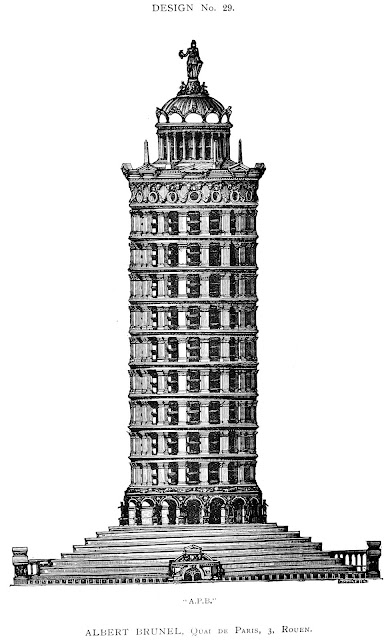
In preparation for such a day ,I've scanned and whitepointed all 68 towers from Descriptive Illustrated Catalogue of the Sixty-Eight Competitive Designs for the Great Tower for London. (1890). Here's the folder. Full text on archive.org, commentary on publicdomainreview. Enjoy!


"Wizards always used to build a tower around themselves, like those ... what do you call those
things you find at the bottom of rivers?"

"Frogs."

"Stones."

"Unsuccessful gangsters."

"Caddis flies is what I meant," said Rincewind. "When a wizard set out to fight, the first thing he always did was build a tower."
-Sourcery, Terry Pratchett

The Columbian Exposition of 1893 also produced some excellent designs intended to out-Eiffel Eiffel, though it's difficult to tell if some of the designs were ever intended to be taken seriously.

Chicago Tribune

A competition held by the Tribune brought a wave of implausible proposals. C. F. Ritchel of Bridgeport, Connecticut, suggested a tower with a base one hundred feet high by five hundred feet wide, within which Ritchel proposed to nest a second tower and, in this one, a third. At intervals a complicated system of hydraulic tubes and pumps would cause the towers to telescope slowly upward, a journey of several hours, then allow them to sink slowly back to their original configuration. The top of the tower would house a restaurant, although possibly a bordello would have been more apt. 

Another inventor, J. B. McComber, representing the Chicago-Tower Spiral-Spring Ascension and Toboggan Transportation Company, proposed a tower with a height of 8,947 feet, nearly nine times the height of the Eiffel Tower, with a base one thousand feet in diameter sunk two thousand feet into the earth. Elevated rails would lead from the top of the tower all the way to New York, Boston, Baltimore, and other cities. Visitors ready to conclude their visit to the fair and daring enough to ride elevators to the top would then toboggan all the way back home. "“As the cost of the tower and its slides is of secondary importance,"” McComber noted, "“I do not mention it here, but will furnish figures upon application."” 

A third proposal demanded even more courage from visitors. This inventor, who gave his initials as R. T. E., envisioned a tower four thousand feet tall from which he proposed to hang a two-thousand-foot cable of “best rubber.” Attached at the bottom end of this cable would be a car seating two hundred people. The car and its passengers would be shoved off a platform and fall without restraint to the end of the cable, where the car would snap back upward and continue bouncing until it came to a stop. The engineer urged that as a precaution the ground “be covered with eight feet of feather bedding.

-The Devil in the White City, Erik Larson


Paleofuture

1d10 Reasons To Build A Tower
1 To loom over your enemies, see them scurry beneath you, and avoid the lamentations of street musicians.
2 Because your rival has built a tower and you simply can't have that.
3 To increase public confidence in your ludicrously ambitious scheme. Spend a million to steal a hundred million.
4 To project something. A bright light, a bubble shield, a weather deflector, or a death ray.
5 A creeping sense of personal insecurity.
6 To escape fog, smoke, smog, forog, frogs, floods, and the peculiar odours of Endon.
7 To show the Hated Foreigner that Endon is the greatest city in the world.
8 To celebrate a centenary / octogintary of an important event.
9 To leave your mark in the history of the world.
10 There's a chronic housing shortage in Endon. You can charge higher rents for a more prestigious building.

New Brighton Tower
Unlike the other entries in this post, this building was actually built, and is probably one of the best industrial wizard lairs I've seen.

2023/02/01

Playing with Scale

RPGs have a tool available to almost no other form of expression. They can play with scale.

Literature struggles with this concept. Gargantua and Pantagruel seem to change size to suit the scene, without ever visibly growing or shrinking, but they are still giants. The reader can refer back to previous sections, or consult illustrations, and see the incongruity, fixed on the page in black and white. 

Animated films can approach the fluid scale shifts of oral storytelling, but it’s a pale reflection of the powers available in the theater of the mind. Some video games play with scale, but it’s usually more about perspective and not about a sense of reality.

But the spoken word flows without hesitation. It does not paint a fixed picture in the minds of listeners. It suggests outlines and details. The listener doesn’t have time to engage with the story in a fully rational way. It just “makes sense” in the moment. Unless incongruities of scale are used for comic effect – more on that later – the audience simply accepts them as true.

RPGs usually try to avoid scale ambiguity. Distances are given in conventional measures. Maps are pretty close to the territory. Clarity is useful. An RPG has to create a shared imaginary vision. If everyone around the table is imagining different things, chaos and frustration are inevitable. “Can I hit it from here?” “Wait, I thought you said the corridor was wide enough for both of us to walk next to each other?” “The fireball hits all of us for how much damage!?” Etc.

OneD&D Virtual Tabletop development preview.

In extreme cases, battlemaps with miniatures (either in real life or virtually) represent the scene itself. The GM’s descriptions take a backseat. What a wonderful opportunity for monetization! What a convenient flattening of the imagination!

But consider an RPG that deliberately plays with scale. Not just nonstandard scales, like Mouseguard, my Flame Pomerium concept, or Arnold K's fractal complexity, but the very heart of what things are and how they are related to each other.

Scale Ambiguity in Classical Haida Myths

If we're going to learn to play with scale, we should learn from the best.

Consider this a sneak preview of a potential project. There's so much I'd like to write about that I'm not sure where to begin. Here's a compressed and oversimplified summary.

Haida Gwaii is an island chain off the west coast of Canada. Like Tasmania, it exists in a blind spot in people's mental maps of the world. If you've heard of it at all, it's probably in relation to totem poles and other art, or for the potlatch.

Through a combination of chance and quiet determination we have "approximately forty thousand lines of written text"[1] from dozens of Haida storytellers, transcribed phonetically, line by line, in 1900-1901 by a 27-year-old linguist named John Reed Swanton. Before European contact in 1774, the population of Haida Gwaii was approximately 30,000, inhabiting villages all over the islands. By 1900, between 350 and 800 Haida remained, largely in two missionary-dominated towns. That anything at all was recorded is remarkable. That what was recorded includes some of the finest myths ever told - and I do mean ever - is extraordinary.   

The tales are so interesting that, aside from looking into and comparing all avaiable English translations of Swanton's transcriptions, and reading a stack of other books, I'm trying to learn Haida.[2] It's worth it.

[1]. Bringhurst, A Story As Sharp as a Knife, pg. 13. For reference, we have thirty thousand lines of Old English. 

[2] It's... not going well.

Shifting Scales: Mouse Woman

This is not a full story. It’s one story within a larger story, in a cycle of stories. Think of it as a musical theme, like La Folia. You’re seeing a few bars of music.

Again he set off.
After walking awhile,
he saw a small mouse in front of him.
There was a cranberry in her mouth.

Then she came to a fallen tree,
and she looked for a way to go over it.
He let her step onto his open hand
and put her across.

She laid her tail up between her ears
and ran ahead.
Not far away, she went under some ferns.

He rested there,
and something said,
« A headwoman asks if you wish to come in.»
Then he parted the fronds of the ferns.

He was standing in front of a large house.
He walked through the door.
There was the headwoman dishing up cranberries. [1]
She spoke with grace.
Her voice had big round eyes.

After she’d offered him something to eat,
Mouse Woman said to him,
« When I was bringing a bit of a cranberry
back from my berry patch,
you helped me.
I intend to lend you something that I wore
for stalking prey when I was younger.» [2]

She brought out a box.
She pulled out four more boxes within boxes. [3]
In the innermost box was the skin of a mouse
with small bent claws.
She said to him,
« Put this on.»

Small though it was, he got into it.
It was easy.
He went up the wall and into the roof of the house.
And Mouse Woman said to him,
« You know what to do when you wear it.
Be on your way.»

-Ghandl of the Qayahl Llaanas of Qaysun, Someone About to Go Out Hunting Birds, trans. Robert Bringhurst. Ch. 4.2

[1] Bringhurst writes that "It is understood that creatures of the sea, forest, and sky take the form of human beings anytime they enter a domesticated space - that is, a house or a canoe, - and that they dress in animal hides when they enter the wild." (Bringhurst, Being in Being, pg. 272). This seems to be only partially true. Storytellers play with the rules. Is Kuugan Jaad, Mouse Woman, a woman/spirit being who wears the skin of a mouse, a mouse-like woman, a woman-sized mouse, a mouse-sized woman, a spirit, or something else entirely? The answer appears to be whatever is in your mind when you listen to the story.

[2] The irony here is probably deliberate. The setup might lead the listener to expect the skin of a mighty predator, but the result is obviously what it should be; the skin of a mouse that Kuugan Jaad was just wearing.

[3] The dreamlike quality of this sentence is superb. It’s used by multiple storytellers, in multiple contexts, so it’s clearly a good one. See: The Qquuana Cycle, Ch. 1.3.5.3.

We can compare this to the same story told by Skaay of the Qquuna Qiighawaay.

He took an overgrown trail. [1]
After walking for a time,
he saw a shrew.
stopped in her tracks by a fallen tree. 

He lifted her across,
and then he watched her.
She went beneath a clump of ferns some distance off. 

He went there.
He spread the fronds aside. 

There was – yes! – the sewn and painted front of a house.
Then that one said to him,
« Come in and see me, grandson.
The birds have been singing
That you would be borrowing something from me.» 

She hunted through her storage box
And bit off part of something for him. [2]
« Yes, grandson, here it is. »

-Skaay of the Qquuna Qiighawaay, The Qquuna Cycle, trans. Robert Bringhurst, Ch. 3.1.2.1. See also Ch. 4.2.1.

[1] Different “he”, in this story. Different conception of Mouse Woman too. First, she appears as a shrew, which is a whole separate discussion I’m not going to get into here, and second, she’s appeared before in the cycle, where she definitely decapitates someone.

[2]. We don’t find out what she bit off for another 100 lines, give or take. This is part of Skaay’s style, possibly an element of what Bringhurst calls his “hunterly reserve”. He uses the ambiguities of Haida to their best possible effect. 

In the sensible, sanitized, and catalogued book of tales, these stories resemble ATU 75 or maybe 554 (I'm not an expert), where the mouse remains a mouse. Admittedly, a more than usually perspicacious mouse, but still a mouse-sized mouse helped by, and later helping, a human-sized human or a lion-sized lion.

Scale-Dancing: Raven

Raven, the trickster, is the master of scale. “In Nisgha, Tsimshian and Haida oral literature alike, he is forever using peapods for canoes, or carving riverboats from elderberry twigs, or giving other proofs that he has no regard for measurement or scale, whether physical or moral.” (Bringhurst, A Story As Sharp as a Knife, pg. 623).

Before they had even started eating,
he headed toward the woods, they say.
He made ten canoes from hunks of punkwood
and filled them with spruce cones for crewmen.
He put flowerstalks of dunegrass
in the crewmens’ hands for lances.

The fleet rounded the point,
and he walked by the tideline, pointing, they say.
« Iixyaaaaay ! How can it be ?
Canoes rounding the point !
And they bristle with crewmen !»

They dropped their food and flew away, they say.
Then he entered the house
and gorged himself on the bark cakes.
Down on the beach, the canoes kept arriving.
They washed up on shore in a heap.

-Skaay of the Qquuna Qiighawaay, Raven Travelling, trans. Robert Bringhurst. Ch. 5.2 
In some stories, Raven is a meta-storyteller, unable to tell stories but able to influence the story he's in.
The one who hooked him hauled him in
and came ashore
and gave him to his child,
and they skewered him for roasting.

When his backside started cooking,
he could hear himself thinking, they say.
« Why don’t they run to the edge of the village for something ?»

They ran outside right after that, they say.
They left the child sitting there alone.
At that moment, he put on his skin
and flew through the smokehole.

The child started crying for its mother.
« Mommy ! My dinner is flying awaaaaay !»

-Skaay of the Qquuna Qiighawaay, Raven Travelling, trans. Robert Bringhurst. Ch. 5.1


Raven is thinking of himself in his own story, like a dreamer. This is one of Raven's names Nangkilslas, He Whose Voice Is Obeyed (The Haida, Swanton, pg. 28). He speaks/dreams what will happen and it happens. I'm sure something like this has happened in your dreams. See also: Through the Looking-Glass, Lewis Carroll, Chapter IV.

UBC Display

Impossible Visuals: Humpback Whale On A Stick Edition

Next day early in the morning, he heard an eagle scream.
He went outside to look, they say.
There was something set up in front of the house.
Eagles were perched on it in a row.
They were calling each other
and sharpening their talons.

Then they went out hunting.
Later in the day, they came back in.
Some of them were carrying spring salmon.
Others were carrying red snapper.
Others had humpback whale.

-Ghandl of the Qayahl Llaanas of Qaysun, The One Who Got Rid Of His Nine Nephews, trans. Robert Bringhurst. Ch. 3.2.
The 50' long humpback whale is used as a scale-based punchline in a number of Haida stories. You can hear the timing. “Some of them were carrying spring salmon.” Normal. “Others were carrying red snapper.” Again, normal. “Others... had humpback whale.” Uproarious laughter, small children falling over, etc. 

But it's a joke, not a lie. The incongruous whale, in the stories, is transported, carved up, speared on sticks (The Qquna Cycle, 1.1.2.5), etc. It's a mental paradox. It's possible to imagine but difficult to visualize.

Mutable Terrain: The Mallard Stick

She was angry after that.
Swinging something long and thing,
bluegreen for half its length,
she gave the town a whack.

The town of Qquuna lurched and tilted partway over.
Then he walked outside
and stomped it back in place.

-Skaay of the Qquuna Qiighawaay, The Qquuna Cycle, trans. Robert Bringhurst, Ch.3.3.3. See also Ch. 1.2.1.3. 

Once again, it's easy to imagine but difficult to visualize a town tipping on its side.

Then he went behind the screen again,
and he pulled up the trap and folded it flat.
The same with the house.
Then he set them by the lakeside
and rolled them up together with the lake
And put the bundle under his arm.

He climbed a tree that used to stand beside the lake,
and halfway up there he sat and waited.

-Skaay of the Qquuna Qiighawaay, Raven Travelling, trans. Robert Bringhurst. Ch. 2.3.4

Raven steals a whole lake. Who steals a lake? See also Isaiah 34:4. It's a bit easier to imagine a lake being rolled up compared to the sky. You can assume grass is below a lake, but what's behind the sky?


Implementing Scale Ambiguity

RPG systems are largely defined by what they consider important and what they consider unimportant.

OSR-type games are probably not the best vehicle for the concept of scale ambiguity. How many Hit Dice does a whale have when it can be stored in your back pocket and also contains a village and it's one whale and it's The Whale and it's your maternal aunt? 

This isn't the anxious pattern-shifting of my Drow posts, where the players are on the outside looking in. For this concept to work, I feel like it has to be available to everyone.

A custom PbtA system? Digging up a copy of How We Came To Live Here? Fate, maybe? Aspects could be a handy dodge for scale issues. A lot of mythology-based RPGs seem to take a superheroes-in-togas approach to mythology, which feels like it wouldn't lead anywhere useful. 

I don't know. I'll keep thinking about it.

For traditional RPG/OSR purposes, item-based problem solving is integral to some Haida stories and I will try cover it at some point. There are also some "spells" and "monsters" (note quotation marks) that are well worth examining. 

And, of course, more jokes.

Sghaagya of the Yaakkw Gitinaay
Haida Texts and Myths: Skidegate Dialect, Swanton, pg. 44