In February of 2019, four women accused noted RPG author Zak (Sabbath) Smith of sexual, physical and emotional abuse. Justin Stewart (Dragons Gonna Drag) has an excellent summary post of the RPG community's response. I posted my own notes here. You can also read this Polygon article, or this article, or any number of contemporary responses.
If you don't know who Zak is, consider yourself lucky.
Since the initial reaction in 2019, reporting on Zak's activities has been sparse at best. One school of thought says that you should
let this sort of thing fade away naturally. It's like a bad smell in
your kitchen. Turn on a fan, open the window, take out the trash, and
it's gone.
But if there's a bad
smell in your basement, it might be time to call in the expensive
specialists and start digging up pipes. The smell won't go away if you
ignore it. The longer you wait, the greater the potential damage.
If you want something done, and nobody else is doing it, sometimes you've got to do it yourself. I couldn't find a good summary of Zak's post-2019 legal adventures, and I felt one would be useful (since there's some speculation online) so I decided to write one.
The court system does not (in my opinion) reliably generate fair results. If I'd ignore or downplay results where the court "got it wrong", it seems unfair to celebrate times when they "got it right", so merely listing the results of the various lawsuits wouldn't be valuable. Examining the arguments and conclusions presented, regardless of results, is more useful. Providing links to the original documents is better still.
I was aided by the tireless work of someone who seemed to have Zak's worst interests in mind. Someone who relentlessly dragged Zak's personal and intellectual flaws into the spotlight, exposed errors, and presented deeply unflattering arguments.
That person is Zak Smith.

Part 1: Mind Like A Sue-er
Zak announced, many times, that anyone who'd commented on, shared, supported, etc. the original posts was in line for a good legal thrashing, and had better watch what they say. Ideally, people would have to do some of the legwork for him, but still! Lawsuits! So many lawsuits!
Edit 2022/03/16. Additional screenshot for context.
And then he started suing people.
Part 2. Smith v. Ettin
In February of 2019, internet resident Ettin posted a long-form Something Awful-style essay on Zak. You can read an archived version here. With a hearty blend of fact, fiction, self-aggrandizing unhelpfulness, and poop jokes, it fits SA's house style. This (and some past collisions) made Ettin a target, and he was (it seems) sued.
Side Note: this is peculiar, because it's widely accepted that Zak ran "The Dongion", a "satirical" blog featuring a hearty blend of fact, fiction, self-aggrandizing unhelpfulness, and poop jokes. You'd think he'd fit in with the goons. And he did! Until he got banned.
Anyway, I don't know if this suit ever made it to court or formal mediation, or
if the parties settled out of court. The latter seems likely. As part of the settlement terms, it appears Ettin had to post an apology on various forums, delete the article and associated tweets, and hand over some money. Again, none of this is part of a court record that I can find, so it's mostly speculation.
Posters on SA responded to Ettin's apology with the grace and quiet dignity of a pack of howler
monkeys on amphetamines. The thread was moved to SA's ambitiously named "Comedy Goldmine"
section and archived. Zak repeatedly replied to his critics with a copy of the apology for most of 2020.
Ettin's subsequent GoFundMe raised around $7,000. Since Ettin said "All my costs have been covered", I think it's safe to assume Zak walked away with somewhere between $2k and $5. It could be more (if "costs" just included legal fees), but it'd be unusual to settle for a huge payment when gambling on a lawsuit would be cheaper.
This settlement appears to be Zak's only triumph to date.
If that seems like a whole lot of squeeze for not a lot of juice, just wait.
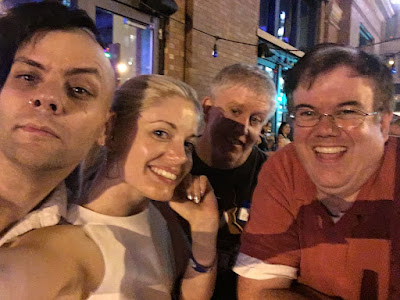 |
Zak (left) and Mike Mearls (right)
|
Part 3: Smith v. Mearls 20-2-15294-7 KNT
Documents available here (backup here) courtesy of Law Orc.
Back in 2014, Zak was invited to consult on the next edition of Dungeons and Dragons, as part of (effectively) market research on the up-and-coming Old School Renaissance. For Mike Mearls, this was probably a totally innocuous part of game development that should have begun and ended with some comments on a PDF.
Instead, six years later, it lead to this lawsuit. Once Zak is in your life, it seems you won't ever get him out.
On to the lawsuit. People seem to expect legal documents to be full of jargon and deliberately confusing language, when, if they're written well, they are extremely clear and linear. Their clarity can be intimidating. Blog posts and novels can be vague and meandering; anything submitted to court should cut like a razor to the heart of the issue. I encourage you to read the documents in full.
A good response boils away everything superfluous, rendering a clear path for the court. Here is what I want the judge to do. Here are the core rules. Here are applicable situations where past judges, faced with the same situation, and in the same region, came to the decision I want this judge to make.
The documents filed by Zak's lawyer... do not do that.
Mearls' lawyers cut to the heart of the matter in their motion to dismiss, and they succeeded. Their basic argument is that, even if everything Zak said was true, it's still not actionable. After a few minutes in court, basically the bare minimum needed to read out names and ensure everything is in order, and the suit was dismissed.
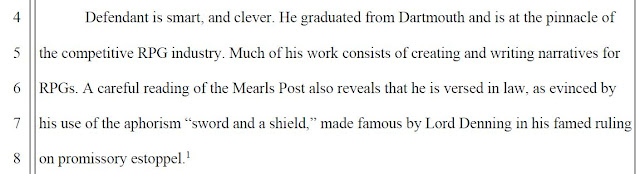
Because this is a blog post, I can take a luxurious ramble through all the arguments Mearls' lawyers ignored as irrelevant nonsense. Take this bit, from Zak's response.
Some of you are probably asking, "what is promissory estoppel"? Some of you, who are smart, and clever, and versed in the law, are probably asking, "what does promissory estoppel have to do with this case?"Yes. Moving on...
Ok, fine. Promissory estoppel is a fancy legal term for "no take-backsies". "Sword and shield" is also D&D term. Lord Denning is dead and I wish I was too. Happy?
I don't know, maybe Zak or Zak's lawyer searched for the term in a legal dictionary and slapped in the first definition they could find, not recognizing that arguing "the defendant knows the law" doesn't really help your main case (i.e. that the defendant broke the law). It's not quite Meads v Meads word salad, but it's definitely not relevant.
This feels like something a lawyer would do when faced with a client with micromanagement tendencies. They're just doing what Zak asks. Sure. No problem. As long as the cheque clears. As we'll see in Part 6, sometimes that approach doesn't merely fail, it backfires.
Tossing in a few cheap shots (like "obscure") is either
a clever tactic to potentially distract the opposition (since obscurity
is not the issue under litigation, and any effort spent disproving the
point is wasted), or just common pettiness.
It's tempting to get sidetracked by, say, examining Zak's adult film career, getting further sidetracked by an incongruous AVN award nomination in 2014 (after a four year gap), discussing the AVN awards voting process,
discussing industry awards and vanity nominations, comparing credits to
see who could have engineered a vanity nomination, using seeded
torrents to compare popularity, digging into adult film revenue numbers for the
early 2000s, etc, etc... but it's just not relevant.
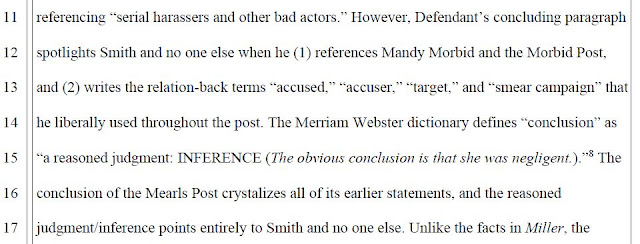
There are a lot of amusing gems in Zak's response, but here's just one more.
Webster's 1913 dictionary defines "confusion" as "The state of being mixed or blended so as to produce
indistinctness or error; indistinct combination; disorder;
tumult."Examples:
"In Zak's response, he confuses the 'conclusion as a termination of an article' with 'conclusion as a synthesis of formal arguments'. He hurt himself in his confusion."
Anyway, case dismissed with prejudice.
Part 4: Smith v. Gen Con 21-2-01684-3 KNT
Documents available here, courtesy of Robert Bohl and Eric Tenkar. Again, I strongly encourage you to read them.
In February of 2019, Gen Con banned Zak. In 2021, Zak sued. The case was also dismissed, for largely the same reason. Here's the opening paragraphs of Gen Con's Motion to Dismiss.
This won't be a shock to anyone who's interacted with Zak online.Let's see what Zak filed.
If you're not aware of how modern art collecting works, this might strike you as an impressive list of institutions. To a certain extent, it is. At some point after WWII, museums and galleries realized that art is a great investment vehicle. For the cost of a warehouse, some shelves, and some archival paper, the institution can place a bet on the future. 99% of the art they accumulate will be worthless, but if even 1% turn out to be early Rothkos, the museum makes money and gains prestige. Most works are donated. Artists get a prestigious line to add to their Wikipedia page (or their lawsuits, for some reason), the museum gets art, everyone is happy.
The fact that a Yale graduate with a lot of charm and hustle has works in a few permanent collections, and displays art in art galleries, shouldn't be a surprise. That's the job. If you're a ditch-digger, you can proudly point to the ditches you've dug, but nobody should be surprised that you've dug them.
It's also largely irrelevant to the case at hand, but by this point, that should come as no surprise. Zak's whole opposition to the motion to dismiss is irrelevant. It's meandering, weakly strung together, seems to ignore the concept of linear time, and is demolished by Gen Con's lawyers with what appears to be unusual relish.
Case dismissed with prejudice.
Update 2022/03/16. Zak has announced he is appealing this case.
Update 2022/07/12. Zak's appeal of the dismissal was granted (PDF). It seems to be a procedural thing, as far as I can tell. All the above comments on the dismissal stand. However, in March 2021
"Smith moved for reconsideration, asking for leave to file an amended complaint.
He attached a proposed amended complaint containing additional facts and exhibits and only requesting relief for defamation, defamation per se, and false light."
Basically, as I understand it, he and his lawyer did a poor job (see above) and asked for a redo, presenting new documents. The judge said "nah, still dismissed". He appealed, and the new judge, looking at the new motion (which I do not have access to at this time), said "OK, this might be enough to actually go to trial."
The ruling notes that Zak "was not required to provide evidence showing how the statements caused the specific damages" and that while he "may not have alleged specific facts proving that Gen Con and Adkison knew or should have known that the statements were false, that is not the issue at the CR 12(b)(6) [should we dismiss?] stage." No additional facts are stated in the ruling, just the same allegations more coherently phrased.
The judge, and Zak's appeal, seems to emphasize the damage the GenCon ban did to what could be generously called Zak's career. I'm not sold on the idea. The ban came relatively late in the sequence of events. Zak has been banned from many places over the years and never seems to take it well.
Update 2023/05/15. Zak's appeal has been dismissed with prejudice. Backup of the order here. The document is very short and well worth reading. I suspect the judge in this case was as sick of dealing with Zak's usual tactics as the rest of the RPG community. 
The basis of Zak's appeal of the initial summary dismissal was that evidence linking Gencon's statement to his claimed damages (2.85 million dollars!!) would be provided at trial. Come the trial, Zak was (of course) unable to show any causal link, because none exists, or provide any new facts, because no new facts can be found. Some new opinions were asserted, to what seems to be general confusion and derision. He did provide his full Enemies List to the court, which didn't help either. Zak also ignored sanctions and orders to pay.
In my opinion, this decision, combined with the Zak v. Grey decision, have rendered Zak both figuratively and literally toothless. Anti-SLAPP motions can use Zak's "discovery abuses or violations of this Court's orders," the judge's statement that "it appears that he has sued a number of [people on his enemies list] without factual basis", or that he "demonstrated a wilful and deliberate noncompliance with discovery sanctions by making retaliatory threats to the Defendant and the Defendant's counsel" to, hopefully, shut down any potential shakedown case at minimal cost. Anyone can now cite Zak's own statements in Zak v. Grey regarding the believability of the original posts.
And Zak’s lawyers, present and future, can also review these decisions and orders and decide if Zak is someone they really want to help shakedown random internet commentators for small sums based on a non-existent link between an arbitrary damage value and a few old tweets.
Update 2024/10/02
Zak appealed the dismissal. The appeal was dismissed. The linked decision is well worth reading. As stated above, Zak was unable to provide any discoverable information because, presumably, no such information exists. Zak's reasoning heavily relies on red string and pushpins without any underlying facts, and, it turns out, it doesn't hold up in court.
Since Zak has a long history of ignoring court orders and sanctions, so GenCon may never be able to recover their fees, but at least this chapter appears to be over.
Intermission: Demon City
In July of 2018, Zak launched a Kickstarter campaign for a book called Demon City, with delivery expected in June of 2019.
As of this article, the book has not been finished, let alone printed and shipped.
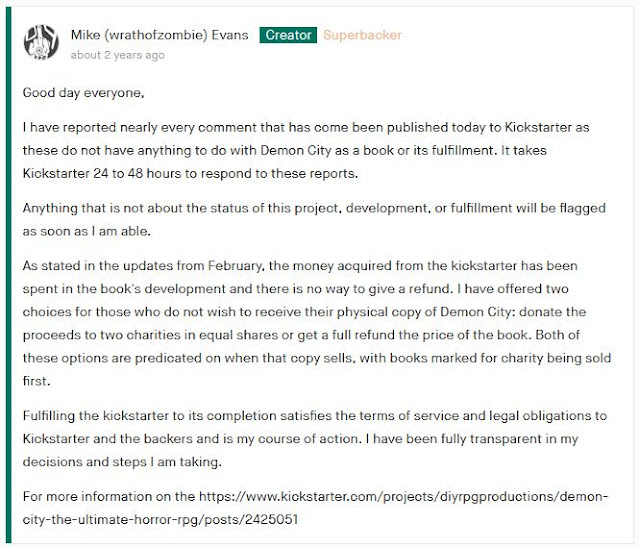
When Mandy, Hannah, Jennifer, and Vivka posted their stories in Feb. 2019, Demon City was the centre of a firestorm of controversy. A number of OSR luminaries had signed on for stretch goals. Some said nothing, some posted about their contributions. Demands for refunds poured in... and ran into a brick wall.
That seems like an unusual funding allocation. If the Kickstarter funded the book's production only (and all the money was already spent), how were physical copies going to be printed? Where's the money to pay for distribution and warehousing? Who's going to pay to print the extra non-KS copies that will then need to sell to generate a refund? Who's been paying for the editing over the last 2+ years?
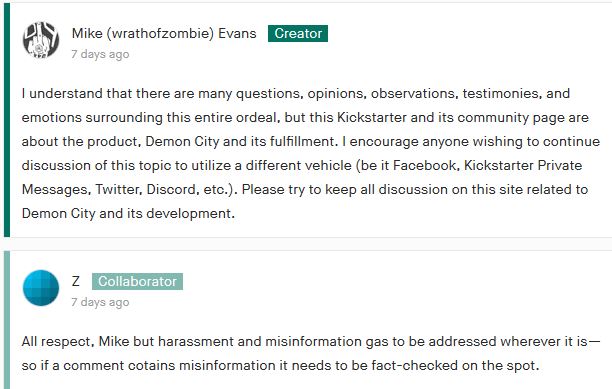
Mike seemed to be grimly set on steering this ship into port. His co-star, the driving force behind the project, seemed focused on other things.
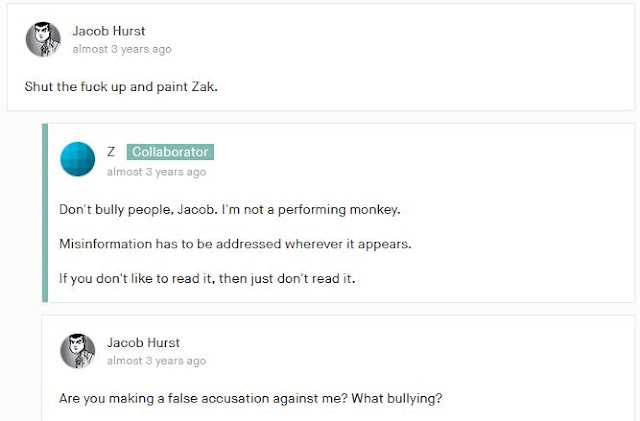
It's not great when someone running a project and desperately trying to moderate the comments section says "stop fighting", and the book's author/artist says "no".
I almost feel sorry for Mike here, but nobody forced him to carry the scorpion.
Presented without comment.
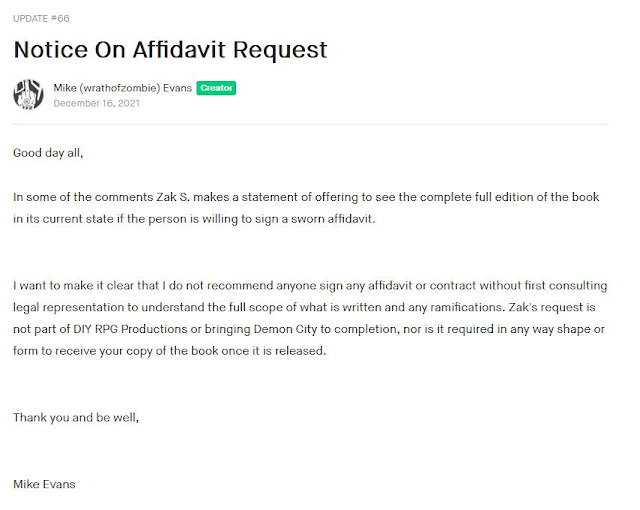
EDIT 2022/03/16. Actually, one comment. The terms of the Demon City affidavit are worth examining. I can't find a copy of it to link to (though I'd be happy to include one), but a backer posted an excerpt (verified by Zak). I'd be especially interested to see what lawyers (if any) attached their name to such a document.
What an interesting agreement.
Tensions between Zak and Demon City editor and Zak fan Jacob Hurst (of Hot Springs Island
fame) also seem high, though Jacob's continued presence on the project
seems odd to me. Mike, I can understand. As the project lead, he's lashed himself to the mast
of this doomed vessel, but surely everyone else could just... quit? Hand
back the money for any work not completed. Heck, if you can afford it,
hand back the whole sum and take the loss; it'd be hard to argue sabotage and bad faith
with a full refund.
Does anyone left on the project really want a credit on Zak Sabbath's Demon City? Really? Why? Even if you accept Zak's proposition that "There is very little room at
the top in the cut-throat entertainment industry of RPG." [sic] (Smith v.
Gencon, Zak's response), which I don't, does this feel like the top?
Part 5: Smith v. Nagy, 2021 ONSC 4265
Link to decision.
In August of 2020, Amanda Nagy filed a SLAPP motion against Zak. The background section of the decision summarizes this case, and it's probably the best place to start.
A Strategic Lawsuit Against Public Participation
("SLAPP") suit is designed to use the legal system as a weapon to silence critics. Several jurisdictions have enacted anti-SLAPP laws to allow for speedy dismissal of such cases. SLAPP motions in Ontario, Canada, have unintentionally turned into high-speed mini-lawsuits, where the
whole proposed case gets litigated before it can get litigated. Unlike a
standard motion to dismiss, there are extra steps and delays, as well
as a higher bar to clear. A dismissal says, "there's no case here". A
SLAPP motion says, "there might be a case here, but it's not worth it."
In this case, the judge determined it was worth it to hear the case in full, and explained process by which they arrived at their decision.
I suspect that any subsequent SLAPP motion has a better chance to succeed. Zak's history of litigation - and threats to use ligation to silence critics - are now trivial to find (even if it's tedious to collate). I'm not sure if Zak's comments constitute "a desire for revenge", but they sure sound like it to me.
"Theyre no better than nazis and should be treated as such" is quite a statement.
It's also difficult to say if public debate was chilled by Zak demanding critics send him sworn affidavits, or offering to send them books if they signed affidavits, or demanding critics send him their full name and place of residence. On the one hand, it's hard to take that sort of thing seriously. On the other hand, it's possible - given the disorganized and confused public knowledge of Zak's legal history - that people elected not to speak up because of the threat of a potential lawsuit.
Describing your opponents via military euphemisms does not pair well with a quest for truth and justice. "Whom shall I target next?" is not, perhaps, the best way to commence a legal campaign.
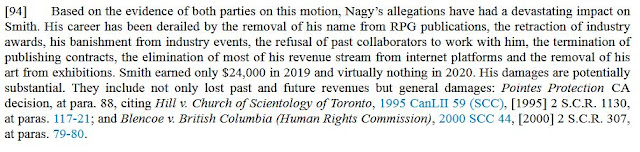
"Smith earned only $24,000 in 2019 and virtually nothing in 2020" is an interesting disclosure.
Merriam-Webster defines "impecunious" as "that scene where the character opens their wallet and moths fly out". It may be difficult for Zak to prove that pecuniary motives don't lie behind any subsequent suits... especially since he's openly admitted to it.
EDIT: 2017/03/17
I finally tracked down another comment.
Once again, I've got nothing to say.
Finally, the decision notes that Zak has "no [prior] history of using litigation to silence critics". While this may be true, he's never shied away from talking about potential litigation. Take this PM to me, for example. You can read the full thread here (and it might be worth it just for the spats joke).
In any case, the judge determined that the case was worth hearing in full, and the SLAPP motion failed. James Cook of Gardiner Roberts LLP wrote a decent neutral summary of the decision. As far as I can tell, James has no connection to the RPG industry or
Zak's other lawsuits, and may not be aware of the hideous quagmire into which
he's inadvertently stumbled.
Part 6: Smith v. Grey 20STCV09708
Link to Ruling.
The legal background to this case is complex. Zak is suing Vivka
Grey for defamation; Vivka is countersuing, and the two suits are smushed together for convenience. This ruling comes in the middle of that suit, and only covers the issues around a single deposition. This ruling isn't as clear as some of the other legal documents, so I'm going to present a section below with references stripped out. Please consult the judge's original ruling if clarification is required.
The parties have identified non-party Amanda Nagy as a
trial witness for this matter. Amanda Nagy’s deposition was set to take place on July 18, 2021 at
9:30am PDT via remote video conference. “[Grey] intends to ask
questions and elicit testimony at deposition regarding Ms. Nagy’s three-way polygamous sexual relationship with her husband,
Plaintiff Smith, and [Grey].”
On July 28, 2021 at 9:20 a.m., or ten (10) minutes
before the start at Ms. Nagy's deposition, Plaintiff Zachary Smith's counsel,
Henry L. Self III, informed me for the first time by email that nonparty witnesses Charlotte Stokely and Michelle Ford would be attending the remote
deposition.
At 9:26 am,
Grey’s Counsel objected by email to Charlotte Stokely and Michelle Ford being
present at Ms. Nagy’s deposition and met and conferred as to the attendance of
Charlotte Stokely and Michelle Ford. The
parties were unable to come to an agreement.
Grey contends that a protective order excluding all nonparty witnesses
from attending Amanda Nagy’s deposition is necessary. The burden is on Grey to show good cause for
the exclusion of all nonparty witness from attending Amanda Nagy’s deposition.
[...]
Here, in California there is a clear longstanding right to privacy of an individual’s sexual practices. The parties anticipate eliciting testimony from non-party Amanda Nagy as to her “three-way polygamous sexual relationship with her husband, Plaintiff Smith, and [Grey].” Nagy has a privacy interest as to the testimony that the parties anticipate eliciting from her.
Further, though parties and their counsel have a right to be present at a deposition, there is no such similar right for non-parties. In fact, Code of Civil Procedure section 2025 expressly provides that non-parties may be excluded from attending a deposition. Given Nagy’s strong privacy interest in the testimony sought, the Court finds exclusion of nonparties from the deposition is proper.
Moreover, as to Michelle Ford and Charlotte Stokely, additional good cause exists to exclude them from the deposition. Amanda Nagy states in her declaration that “Michelle Ford has sworn an affidavit supporting Zak Smith in his case against [Nagy] here in Ottawa, Canada, and Charlotte Stokely has provided Zak Smith a statement of support.” Amanda Nagy also states that she has “post-traumatic stress disorder (PTSD), officially diagnosed by Doctor David Bakish on February 20, 2020, here in Ottawa, Canada.” Nagy states that “[h]aving Charlotte Stokely, Michelle Ford, or any other non-party, especially other witnesses [Nagy] know[s] personally and that support Zak Smith, is highly trigger for [Nagy] and [her] PTSD.”
In opposition, Smith offers scant explanation as to why Charlotte Stokely or Michelle Ford are necessary at the deposition.
[...]
Here, there is an obvious longstanding privacy interest in the testimony sought in the deposition of Amanda Nagy. The timing of Smith’s last-minute insistence on the attendance of non-party attendees who are testifying against the deponent in another action is somewhat suspect. Moreover, Smith’s opposition to this motion was without merit. Accordingly, the Court finds that some sanctions are warranted.
Accordingly, based on the totality of the circumstances, sanctions are granted in the amount of $1,847.19.
Zachary Smith and his Counsel of Record, Henry L. Self III, are jointly and severally liable and ordered to pay monetary sanctions in the amount of $1,847.19 to Vivka Grey by and through counsel, within thirty (30) days of notice of this order.
This, in my opinion, is the Doom That Came To Sabbath.
If you want to try this greasy daytime-TV-lawyer tactic in
court, you'd normally get your supporters to show up and sit in the
gallery. Maybe the judge throws them out, maybe not, but the
intimidation works either way and is plausibly deniable.
Trying it on a zoom call? That's... ambitious.
It's absolutely transparent what Zak was trying to do, so transparent that the judge tossed sanctions at both him and his lawyer. Judges don't like surprises. Judges don't like bogus reasoning. Judges don't like intimidation. Qui maledixerit feritor, as the well known legal maxim goes. Anyone who wishes to formally cite Zak's bullying, harassment, and generally bad
behavior can use this ruling as an example.
Edit 2022/03/16: I missed a second ruling in this case. Link. This one is more of a procedural ruling, determining if a portion of the combined defamation case can go forward. There's not too much of general interest. Vivka's portion of the defamation suit seems to have sufficient grounds to proceed, but the "Intentional Infliction of Emotional Distress" portion should be smushed into the defamation portion under California precedent.
Zak's lawyer for this case is "Henry L. Self III". Amazingly, this isn't another Zak sockpuppet account. Irony is dead and we're living in its remains.
Update 2023/03/07 - Smith v. Grey 20STCV09708 Decision
The decision is here.
So, Zak has won a lawsuit... but the manner of victory and its results would make even Pyrrhus of Epirus wince at the cost. Of the eight allegedly defamatory statements against Zak evaluated by the court, six were found to be true, one was found to be nonactionable opinion, and one was found to be false. But one is all you need, so Zak won... $1 and court costs (not his legal fees, just the procedural fees paid directly to the court).
Why
is this all coming out now, in 2023? As far as I can tell, it's because
Zak announced a reprint of a book and then started publicizing his
"victory" via assorted minions. And if you believe his narrative, it's a flawless victory. But if you read the decision... it's really not.
I strongly recommend reading the decision. I genuinely cannot imagine having any respect for Zak Sabbath, as a person, after reading it. If you can't be bothered, there's a point-by-point summary on twitter here. There's very little I feel I can add. I'm not sure breaking down the decision in this post would be useful when you can just... read the decision.
Once again, Zak seems to have his own worst interests at heart. Leaving aside the testimony of others, let's see what Zak has to say about himself.
Here's a convenient image with the completely normal post-trial victory selfie.
If these quotes seem bad out of context, they are, in my opinion, much worse in context. Zak seems to be trying to re-litigate the trial on twitter, using video from the depositions, which is really weird and uncomfortable, and also not how trials work. You had your chance. You won. The ashes you taste are victory.
Vivka Grey has a GoFundMe for her legal expenses, which she says total $560,000. As of this update, she has raised $60,000.
Update 2023/04/18: Part 6.5: Cameron Banks
On 2023/04/16, RPG designer Cameron Banks posted the following on twitter.
As with Smith v. Ettin (Part 2, above) this appears to be a settlement, not a judgement. A settlement is not the result of a judge ruling on the merits of a case. A settlement is the result of lawyers agreeing on a way to prevent a lawsuit from happening (or stop one that's in progress), for reasons that could have nothing to do with the law and everything to do with the cost of going to court. Zak refers to this as "winning a lawsuit", but that is, in my opinion, misleading.
Additionally, thanks to the Smith v. Grey decision, anyone who wants "proof [Zak] did anything wrong" can potentially cite Zak's words or the court's findings.
Part 7: Next Steps
It seems unlikely that Zak will quit. It does not appear to be in his nature. The smell in the basement will linger. But at least the lights are on, and we need no longer fumble in total darkness.
Since February 2019, I will take any
opportunity to talk to any lawyer, especially in person--former judge,
current DA, public defender, divorce lawyer, patent lawyer, someone on
the side of a bus, whatever. I buy them lunch and ask them questions.
-Zak
Watching a person with strongly felt and dubiously coherent legal grievances rant at an unrelated legal professional lured into lunch under false pretenses is painfully awkward. It's like meeting a dentist while shopping and showing them your rotten teeth. Nobody wants to see that! Put them away and book an appointment like a normal human being.
Also, most good trial-hardened legal professionals will refuse (out of pride or self preservation) to offer anything close to an opinion on any subject outside of their full control. You might think they're confirming your statements, but if you boil it down, they're making noncommittal noises. I can't imagine Zak, in person, is somehow able to present his arguments more clearly than he can manage in court. Oh well.
Poor unsuspecting lawyers of the Los Angeles area. Good luck out there.
Final Notes
I've tried to cover all
the cases and rulings I can find. If you find others, post a link in
the comments or write your own post. If I've made any significant errors, let me know. If you find any particularly amusing or relevant details in the documents that I've missed, post them too.
Mandy has a GoFundMe for legal fees. As of this post, it's raised $12,561 with a goal of $20k.
Zak (via a proxy) also has a GoFundMe for legal fees. As of this post, it's raised $3,029 with a goal of $20k.
I
am not a legal expert (if the commentary above didn't make that clear).
Nothing in this post should be construed as legal advice.