2022/03/01

OSR: Legal Spells in Endon

Loxdon College has 1,000 students and, at present, 4 areas of study.
-History / Literature / Politics
-Law
-Medicine
-Magic

Why, in a game where you could be a Wizard, would anyone choose to be a Lawyer? 

  • The pay is better.
  • Courses are less likely to kill you.
  • The finer details of promissory estoppel might give you a competitive edge in business.
  • Friends in the justice system can make minor infractions vanish and major crimes sink into a morass of procedure and delay.
  • You can be a Brawler, Duelist, Thief, or Dandy.

The System

Feel free to skip this bit; it's probably not relevant for actual campaigns. It's nice to have the information in one place though. Obviously, none of this is actual legal advice, or even fictional legal advice.

In theory, the judicial system of Endon is an independent structure that neither relies on the state nor the Monarch. In practice, the judicial system is an arm of the state, prone to the same biases, jealous of its power, slow to change, and lacking both mercy and perspective.

Medical practitioners are divided into Surgeons (who cut into patients, pull teeth, and dispense practical advice) and Physicians (who know medical theory, dispense prescriptions, suggest treatments, and try to avoid touching patients). Physicians aspire to nobility; they consult for a living and their fees balance nonchalance with avarice. Surgeons are workers.

Similarly, lawyers are divided into Solicitors (who draft documents, collect fees, and handle routine legal matters) and Barristers (who study legal theory, appear in court, and avoid direct contact with money if at all possible). Solicitors practice a trade. Barristers indulge in a hobby.

A degree in Law is not required to be a lawyer in Endon, just as a degree in Magic is not required to become a wizard. Most lawyers are members of the Middle Class, though the profession represents one of the few avenues where talent (and skill at social manipulation, and heaps of money) can take a lawyer from the bottom of the Middle Class to the lofty heights of the Upper Class.

Becoming a Solicitor requires a 5 year apprenticeship as a Clerk. A degree in Law lets a student skip all but six months of the apprenticeship... but as tuition at Endon College costs 15gp per Season (not including room, board, and incidentals), while an apprenticeship provides a small salary, it is not a route commonly pursued.

Solicitors deal with clients directly, taking fees and passing them on to Barristers (as "gifts", to maintain the fictional distinction between a trade and a pastime). In a bizzare inversion of the normal social order, Barristers clamour for the attention of Solicitors, hoping to receive cases, revenue, and prestige. 

While Solicitors can only argue in a few minor courts, they cannot lose their status by means other than death. In theory, Parliament could strip a Solicitor of their credentials. In practice, Parliament would probably find it easier to encourage a conviction for fraud, treason, or uncommon affray and assign the appropriate punishment. Radicals, troublemakers, and frauds prefer the Solicitors's role.

Becoming a Barrister is a slightly more fluid process. The Grim Baliol, the high courthouse of Endon, is surrounded by boarding houses and minor courts. A prospective Barrister needs only to show up at one of these courts, build social connections with existing Barristers (usually for about 3 years), and then receive a call to the Bar. A degree in Law grants no special favours in this process, but since students mingle with existing Barristers, build strong social connections, and generally grease the wheels of social mobility.

Unlike other court systems, the Bar in Endon is a physical object, a cylindrical bronze rod buried in the dungeons of the Grim Baliol. Touching it without flinching or fleeing in terror makes one a Barrister.

Some courts (the Court of Last Appeals, the Court of Unusual Inquests, etc.) require Barristers to have a Law degree, arguing that the arcane and weighty matters dealt with by these courts cannot be understood without appropriate training.

After a decade or two of competent work, a Barrister's peers can elect them to the ranks of the Monarch's Counsel, granting them the right to wear silk robes and add the initials "M.C." behind their name. Another decade, and the Minister of Justice can appoint them as a Judge in one of the courts, adding additional robes and a thick wig to their regalia.

No rule prevents women (or sentient trees, or magical constructs) from becoming Barristers or Solicitors. A few Solicitors might, for ideological or financial reasons, accept a woman as a Clerk, but Barristers, buttressed by centuries of traditional bloody-minded obstinacy, are unlikely to willingly admit one to the Bar. The judicial system is a small close-knit club.

Courts and Cases

Minor criminal and civil cases are handled by Magistrates. Any member of the Upper Class with the right social connections and time to spare can become a Magistrate with minimal effort. It is not a prestigious role. Magistrates are not paid. The role requires literacy, patience, and a very basic knowledge of the law. They judge cases "by the book", assigning standard fines or punishments for cases where the evidence is clear. In a Magistrate's court, the word of a Copper is sacred. Some Magistrates are corrupt, some are tyrannical, some are merely filling time.

If a Magistrate can't figure out who is in the right, or feels the details of a case exceed the bounds of their legal knowledge, they can pass the case to any number of specialized hierarchical Courts. There, Judges (who were once Barristers), and Juries (consisting of twleve men of Endon who can be trusted to show up and vote correctly) decide complex cases.

Defendants do not have a right to counsel. Some irritable Judges consider the mere presence of a Barrister to be an admission of guilt; the defendant should simply tell the truth and let the court decide. A lawyer merely introduces complications. With criminal trials proceeding at literally breakneck speed, widespread ignorance of court procedure among Endon's population, and laws predisposed to punish and chastise, trials are treated as a high-stakes gamble for most citizens.

George Cruikshank

Magical Industrial Litigation

Actio personalis moritur cum persona - "A personal right of action dies with the person."

Charges related to strictly personal actions - fraud, murder, etc. - cannot survive the death of the person who committed them. Faking your own death is (of course) merely another charge to add to the list, but actually dying (with witnesses), then returning to life, technically clears a host of outstanding charges and potential legal actions.

However, Dread Necromancy is illegal in Endon. Either you were raised by Dread Necromancy (and subject to the appropriate penalty) or you weren't and are still liable. Attempting to prove you were resurrected by non-necromantic means is likely to irritate a Judge and result in a swift sentence of Horrible Death.

Plot Hooks:

  • A botched charm-like spell have convinced everyone that your professor is dead. He's not (and he's still in his office), but people keep trying to bury him. The effect is weak enough that solid concentration can temporarily hold it off, but anyone not paying attention will interpret the Professor's movements as "spasmodic twitches" or "ghoulish pranks", his voice as "trapped wind", and his notes as the desperate attempt of lazy students to pass a course instead of retaking it.
  • The Archlich Aoraxestave Triumphant has sued the City of Endon for nonpayment of ancient tithes. Ordinarily, the City would refuse on the grounds that the Archlich is undead, but the Archlich has a royal warrant dating from "Time Immemorial" (630 years ago last Thursday) showing that the rights were assigned when the Archlich was already undead. It's a bit awkward. With compound interest, the tithes would bankrupt Endon. Either find a legal way out or permanently dissuade the Archlich.

Dan Peacock

Consensus ad idem - "A meeting of minds."

Contracts require both parties to agree on the terms. Vagueness, deliberate or malicious, can lead to the contract becoming null and void.

For very high stakes commercial contracts, some industrial wizards turn to telepathy to ensure a literal meeting of minds and a fusion of intent. If two parties share the same mind, there can be no disagreement. Non-consensual mind-altering effects are illegal, but nothing in law prevents two or more willing participants from direct communication. Tales of accidental mind-swaps, secrets revealed, personality fusion, and ancestral possession are best left to the Penny Dreadfuls. Ignore the Cult of the Invisible Hand. 

Plot Hooks:

  • The sixty-odd shareholders of the Northern Transubstantial Rail-Away Ltd, a speculative company, decided to vote via telepathy. Something went awry. The sixty-odd-bodied entity that coalesced from the ashes of their meeting house is embroiled in dozens of lawsuits (including alimony, parking offenses, and Moral Crimes by the score), and is either looking for swift justice or a way to separate its constituent minds and memories.
  • Someone is making a fortune by detecting correlating traces of telepathic magic and the location of business magnates to potential mergers and sales. Seems like a good way to get rich; find this person, steal their system, and retire.
  • One of Endon's Wackit teams (the Knickertwisters) might be using telepathy to coordinate plays. This isn't technically against the informal rules of Wackit, but it threatens to split the league into Sorcerous and Mundane branches. Many scions of the Upper Class play Wackit; telepathic access to their secrets might tempt a rogue (or a law student) into crime.

"A living flesh and blood sentient man"

The definition of "person", in most of Endon's law dictionaries, spans a dozen pages, includes a half-dozen contradictions, and is generally as useless as a law dictionary's definition of "obscene material". Judges know a person when they see one. 

The general consensus among wits and Barristers is that a person must both 1) be capable of wearing trousers and 2) understand the concept of paying taxes. A Dragon could (in theory) wear trousers and could (in theory) pay taxes; therefore a Dragon is a person under the law. A Goblin could wear trousers, but cannot (and Barristers have tried) understand the concept of paying taxes. A Goblin is therefore not a person. 

Entities of nebulous personhood who wish to participate in Endon's legal system can sign a declaration stating that they are a "living flesh and blood sentient man" for the purposes of Endon's laws. Judges treat such declarations with deep suspicion, but usually accept them. Notorious voting rights campaigner Edwina Thurnsby attempted to use such a declaration to vote in a Parliamentary election and was charged with Treason, but eventually found guilty of Mere Lying, paid a small fine, and returned to campaigning.

  • Thord is a Flesh Golem. Thord is made of several bits of dead people (including a few criminals). Thord, as far as any wizard can tell, was not raised by Dread Necromancy. As your final class project, you must assist with one of three lawsuits surrounding Thord. 

1. Defend Thord against a charge of Not Being Alive. 

2. Thord's creator is suing Endon for imprisoning Thord, thereby depriving Thord's creator of his property without due process.

3. Thord is suing Thord's creator, arguing Thord is not property.

  • Your Professor suspects Thord is a publicity stunt engineered by the Resurgent Golem Company. But how to prove it?
  • Your Professor is also a Flesh Golem and doesn't want any competition. You know, your classmates know, the Judiciary is blissfully unaware (and unlikely to believe any evidence, as the Professor is a long-established member.). Is Thord aware?

Duorum in solidum dominium vel possessio esse non potest - "Two persons cannot own or possess a thing in its entirety."

Under Endonian law, a person's soul is a thing owned by a person, and ownership can neither be subdivided nor transferred. Some spirits, demons, and otherworldly patrons may face court-ordered eviction notices. Legal exorcisms are considered an ineffective novelty at best and a fee-generating scam at worst. Still, faced with the prospect of listening to years of civil litigation, a spirit may choose to voluntarily depart for a more interesting host.

  • Armed with bell, book, and fee schedule, you are training as a Legal Exorcist. You toss tenants off their land, ghosts from their graves, and try to put things in their proper place (as the law sees it) by bluff, writs, and mediation. 
  •  Using a Thaumic Prism, a hedge wizard accidentally split a gold coin into two entangled coins. Anything that alters one coin alters the other. No one is sure if this is counterfeiting (illegal), alchemy (legal), or illusionary currency (illegal).

N.L. Morrison

Res ipsa loquitur - "the thing speaks for itself"

Sometimes, negligence does not require proof other than the results. A barrel of flour cannot fall out of a second-story warehouse without some negligence.

This minor legal maxim has taken on new life in Endon. Court-appointed wizards can grant inanimate objects the power of speech. The evidence of the barrel can - if the court so wishes - be heard directly. Deodands can be charged for their crimes. Objects tend to know only information related to their role. A spoon knows it was used to stir liquids; it can't recognize individual people. An object carved with eyes and a face might be more perspicacious.

Plot Hooks:

  • A wizard has a great deal of control over their newly animated object. It's possible - consciously or not - that they are manufacturing evidence from suspicious thoughts and leading questions.
  • Throckmorton Wells wants to put a surveillance gargoyle on every corner. All one needs to do is animate and interrogate the gargoyle; there's no magical upkeep.
  • Echoes of animating spells are bouncing around the Casques of Evidence in the Grim Baliol. While valuable evidence sometimes "walks off" and into a Copper's pocket, there's a risk the euphemism may become literal.

Cornelis Saftleven


Blindspots

Under current Endonian law, spells cannot be patented. Specific magical devices can be patented, though initiations and variants immediately appear, but spells exist in a nebulous region of law and precedent. The case of Scruggs v. Henslow has challenged this paradigm. If spells can be patented, magical innovation in Endon will be changed forever. Wealthy industrial interests on both sides of the case have poured blood and treasure into it for a decade with no result. Law students might be tempted to venture into its sprawling ecosystem of lawyers, clerks, and sub-cases, but Scruggs v. Henslow tends to consume and digest anyone foolish enough to attach their name to the case. It's one of many ticking time-bombs in Endon.

The laws of Endon are explicitly forbidden from dealing with cakes, puddings, or confections. De cuppedium non curat lex; the law does not concern itself with trifles.


2022/01/27

OSR: The Blockchain Mine

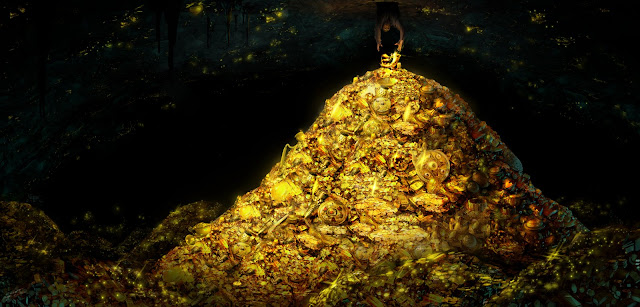
Good morning, and welcome to AdventureGild ®'s Blockchain Mine, sponsored by AdventureGild ®. As a new Adventurer, you may find the Blockchain Mine overwhelming, but don't worry! We are here to assist you in the onboarding process.

Cryptcurrency is this plane's newest and most valuable resource. In the earliest days of exploring the Blockchain Mine, we found huge lumps of cryptcurrency lying on the ground. We didn't know what they were worth at the time! Silly us. 

But now, we know that cryptcurrency is a wonderful, magical, and immeasurably valuable substance. Let me give you an example. Your local lord taxes you in gold, labour, or goods, but cryptcurrency is none of those things, and therefore cannot be taxed! That's right; every bit of cryptcurrency you mine, you keep!

As we delve deeper into the Blockchain Mine, cryptcurrency has become more scarce. But don't worry! Studies* show that it is not possible to delve too greedily or too deep, so keep on mining! Remember that any cryptcurrency you mine today will be worth more tomorrow, as supplies are constantly decreasing. You don't want to be left behind. This is a regime of natural hyperdeflation.**

Piotr Dura

Mining

Your mining rig (including pickaxes, lanterns, rope, and other gear) can be purchased at any AdventureGild ® location using gold pieces. Only certified rigs are permitted in the Blockchain Mine. A basic rig might not let you mine cryptcurrency fast enough; invest (your gold) in high-quality enchanted gear.

Serge Pricing

The Blockchain Mines are cold and damp. An outfit of thick serge is mandatory, and can be purchased at any AdventureGild ® location using gold pieces. Serge pricing fluctuates with demand, so try to purchase your outfit when demand is low, and resell it when demand is high. Remember, once you're in line you're locked in, and must purchase or sell at the market value when you reach the front of the line.

Alex Brock

Proof of Stake

In order to enter the Blockchain Mine, you must present proof that you own a sturdy wooden stake. Vampires are common in the lower levels. Stakes can be purchased at any AdventureGild ® location using gold pieces. Only certified stakes are permitted in the Blockchain Mine.

Proof of Work

To ensure complete transparency, all activities of Adventures in the Blockchain Mine, and all purchases made with cryptcurrency, are recorded in a series of immutable ledgers. Since these ledgers are large and heavy, they are stored in a locked warehouse near the Blockchain Mine. You, or any other Adventurer, can view any record at any time.  

Forks

Instability within freshly mined lumps of cryptcurrency can, in rare cases, trigger a Forking Event. Duplicates of Adventurers, cryptcurrency, items, and memories may occur. If you encounter a copy of yourself, the Blockchain Mine suggests you fight to the death to establish which version is correct. Collaborating with a Forked duplicate is strictly prohibited. Rugged individualism is the watchword of the profitable Adventurer.

Non Fungal Tokens

To validate your identity, and for fashion purposes, Adventurers are encouraged to purchase one or more Non Fungal Tokens from other Adventurers or from any of the stalls near the edge of the Blockchain Mine. Most Non Fungal Tokens are discs of wood, lacquered to prevent mildew, and attached to a handsome linen cord. Though they may superficially resemble each other, each NFT is unique, and can be used to identify the wearer. Thanks to variation in wood texture and lacquer colour, some NFTs are rare and extremely valuable.

Remember, in the Blockchain Mine, possession is ten tenths of the law. Do not lose your Non Fungal Tokens.

If you'd like to set up your own Non Fungal Token stall, please purchase an access permit from any AdventureGild ® location using gold pieces, and pay the Ghast Fee for each Token you create.

Igor Krstic

Ghast Fees

Transfering cryptcurrency from one location or person to another angers the Ghasts, who must be propitiated before the lump can be transferred or moved. They are usually satisfied with a small portion of cryptcurrency, but the hunger of the Ghasts is unpredictable.
 

The DAO™

A Deified Axiomatic Organism, the DAO™ lurks in the Innovation Pit. Anyone who owns a Governance Token (which can be purchased at any AdventureGild ® location using gold pieces) can vote on proposals. The DAO™ senses the intent of your soul and translates it into soundforms.

The murmuring of the DAO™ is interpreted by AdventureGild ® Peacelocks. Don't worry; the AdventureGild ® promises to faithfully obey the will of the DAO™, which is really the will of all Adventurers. 

Sacrifices to the DAO™ are held on Tuesdays and Thursdays at 5:30pm.

Unknown

Cryptcurrency Exchanges

You may have noticed that most items required to work in the Blockchain Mine can only be purchased with gold pieces, not cryptcurrency. Don't worry! You can exchange your cryptcurrency for gold pieces at the AdventureGild ® Exchange Hall.

Please note that all cryptcurrency is not equally valuable, and must be graded before exchange. An exchange fee will also be charged, in addition to the portion taken by the Ghasts. Exchange rates are subject to change at any time without warning.

Also, while cryptcurrency cannot be taxed, any gold taken from the Blockchain Mine can (and will) be taxed heavily. Why not leave your earnings in their natural form; lumps of cryptcurrency!

The Wyrms of Service

If you feel dissatisfied with conditions in the Blockchain Mine, please consult the Wyrms of Service. Remember, you're not a worker, you're an Adventurer! Workers have rights; Adventurers have opportunities!

Arthur Rackham

Inspecters

If you experience a critical mortality event in the Blockchain Mine, you may be eligible to become an Inspecter, and record Adventurer activities in the Proof of Work ledgers. Inspecters wear the Blockchains they forged in life; how fashionable!

Smart Contracts

By reading this contract, and entering the Circle of Protection Against Fear, Uncertainty, and Doubt that surrounds this location, you have automatically registered as an Adventurer! Congratulations! Please submit payment (in gold pieces) into the box below. 

Thank you, and good night.

*Studies is the given name of an imp conjured AdventureGild ® Peacelocks and should not be interpreted as evidence of actual studies.

**As opposed to a regime of unnatural hyperinflation, such as Kiel Chenier's Blood in the Chocolate***

***If you know, you know. If you don't, you really don't want to know. 


2022/01/25

Film Notes: Ascension (2021)

Ascension (2021) is one of the best films I've seen in the past decade.

Tradition

Holy Scripture presents a kind of mirror to the eyes of the mind, so that our inner face may be seen in it. There we learn our own ugliness, there our own beauty.

-Pope Gregory I

I'm not an expert in direct cinema / cinéma_vérité or whatever you call observational cinema. Comparisons to the trilogy of Chronos (1985), Baraka (1992), and Samsara (2011) are inevitable, but Ascension comes off very favorably. Samsara is a coffee table book. A tourism film. It's apolitical guided meditation. It's about the world, but it's not of the world.

Ascension is less frenetic and less spiritual. It resembles Le Sang des bêtes (1949). The camera doesn't blink, doesn't look away. Le sang des bêtes is no more about blood than Ascension is about plastic packaging... and no more about France than Ascension is about China.

The eeriness of the everyday. The unexamined world. Ascension is full of small details. Tiny gestures. Adjusting a collar. Idly rolling a pen. Layers of theming. Skin tones. Hair. Screens. Plants. Water. Plastic bags, wrapping and unwrapping. Fixation. Control. In comparison, the theming and transitions of Samsara feel clumsy and detached.

I'm not doing a very good job explaining it. Whoever you are, and whatever you believe, you'll have something to talk about after watching Ascension.

Tone

There's no artificial grain or tint (see, in contrast, Steel Town (2016)). There's no grey-green dystopian filter. Colours are bright and real without being oversaturated in editing. 

And it's so well framed! There's real craft on display here. This is Jessica Kingdon's first feature film, though her short film Commodity City (2017) showcases some of the same techniques and themes.

The soundtrack by Dan Deacon is good. It doesn't rely on its discordant tones for impact. It supports the film without steering the viewer. It's nice to see that Dan is still involved in interesting projects.

Maybe Ascension has power because it feels real and relevant, in this age of sequels, remakes, back-catalogues, aging risk-adverse producers, and permanent nostalgia.


Context

To what degree should direct cinema be supported by outside commentary? Does knowing more about the filmmaker's background and motivations make the film more interesting, or is it purely optional? Clearly, other people have had the desire to dig deeper after watching Ascension. Like any thought-provoking documentary, the film feels unbelievable. Was any of the dialogue scripted or prompted? Are the participants aware they are being filmed?  How was the camera hidden? In a world where cameras are ubiquitous and everyone expects to be filmed at all times - for surveillance or for marketing - does it really matter?


Final Notes

Ascension made $17,000 at the box office. I know 2021 was a bad year for films and theaters, but that seems ridiculous. You can (and probably should) watch it online at one of these festivals.

2022/01/17

40k: HamWarmer 24.5 Update - v0.4

Here's another round of updated HamWarmer 24.5 PDFs. Testing will continue until I lose interest, civilization collapses, or I achieve perfect balance.

I'm reasonably happy with the results so far. Alternating activation makes the game feel much more dynamic. It's trivial to put together a list.

Patchnotes:

  • Units no longer collide during the Fight Phase, then mutually decide to flee in the Morale phase.
  • Tau do more Tau Things for the Tau Empire.
  • Psykers made slightly less scary.
  • Units can now Infiltrate on Turn 1.
  • Carnifexes move at a sensible speed.
  • Synapse ranges tweaked.
  • Many points cost changes.

And finally, here are a few pics from a test game.

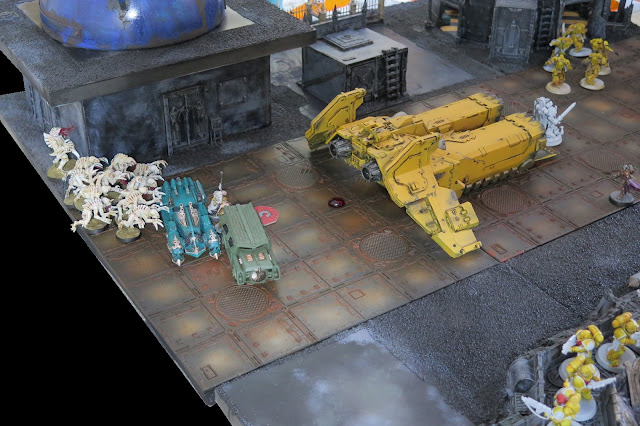
The scenario pit the Imperial Fists against a Tyranid invasion force. Four groups of civilians were trying to escape a doomed spaceport. The Imperial Fists scored points for each shuttle or vehicle that successfully launched, and the Tyranids scored points for each civilian devoured.

Sneaky Genestealers attempt to seize an objective, but the civilians escape just in time, exposing the Genestealers to devastating bolter fire.


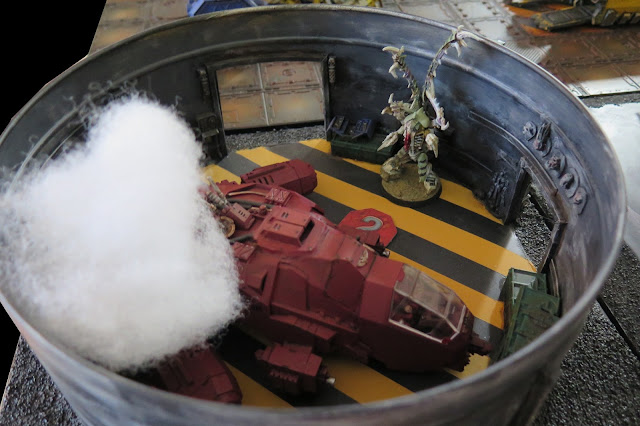
Meanwhile, Spore Mines rain down on the battlefield, inflicting a few superficial injuries but ultimately doing little to deter the Astartes.

A Lictor destroys one shuttle, but it is a minor victory for the Hive Mind. The majority of the precious biomass in the spaceport escapes... for now.

2022/01/15

40k: Tyranid Swarm Completed

The Tyranid project I started in late 2020 is finished.

The prospect of an upcoming game (in person! With a real living human!) spurred me to finish the last few squads in two marathon sessions.

Every model in this army was purchased second-hand. The vast majority (including all the 'gaunts) had to be stripped and repainted. Still, the final results are worth it.

The original scheme was inspired by Marco Schulze's Hive Fleet Ouroboros, as seen in Forgeworld's book The Anphelion Project.


120 Termagants, 3 Pyrovores, and 1 Tervigon.

20 Gargoyles, 2 flying Hive Tyrants (one based on the old Forgeworld kit, one in plastic), 3 Lictors, and 8 Zoanthropes (including 6 Alien Brain Larva from Trollforged Miniatures).

60 Hormagaunts, 1 Tervigon.

32 Genestealers, 2 Broodlords, 1 Carnifex.


9 Raveners, 1 Trygon, 1 Slitherer (Red Terror), 3 Venomthropes, 1 Toxicrene, 3 Biovores, 24 Spore Mines, 1 Barbed Hierodule.

3 Hive Guard, 6 Mucolid Spores, 2 Carnifexes w. Crushing Claws, 2 Carnifexes w. Quad Devourers, 2 Carnifexes w. Twin Venom Cannons, 3 Tyrant Guard, 9 Ripper Swarms, 20 Devilgants, 1 Hive Tyrant w. Venom Cannon, 1 Hive Tyrant w. Quad Boneswords, 1 Warrior Prime, 9 Tyranid Warriors.

Painting Recipe:

  • Black primer.
  • Airbrush chitin in Vallejo 71.023 (Hemp). Highlighted up with a few drops of green and white
  • Airbrush carapace in Vallejo 71.075 (Sand Ivory). Highlighted up with a few drops of white.
  • Ink with Vallejo 73.300 (Sepia wash).
  • Drybrush carapace with Pallid Wych Flesh.
  • Touch up chitin with a 1:1 mix of Pallid Wych Flesh and Castellan Green.
  • Tongues and biomorphs in Xereus Purple, Pink Horror, and a dilute layer of Flesh Tearers Red.
  • Teeth, eyes, and biomorphs receive a wash of Gloss Nuln Oil.
  • Base in a 1:1 mix of Vallejo 26.809 Industrial Thick Mud and Vallejo 28.807 European Mud.
  • Touch up base rims.
If you can't paint so hot, paint a lot.

2022/01/10

40k: HamWarmer 24.5 - Tau

HamWarmer 24.5 is my wobbly homebrew ruleset for Warhammer 40k games. Here's my take on the Tau faction.

Adrian Smith

Tau PDF (v.0.1)

The goal of this project, aside from simplifying the rules, is to make every army feel "right". Space Marines should feel like armoured posthuman warrior-knights. Tyranids should feel like a horde of ravening space bugs. Tau should feel like a combined arms force that bends (or outright breaks) conventions.

With HamWarmer 24.5, I'd like armies to rely on positioning and tactics to mitigate weaknesses. Screen. Redeploy. Use allies to tie up advancing units. Or, if that fails, just shoot everything before it gets to your lines.

As usual, testing is ongoing. Alternating activations makes Markerlights (and Tau shooting in general) much more interesting for everyone. Markerlight-heavy units tend to fire first (but can't benefit from their own Markerlights), followed by heavy weapons and seeker missiles, followed by everything else. 

I've also integrated some long-forgotten Kroot units into this list. Daniel Cockersell's sculpts deserve better.

If you spot any errors or omissions in the rules, let me know.

2021/12/26

5 More Stupid yet Robust Games for Video Calls

Back in 2020, I came up with a list of 10 games designed for socially distanced gatherings. Turns out that 2021 isn't much different. Oh well.

(And I doubt next year will be better, because it's 2020 too! Ah ha ha ha! Ah hah. Haaa.)

I used up most of my best concepts in 2020, but here are 5 more games to add to the list. They've all been tested.

Criteria

  • Will work over video chat.
  • Cannot require special items, applications, or elaborate preparation.
  • Cannot rely on the physical fitness of any participants.
  • Are not intellectually challenging.
  • Are sufficiently ridiculous that anyone who gets overly competitive will feel a bit silly, yet still retain a degree of competition.

Items
Each Participant Will Need: Several sheets of paper, a marker, and a pen.
Each Household Will Need: A ruler or tape measure, and an umbrella, rolling pin, or walking stick.

A marker is easier to see when held  up to a camera. Pencils will not work; they're too hard to see. The ruler/tape measure and umbrella/rolling pin/walking stick keeps people guessing and promotes interest in the game. Ooh, what have they got planned?

Participants
The games work with up to 20 people, though anything past 10 results in moderate chaos from time to time.

The person organizing the games should commit to them knowing full well they'll look like a damn fool. The organizer can participate in most of the games.

If you've got one uncle who flipped a card table when they lost a particularly close card game, or an aunt who hasn't had fun since 1952 and has no intention of starting now, these games simply won't work. Arguments should be fun, self-aware and performative, not actual fights. As with any game, you need a certain type of relaxed group.

douglasbot

11. The Folded Creature Game

This game depends on 1. The Category Challenge from last year's list and a separate piece of paper. It should be played before the items on the list are revealed or compared.

Depict the second animal on your list using a piece of paper. You cannot draw on your piece of paper, but you can fold it, cut it, or tape it. You have 90 seconds starting now.

Taking it in turns, show your animal to the group. Everyone writes down their guess. You get 1 point for each person who correctly identifies your animal. Anyone who correctly identifies your animal also gets 1 point.

Notes
The joy of the category challenge is realizing you've put yourself in a terrible position. It wouldn't be as fun if the host gave everyone a list of animals. 

Moving your folded animal to assist the judge is technically cheating... but it also leads to lively debate and adds to the fun. Making noises is beyond the pale. You can also try this with the other categories (machines, foods, or musical instruments), though it will be more difficult.

 
12. The Hand Arrangement Game

This game also depends on 1. The Category Challenge from last year's list

Taking it in turns, arrange your hands so that they resemble the third animal on your list. You cannot move your hands once they are arranged. Everyone writes down their guess. You get 1 point for each person who correctly identifies your animal. Anyone who correctly identifies your animal also gets 1 point. 

Notes
This game works well with the other categories (machines, foods, or musical instruments). It's basically shadow-puppets, but without the shadow bit. Everyone cheats and wiggles their hands; it's inevitable.

 
13. The Most Comfortable Chair Game

Draw the most comfortable chair. You have 90 seconds. You cannot write letters. 

Taking it in turns, show off your chair. Players vote on the most comfortable chair. The winner gets 5 points.

Notes
Vaguely based on the prize task in Taskmaster S4E7. Soliciting votes (by extolling the chair's virtues, by threats, or by strategy) adds to the hilarity of the game.

14. The Modified Portrait Game
This is a variant of 4. The Portrait Game
.

Using a marker and a piece of paper, draw a portrait of one person you can see on this video call. You cannot use your dominant hand. You cannot write letters.

You get 1 point for each person who correctly identifies the subject of your drawing. However, if everyone correctly identifies the subject of your drawing, you get no points.

You have 30 seconds starting now.

Notes
The same suggestions and drawbacks apply, but this variant adds a bit of bluffing and deliberately misleading details.
 

15. The Spaceship Game
This is a variant on 10. The Monster Drawing Game.
 

Using a marker and a piece of paper, draw the spaceship I am going to describe. You have 2 minutes to draw the spaceship, starting from when I start describing the spaceship. I will not stop or repeat myself.

My magnificent spaceship has a spherical crew module and three windows. It has a hydrogen fuel tank and an oxygen fuel tank, and two rectangular solar panels, and one more window, and two round solar panels, and a long truss made of triangles. 

It has one big engine and two smaller engines. And it has a spare oxygen tank. And it has a spider-shaped antenna. And an escape pod that looks a bit like an ice cream cone. And the escape pod has a round solar panel. And it has a cube-shaped cargo pod on the end of the truss.

And it has a really cool name, painted on the side. It was sponsored by the USA and Russia and China and Australia, and it is leaking air, and it is crashing into the moon.

Hand your drawing to someone else to mark. You get 1 point for each criteria your spaceship meets. Arguing is permitted. Maximum of 20 points.


Criteria (1 point each):
[Read out loud and get people to put a checkmark for each criteria met, then collate the totals.]

Spherical crew module?
1 Hydrogen tank?
2 Oxygen tanks?
2 rectangular solar panels?
3 round solar panels?
1 triangular truss?
Cube-shaped cargo module on the end of the truss?
1 big engine?
2 small engines?
Spider-shaped antenna?
Escape pod that looks like an ice cream cone?
Total of # windows?
Really cool name?
USA flag?
Russia flag?
China flag?
Australia flag?
Leaking air?
Crashing into the moon?
Sufficiently magnificent?

Notes
Taskmaster task reference (UK S10E09). Pause while describing the spaceship to let people catch up. Really relish each word.


Final Notes

Designing games for video calls is tricky. The constraints make a lot of traditional games impossible. It's a fun challenge, and I'm sorry this year's list aren't quite as good as last year's. Still, more games means more options. Enjoy!

2021/12/21

OSR: 1d20 Ludicrous Taxes

My thoughts on taxes in medieval-ish settings remain controversial. So it goes. Here are some more taxes.

Paranatural (edited)
States traditionally tax things for two reasons. 

1. To discourage something, as part of a broader policy. The state doesn't want everyone to wear imported fabric when local fabric will do, so imported fabric is heavily taxed.

2. To raise revenue. Raising existing taxes is often difficult. Rates are set by tradition; adjust them and people might rebel. New taxes are safer. The state doesn't care how many windows you have. Windows are just a convenient measurement of building size, occupancy, etc... until people start making buildings without windows. 

The second method leads to ludicrous or counterintuitive taxes. If a thing is legible to a state, it has been taxed at some point. To make a setting weirder (but never as weird as real life), take a thing and imagine how a slightly disorganized state would tax it. The more legible, the better. Counting is very legible. Weight and volume are tricky. Emotions, names, etc. are next to impossible.

People will try anything to get out of paying taxes. I remember a vague quote I can't source that goes something like, "Since the poor cannot pay, and the rich will not pay, the burden falls ever on the middling sort." For more information (and things to argue about), see Seeing Like A State (Scott, 1998) and/or The Art of Not Being Governed (Scott, 2009).

1d20 Ludicrous Taxes

1. Distance Tax
Pay for perspective. The state is shrouded in a fog-like effect. Pay to wear an amulet that grants 10', 50', 100', etc. of clear air. Peasants navigate by ropes and painted floors; the rich display art on billboards. Amulets expire monthly.

2. Language Tax
The state wants polyglots. The more languages you can demonstrate, the less tax you pay. Monoglots have to wear a special hat (and pay for it, of course). With fluency in five or more languages, you are exempt from the salt tax and road tax, but have to spend an hour a week instructing the youth (who will lob spitballs at you with unnerving accuracy).

3. Sword Tax
To discourage violence and rebellion, swords are heavily taxed. Maces, bows, cannons, tridents, etc. are not as heavily taxed. Outlandish weapons proliferate. Desperate tax inspectors search for anything that could potentially be a sword, including cutlery, daggers, elves (around the ears), etc.

4. Gravity Tax
Pay up or float off. Your local Civic Mage pours some gravity into you every Thursday if you've paid your taxes. If not, gravity fades over a few weeks until you drift upwards like an untethered balloon. Peasants wear lead shoes and shuffle. Misers and the elderly bounce around indoors, eating off the top of wardrobes. Maybe the entire state is inverted?

5. Vwl Tx
Xpnsv. Brdn flls mstly n wrtrs. Xprmntl vwls.

6. Left Turn Tax
Inspectors on every street corner directing traffic and collecting coins. Continual urban smuggling. Pedestrians unaffected unless carrying more than 20lbs; relay chains sometimes employed on market days.

7. Stair Tax
A prosperity tax without the need for accurate records (in theory). Promotes sprawling buildings, or, where that isn't possible, ladders and bucket elevators.

8. Hat Tax
Hats (or at least some form of head covering) are mandatory (and vital, given the local climate). Arguments over what constitutes a hat, what materials are allowable, etc. dominate all discussions. Hoods are popular among the peasantry, as they are taxed as shirts. Among the nobility, enormous convoluted constructions or shoes with head-sheltering backs proliferate. Tax inspectors are fed up and have started attacking milliners in the dead of the night.

9. Height Tax
The state wants tall soldier-citizens. The state doesn't have the right to ask a citizen to remove their footwear. I'm sure you can work out the rest. Epidemic of broken ankles and bruised foreheads.

10. Frog Tax
The state hates frogs. If you have a frog on the premises, even a depiction of a frog, or even an item that could be mistaken for a frog by an overworked inspector, expect a very heavy fine. The Resistance operates frog farms, smuggles them into the homes of the loathsome nobility. Frog-hunting terriers are prized.

Pieter Brueghel the Younger

11. Colour Tax
Another prosperity tax. How many colours can an inspector see when they look at your house, your clothes, or your place of work? Dyes and paints proliferate. Families choose a shade and slather it on everything. Arguments over hue and tone pit tax collectors against artists and dye-makers. Tax collectors carry painted wood chips for reference.

12. Travel Tax
To discourage emigration and searching for better work (and also to use up a surplus of strong dvangerworm cord). Citizens are assigned a home ring (iron, bolted to the foundations), and are physically tethered to it with cord. Can buy additional 100' lengths of cord for a fee. Cord colours and banding patterns change annually. Streets are a tangle. Doors have gaps. Nobles have carts with miniature houses and portable rings. Anyone without a cord is shunned or mobbed. Foreigners escorted from the border to their residence under armed guard. Lengths of cord lopped off as punishment for crimes. Maximum cord lengths sometimes tattooed on arms.

13. Nipple Tax
A convenient measure of household membership and livestock. Poultry is popular, as are snails. Mutilation doesn't get you out of the tax, but does inspire proverbs and epithets. "Nipplesnipper here doesn't want to pay."

14. Furrow Tax
Fields taxed by furrows, by walking along one end and counting the number of lines. Farmers plough in spirals, ovals, or curls. Same methodology applied to village road layout, with similar results. General cultural distaste for hard edges and terminating lines.

15. Clerical Tax
Polytheism is more-or-less mandatory, since different gods control crop growth, weather, metallurgy, commerce, travel, childbirth, etc. Each quarter, or for a special fee at any time, citizens select the number of gods they wish to invoke and pay the appropriate tax. Priests of various gods are jealous of their own portfolio, yet try to add more domains to increase revenue. Invoking a god without paying the correct tax sometimes attracts divine wrath, as the gods also get a cut (via state-sponsored rites and sacrifices).

16. Infernal Tax
Selling souls (or other services) to a select cadre of devils is culturally acceptable, but in return, the state demands its share. The devils like the arrangement (for both fiendish and economic reasons), and form a shadow bureaucracy. The state trades its share to the devils for additional benefits.

17. Pot and Bucket Tax
Any container that can contain the owner's head is taxed and stamped. Buckets, barrels, pots, and cauldrons develop elongated forms, narrow necks, or simply disappear. Massive wine and oil decanting stations on the border. Pans (with lips shorter than a thumb's breadth) are taxed as shields.

18. Sobriety Tax
Used to maintain the oligarchy. If everyone is inebriated, the sober have a monopoly on clear-headed decisions. Somewhat hampered by the need for skilled labour, the desire of the nobility to get drunk and stay drunk, and constant supply chain issues. Little streams of alcohol trickling from the rocks cause erosion. Burning braziers of herbs in public locations. Probably a bad idea, but all the reform-minded folks are absolutely smashed and can't agree on a course of action.

19. Shoe Tax
Foreign shoes are ruining the state's economy! Foreign nails, foreign leather, foreign fashions! Shoe imports are taxed, forcing most visitors to buy new shoes at the border and ceremonial burn their old footwear (or sell it to eager vendors). Nobles wear additional imported shoes on the end of their regular shoes and display dazzling cabinets of impractical footwear.

20. Tax Tax
A surcharge applied to a household or citizen's tax total, based on the number of taxes paid, the difficulty of collection, and the whims of the tax collector. A tax tax tax is applied to the tax collectors.

2021/12/17

OSR: Unsolved Magic Problems

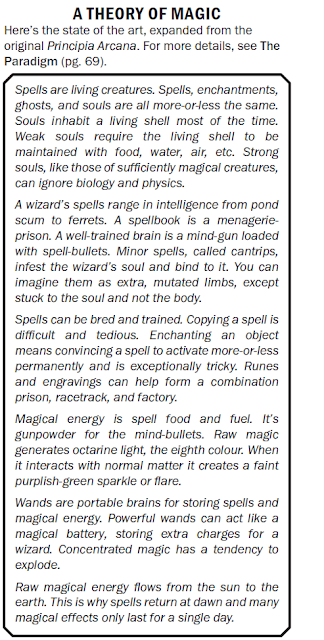
The wizards of Loxdon College have systematized magic. The world of enchantment is legible, via the paradigm below.

Like any decent paradigm, there are exceptions, and these exceptions keep theoretical wizards up at night. Since Endon is an industrial city, theoretical wizards are mostly ignored unless their discoveries are marketable. "Theoretical" does not nessesarily mean "stays indoors and reads all day" (though it often does), but indicates that the wizard in question does magic for knowledge, not for gain.

Unbreakable Curses

Geas-type spells are simple; a blob of spell-stuff attached to the target's soul, watching, waiting, ready to detach or detonate if certain conditions are met. A thaumic parasite, similar to a curse. The stronger the spell, the more difficult it is to disentangle without damage.  Some curses vanish into the target without a trace. There's no differentiation between the target's soul and the spell, and no possibility of disenchantment.

Some theoretical wizards believe that the soul contains echoes of its past forms, and can (under the right circumstances) undergo a sort of reversion or back-transformation. 

Plot Hooks:

  • We need you to kidnap a vampire.
  • We need you to get rid of this vampire we kidnapped. The usual methods aren't working (and it's probably our fault).
  • Are you willing to take a powerful magical oath with paradoxical wording?


Warlocks and Clerics

No law forbids the study of divine magic, but tradition - and common sense - suggest that such research is unlikely to lead to a long and fruitful life. Putting a cleric in a prismatic centrifuge tends to attract divine wrath. The vague consensus is that the mighty soul-stuff of a great power is directly bonded to a chosen vessel's soul, or dispatches specially prepared spell-creatures at selected times. Some wizards believe clerics are merely delusional wizards.

Plot Hooks:

  • We need you to capture two clerics of utterly opposed deities so we can put them in a prismatic centrifuge at the same time. Any divine punishments should cancel each other out.
  • Some scruffy-looking undergraduate wizards with a butterfly net are following you, a perfectly sensible warlock, around Endon. They think they're being stealthy.
Tomas Honz

Druidic Slow Magic

Druids threaten to destroy towns, move forests, cause floods, or withold rain. Sometimes, but rarely immediately, the threatened effect occurs. It could be coincidence, but a magically induced coincidence is still worth studying. Some effects would require megathaums of energy to produce by conventional spells, yet the druids manage it without spectacle or side-effects. A series of small spells? A massive spell, so large and diffuse that it encompasses any ground-level observers?

Plot Hooks:

  • We need you to get in a hot air balloon and fly over the secret druidic hills during the summer solstice. 
  • We need you to rescue a research team. Their hot air balloon crashed in the hills.

Power Word Spells

The classic power word trio of stun, blind, and kill, are, to some wizards, the archetypal offensive spells. Power word stun is so simple and nonlethal that it's used as a sort of magical lab rat by experimental wizards. 

Efforts to breed other power word spells always seem to fail. The lineages are remarkably stable. Minor changes in duration or effectiveness are noted, but they're well within general spellcasting tolerances. Fifty years ago, Marneus Cleept claimed to have created power word flame, but the only copy perished with him (and his tower). Power word pain attracted some attention until it was discovered to be a lightly modified power word stun.

Plot Hooks:

  • We think we've invented power word forget. You can imagine why that might be an issue.
  • Power word kill appears to only work on creatures below a certain mass or level of self-will. Why should this be so? Take this stack of wands and try killing large and dangerous creatures. Record the results in this convenient red notebook.

Non-Existent Mirrors

Illusionists access the Mirror Dimensions through mirrors and octarine light. Reflective surfaces vary, but have included water, mercury, silver, gold, obsidian, and anything else that will hold a glossy finish.

Some theoretical wizards have noted that matter itself bends light. While observing the wandering stars pass behind the sun, the crystal spheres appeared to waver, as if observed through water. The same effect was noted on the edge of spheres of annihilation, particularly ancient and well-fed spheres. By carefully positioning eight spheres of annihilation (eight chosen more for tradition than mathematics) in a ring, it might be possible to bend a beam of light back on itself, creating a mirror-without-a-mirror. No one is sure what will happen, but it could create an unlimited source of raw magic, open a stable portal to the mirror realms, or turn time and space inside-out like a dusty pocket.

Plot Hooks:

  • Please bring us any spheres of annihilation you find. Will pay top dollar, no questions asked.
  • When we added the seventh sphere, flickering mirror duplicates of objects, people, and spells started appearing on campus. We aren't sure if adding the eight sphere will fix the problem or make it worse. Place your bets. Books close at midnight.

Thomas Mahon

Bonus Content: 1d10 Ways To Get A Bunch Of People Into A Place When Only One Person Is Admitted

Originally posted in a comment on this post.


1. Portable Hole
The old classic. Sew it into the lining of your coat. Party climbs inside with a deck of cards, a few pig bladders full of spare air, and a lot of hope.

2. The Back Passage
A variant on 1. People check for portable holes, you see. So if you want to hide it, you’d better put it somewhere nobody wants to look.

3. Dream Key
A silver key on a chain. Antique, heavy. Insert it into a sleeping person’s ear, turn it, and climb into their dreams. All you need to do is time your exit, avoid detection, and avoid the (very real) dangers inside your friend’s head.

4. Waxenbeans
Eat them to turn into a tiny wax figure of yourself for 12 hours, give or take. Let’s hope the monks don’t discard material possessions before it wears off.

5. The Sigils of Conjoined Destiny
You’ll need two logs, scaffolding, rope, paint, and very trusting friends. Rig the logs up like they’re going to strike a bell, except the bell is you (all of you). Paint the sigils (carefully!) on the ends of the logs, ensuring they’ll collide at the correct alignment. Place your heads at the impact site. Release. For up to a week, or until someone catches on and unravels you, everyone hit by the hammer will be one person for the purposes of... everything. It’s difficult to say if you have one body or several bodies, because you’re also subject to the same entanglement.
 
6. Reduction To Essential Salts
Requires a lot of trust a tolerably dry environment. Not anyone’s first plan.
 
7. The Lover’s Gate
One of those ridiculously forlkoric spells every hedge mage claims to know, but which most can’t cast. It’s an old spell, probably older than language. Calls a willing person to your side no matter where they are, provided you have mixed your blood with their blood (or the folkloric equivalent, if you get my drift). Has the baffling tendency to punch through wards, antimagic fields, glamours, and time itself, but only temporarily. The summoned person slowly feels themself drawn back to their origin. For the first few minutes, walking is easy. Then it feels like walking uphill. Then a run. Then a sprint. Then striving against a hurricane until they are torn away, tumbling, back to whence they came.

8. Living Tattoos
For two fat hogs and a barrel of red wine, there’s a man down Treacle Alley who will put you in a flask and tattoo you onto a person’s skin. You can run around in that warm flat world until someone draws you out with a lodestone. No refunds.

9. Dimensional Shivering
The Illusionists invented this once accidentally. You’ll need two full-length mirrors (and I do mean full length, unless you want to lose your feet), a source of octarine light, and ginger (for the nausea). Fold yourself flat. Your friend then rolls you up and slips you into a cigar or a belt. Unfolding yourself is a trickery process, requiring a quartz prism and octarine light (or, in a pinch, sunlight, though you’re likely to come out greyscale for a few weeks).

10. Thomas Contagion
Anyone who eats a piece of Thomas Infolded can, until their spiritual immune system kicks in, ingest other people, in the same manner as Thomas Infolded. Unless you can hover, you’ll also take on their mass and ailments. Imagine they’re standing on the soles of your feet, but upwards. When your body decides that this is wrong and kicks the interlopers out, expect a lot of mess and turmoil.