2023/08/18

OSR: Iron Gates Draft Content: The Arena of Rhen

The Iron Gates is an Alexander Romance / Dark Souls setting guide. After years of (vague and unfocused) development, it's finally reached the point where I can start writing actual content.

If you want to see six pages of very early Iron Gates content focused on the Arena of Rhen, sign up to my Patreon.

This map is a placeholder, as is all the art in the PDF. It's an edited version of these maps from 1532. Names are currently real-world references to help me design the locations, but will be switched to in-setting references.

Layout and Writing

The Monster Overhaul (which is now available, in case you missed it) was written and designed entirely in a layout program. Since monsters followed a standard template, this let me cram every page full of content without worrying about splitting a paragraph over two pages or cutting content. I could choose my words to fit the rows of a table or the width of a column, and design spreads and tools without worrying they'd be mangled in the transition from raw text to final PDF.

This approach had a few downsides. Dai Shugars can produce astonishing and skilful layouts like Moonlight on Roseville Beach and Gangs of Titan City. Forcing Dai to work with my spartan requirements for the Monster Overhaul's layout was like demanding an award-winning chef cook plain rice. Sure, it's possible to screw up plain rice, and if you do you'll really notice, but it doesn't allow much in the way of showing off.


For The Iron Gates, while I'm still creating the book in a layout program, I am not sticking to strict templates. I'm deliberately leaving lots and lots of room for graphic design, art, and revisions. The layout program is a map, saying "I want this information on this page", but the how, the where, and the format will all be left to an expert. This means the current draft pages are hideous.

While the book will still be aggressively utility-focused, I feel that a setting like this requires evocative layout. It can't present the world in a crisp manual-like manner. It needs to ooze secrecy and decay, evoke grandeur and wonder, and generally get the GM into the correct mindset. Washing machine manual layout will not do! 

I can also put zone and theme coding in the background. The pages for Rhen could have a different theme than the pages for Meridia, etc.

Very early world map from 2018.


Structure

I'm designing the Iron Gates as a series of nested pointcrawls. There's a continent-scale city/landmark based pointcrawl, but each city is a pointcrawl, and some locations within each city will be pointcrawls or 1-2 page dungeons.

Currently, the plan is to embed unique creatures within their chapters, instead of putting them in a catch-all bestiary chapter. Gladiators, for example, appear only in the Arena of Rhen. To minimize page flipping, it makes sense to put their stats near the Arena map, in the Rhen chapter.

This choice does run the risk of creating duplicated statblocks. Elephants, for example, show up in the [Carthage] section and/or [India] section in happier circumstances. Where this occurs, the plan is to include a smaller local statblock, with a reference to larger half/full page spread elsewhere for cultural details, extra tables, etc.

Putting the monsters in the middle of location chapters does limit the number of monsters I can use in any one location. I can squeeze 4 monster statblocks onto one page, but two or three gives me more flexibility in layout. The Arena, as one of the major combat-based locations in Rhen, has four monsters and two boss fights.

Obviously, not every location can have 6+ pages of content, or the book would be 700 pages long and hopelessly unwieldy. 

In the draft pages, some words or items are placeholders for thematic links that don't yet exist. I know I want to do something with this concept/item/location, but the other end of the link hasn't been fully developed. 

Loot

I'm testing a new format for items. Loot is important in a Soulslike game. Every item has to have some symbolic weight, some purpose or hint at the nature of the world.

I'm planning to embed loot within a bestiary entries. Some enemies, but not all, drop capital-L-Loot. Some only drop gold. Some drop nothing of value.

Items have a:

  • Material (Gold, Iron, etc.). If it just adds 1 to that character, it's not numbered. If it adds more than one, it's numbered. E.g. Iron II adds 2 Iron to the PC's total. Gold and Iron totals have mechanical effects.
  • Slot / Function (Head, Arms, etc.)
  • AC or Damage.
  • Extra rules.
  • Flavour text.

Items can have a set bonus. You can mix and match Gladiator items and still get the set bonus.

In a perfect world with an unlimited art budget, every item will get a unique non-public-domain illustration. In the real world, we'll see.

Ideally, the items will be printable on cards, like Dave Arneson's original magic swords in Blackmoor.

Bogdan Rezunenko

Minimal Text, Maximum Lore

It's easy to churn out page after page of setting lore. It's much more difficult to get anyone to read and digest your work. The Iron Gates will have as few paragraphs or pages of lore as possible. I intend to ruthless edit the book down to a bare minimum. Can this paragraph be a sentence? Can this sentence be an entry in a table? Can this table be thrown out entirely? 

I may also include real-world quotes, provided they don't contain any information that contradicts the setting.

"Closing his eyes, he forbade his spirit to participate in those evils. And would that he had blunted his hearing! For when he was smacked by the whole crowd's huge shout at some fall in a fight, he was overcome with curiosity and as if prepared to despise and overcome whatever was going on, he opened his eyes and received a more severe wound in his soul than the gladiator received in his body, and fell more miserably than the man at whose fall the shouting happened.... For when he saw that blood, at once he drank up the savagery and did not turn away, but fixed upon the sight and sucked up the madness and lost his senses and was delighted with the crime of the contest and grew drunk on gory delight. He was no longer the man who had come, but one of the crowd, and a true companion of those who had brought him. In short, he spectated, he shouted, he blazed with emotion, and took away with him an insanity by which he was incited not only to return with those who had brought him, but even taking along others in their place." - St. Augustine

Details and Accuracy

The Iron Gates is not a historically accurate setting. It can't be. It's based on the Alexander Romance and In Cath Catharda, and both texts bear only a slight resemblance to reality. 

You know what the Colosseum looks like, but the author of In Cath Catharda doesn't, or when it was built, or why. While writing the setting, I try to imagine what a poorly travelled and mildly credulous 14th century Irish monk would picture Rome or Byzantium, based on the available texts, and work from there.

2023/08/12

OSR: The Mystery of Uriah Shambledrake Session 21 & 22 - A Castle in the Air

In the previous installment, the PCs:

  • Exploded a photograph.
  • Experienced horrible sobriety.
  • Participated in Endon's first ever car crash.

The PCs are:

Tom Shambledrake
Electric Wizard and heir to the bankrupt Shambledrake estate. Inventor of the Lightning Accumulator, the Lightning Inverter, and the Iron Spike. Currently afflicted with a troll arm and eye thanks to emergency trollblood healing.

Jonty Earl
Dandy. Assistant Professor at Loxdon College. Deeply enmeshed in stock-jobbery and financial chicanery.

Dr. Augustus Hartwell

Biomancer. A foreign doctor and self-described "quack", currently employed at Blumsworth Hospital. Ally of speaking rats, workers, and other vermin.

Lizzy Ramchander
Potion Wizard, former cook, former brewer, and current secretary to Doyle Wormsby. Can duplicate herself. Currently part troll as well.

Doyle Wormsby
Civic Wizard, Private Investigator. Broke his arm in Endon's first automobile accident.


Conor Nolan
Tom rushed off to visit George Miles, creator of the flying Mira, and member of the defunct Amateur Aeronautics Society. Miles, terrified by Tom's appearance and vague threats, told him all he knew. It wasn't much. The Society was a club of ambitious wizards. At the dawn of the Magical Indstrial Revolution, they'd seen a future for systematized magic beyond textiles and waterwheels. 

Though intially united by a vision of a utopian magical future, the Society splintered immediately. Miles suspected the Shambledrakes were merely using the Society for their own unstated ends. He didn't know what Tom was, exactly, but knew that the three Shambledrakes had used some sort of time magic in the Society's last tumultuous days.

Edward Konivov and Professort Tallerand left to create The Project. Miles remained noncomittal. His goal was flight and reaching the moon, not immortality, but he appreciated The Project's goals... if not their methods.

Lord Tarrigan-on-Burl had provided most of the funding. He was the mysterious figure who'd vanished from the thaumograph. Miles hinted at some form of truce. Lord T-on-B was opposed to The Project and their goal of universal immortality through time travel and memory extraction. Miles hinted that Lord T-on-B was no longer entirely human. He was the Society's first attempt at world-changing magic... and the experiment, whatever it was, worked too well. The truce let the Project pursue their goals, with only mild interference, because Lord T-on-B expected The Project to fail.

Tom, by investigating the thaumograph and targeting Lord T-on-B's origins, had activated some sort of defensive countermeasures. The truce was over. 

"What sort of countermeasures?" Tom asked, as a seven-foot-tall steel golem on a column of flame smashed through the window of Miles' office.

After an eventful chase and some hasty spellcasting, the two wizards managed to dispatch the fire-filled golem while piloting a Mira over Endon's streets. The damage the golem managed to inflict resulted in Endon's second ever car crash, on the same day as the first.

"Some sort of fire elemental in a suit, like a Gel Knight but on fire," was Lizzy's professional assessment. Tom, scorched, battered, and windblown, was not comforted.


After retrieving three amulets of featherfall from George Miles and calling him a cab, Tom set off for Loxdon College. The eclipse had thrown the faculty into a state of almost frenzied apathy. Leading theories included "cloud moths", "a new moon or minor planet", and "an optical illusion", but the leading theory was that the eclipse was a thaumic lens. A precursor to the magic accumulator, a thaumic lens was a spell that focused raw magic from sunlight into a condensed and useful form. Most were the size of tea saucers and similarly fragile. A lens thing large could accumulate a megathaum an hour, or more, and Tom thought he knew where all that magic was going.

The iron sarcophagus he'd created to trap the body and soul of his twin, Uriah Shambledrake Junior, was a perfect magic barrier. Nothing could get in or out... in theory. But if Uriah Shambledrake Jr. had cast a titanic thaumic lens before fighting Tom, the lens could still be dumping magic into him. Gentle repose and the sarcophagus kept Uriah Shambledrake Jr.'s soul tethered to his body, so any spells he cast in life might still be working.The sarcophagus could contain several megathaums of raw magic, enough to turn most of Endon into a smoking crater.

Tom asked Professor Bazzard, a specialist in abjuration, to come to the Iron Spike and consult on the problem. Prof. Bazzard agreed, but was unable to determine what was happening inside the structure. She suggested Tom move the whole thing outside the city as fast as possible, but that teleportation magic would be a bad idea. While Jonty rounded up every geomancer and elementalist he could find, Tom, Lizzy, and Dr. Hartwell prepared for a high-altitude excursion. Doyle declined, pointing out that his arm was still broken.


If they couldn't defuse the bomb, they could at least prevent it from getting stronger, and bring some peace of mind to Endon's citizens at the same time. Chastity Flintwich had modified the group's remaining Mira, as part of a plan to escape Endon with her loot and back pay before the explosion. She reluctantly agreed to turn the vehicle over to Tom, but quit the Iron Spike company, bought a fast horse, and left town.

Chastity had modified the Mira with a sphere of gravity snail shells. By rapidly spinning the sphere, the direction of local gravity could be changed from "down" to "forwards". Properly aimed, the Mira could "fall" forward, or nose-first into the sky. Tom, Dr. Hartwell, and Lizzy launched themselves at the eclipse, stopping only to retrieve Uriah Shambledrake Jr.'s broomstick.

The faculty of Loxdon College estimated the disc of the eclipse was "somewhere in the upper air" and could be destroyed by "a solid blow or strong magic." Bundled in warm clothes, the three wizards fell upwards. At the last possible moment, Tom realized the eclipse wasn't a thin disc of magic, but a solid stone structure, hanging impossibly in the air. He pulled Chastity's emergency brake, which spun the gravity snail shell device even faster, and converted it into what wizards call a "gravity oops" and causing the third Mira accident of the day. The imploding singularity spun the Mira around and sheared the bottom off the vehicle, including the soles of Dr. Hartwell's boots. The three wizards bailed out of the vehicle, clinging to the broomstick like deranged sloths, before landing in a shadowy stone courtyard.

The Order: 1886 concept art

The eclipse wasn't caused by a thaumic disc. It was caused by a gigantic gothic castle floating in the air, with its own gravity, currently at around 90 degrees to the world below. Skulls, bats, hooded statues, and other morbid decorations covered every available surface, in defiance of logic and taste. 

Tom assumed the castle was the lair of his twin brother Uriah, pulled into this reality or perhaps created from scratch; an inverted tower to match the Iron Spike. Tom assumed he could pass for Uriah in dim light, and set off to explore "his" castle.

Behind a pair of stone doors, inside a great hall, Tom discovered six animated skeletons in servant livery setting a table. They beckoned the group inside. Tom introduced himself as Uriah, said that Dr. Hartwell and Lizzy were his guests, but did not sit at the table. Lizzy opened a cloche to discover her own severed head on a platter. The illusion screamed at her. Lizzy screamed back, slammed the cloche shut... then stuffed the whole thing in her handbag. 

"Take me to the Inner Sanctum," Tom commanded, and a liveried skeleton dutifully lead the party up a flight of stairs and into a shadowy study. Huge windows gave them a view of Endon's distant lights from above. A claw-footed stone desk and a high-backed chair faced the windows. Lizzy flicked back the drapes to bring a bit more light into the room, turned to see what was in the chair, screamed, stumbled, and fell through the window.

Tom leapt onto the broomstick, charged through the falling glass, snagged Lizzy by the coat, hauled her onto the stick, managed to aim back towards the window, and crashed into the room, all without pausing for breath. Dr. Hartwell tore down a curtain to try and cushion the impact. It didn't help.

"What was that!?" Tom asked, trying to unbend the point of his wizard hat.

"There's a man in that chair!" Lizzy said, pointing. 

The other two wizards slowly turned. There was indeed a man in the chair, rising slowly and graciously to greet his guests, despite their window-breaking and curtain-shredding shenanagins.

"Good evening," the figure said, bowing slighly. "Welcome to my castle."

Tom suddenly realized that this was not Uriah Shambledake Jr.'s castle. The figure resembled the mysterious disappearing figure in the thaumograph of the Amateur Aeronautics Society, the ellusive Lord Tarrigan-on-Burl, the group's nemesis from the very beginning.

"Fangs," Lizzy whispered to Dr. Hartwell, holding up two fingers in front of her canines. "Oily hair. Evening dress. Evil castle."

"I was expecting the other Shambledrake," Lord Tarrrigan-on-Burl continued, "but you will suffice." He drew a glowing green sword and swung it at Tom's neck.

Lizzy cast grease before the vampire's swing reached its apex. The sword slipped from his hands and sailed out the window.

From the Iron Spike, Doyle spotted the green flash on the eclipse, and the subsequent sparkling green comet. He decided to investigate on the ground, eventually locating and retrieving the sword.

Meanwhile, in the castle, Tom, Dr. Hartwell, Lizzy, and the vampire all watched the sword receed into the distance for a beat, then started fighting properly. Tom attacked with Uriah Shambledrake Jr's axe of black glass. Dr. Hartwell threw his lantern at the vampire, setting it on fire, and then covered the dapper undead in a curtain.

"You would use fire against me?" Lord T-on-B said, flinging the burning curtain aside and casting summon fire elemental. Lizzy cast cone of dense foam, soaking everything, including the rising flames, in a cloud of beer-scented liquid. 

The resulting confusion gave Tom enough time to retreat, dig out his spellbook, and cast light, dumping enough magic into it to ensure the spell had all the properties of natural sunlight. The vampire screamed, sizzled, and collapsed into ash. Lizzy prodded the remains with her foot. "Ooh look, a fang!" she said, and put it in a sealed vial.

"Do you hear that?" Dr. Hartwell asked. "I think this castle is collapsing."

"Must have been a load-bearing vampire," Lizzy said.

"All these books are fake!" Tom cried from the other side of the room. "They're just props! There's no forbidden lore here."

With a prop book stuffed in his pocket, Tom remounted his broomstick, helped the other two wizards clamber aboard, and flew out the window, aiming for the Iron Spike and safety. The castle crumbled and faded behind them, revealing, briefly, a complex magical instrument the size of a cottage, which also vanished in the light of the newly revealed sun.

"Could that have been a light-to-stone engine? Similar to the lightning inverter, perhaps, but instead of lighting to magic, magic to stone? Ingenious!" Tom said, squinting over his shoulder.

"Less talking more steering!" Dr. Hartwell cried.


Once on the ground, the group immediately started to move the iron sarcophagus out of the city. According to Prof. Bazzard, whatever magic was happening inside it was still happening, eclipse or no eclipse. The group's hired elementalists cast control earth under the sarcophagus, and, with a great wailing and gnashing of teeth from the residents who lived along the route, sent it out of the city on a tidal wave of soil and stone. The PCs followed behind in a hired carraige. 

Half a mile from Endon's newest suburb, the sarcophagus started to smoke and crackle. "Bury it!" Tom yelled, pointing down, and the elementalists dutifully tried to sink the strucutre into the earth.

The sarcophagus disintegrated in a burst of light and sizzling droplets of iron. A pair of draconic wings of golden light emerged from the wreck, carrying Uriah Shambledrake Junior upwards. He was alive and, even at a distance, visibly furious. "Finally free!" he roared.

Tom sighed, hopped on the broomstick, and flew closer. "Hello," he said politely. "Look, this is all a bit silly can we talk?"

"Talk?! Pah! You trapped me in this fiendish device! Do you know how difficult it was to return to life?" 

"I didn't know you could return to life!" Tom said. "How did you manage it?"

"How did you manage to end the eclipse?" Uriah replied.

"Oh, that? Went up, fought a vampire, blew up a castle," Tom said.

"You... fought Lord Tarrigan-on-Burl? And won?" Uriah said, shocked.

"I am a very powerful wizard, you know," Tom said. 

"You shouldn't be. By all rights, you shouldn't be."

"What do you know about my, err, our origin? Because I am very confused, and a bit worried, and things are clearly spiralling out of control. Now we should either fight this out," Tom bluffed, as he had no spells remaining, "or establish a truce. I vote for a truce."

In the distance, Lizzy shouted that she also voted for a truce.

Uriah sighed, climbed down the heap of stone and rust flakes, and accepted. "But I want my axe back," he said.

"The axe... will be discussed soon," Tom said, clutching the weapon protectively. Wizards rarely give up magic items willingly.


Yuri Hill

Over a very tense and unusual dinner, Uriah Shambledrake Jr. revealed that he and Tom were, as suspected, time clones. Since time immemorial, the Shambledrake family owed fealty to The Shambledrake, a diseased or misbegotten dragon that lurked beneath Shambledrake Manor. It claimed the firstborn child of each generation as its champion and mouthpiece. Uncle Uriah was one, and so, currently is Uriah Shambledrake Junior.

Tom's parents did not want to give up their only child, and used Edward Konivov's time magic and an eighfold mirror to create two children, and raised them on opposite sides of a mirror. When The Shambledrake realized it had been duped, it arranged for an accident to claim Tom's parents on both sides of the mirror, the famous hot air balloon disaster that initiated Tom's fascination with lightning. Konivov's time magic allowed both parents to spend a bit of time with their children, but could not avert their fate.

But before that, filled with zeal and ambition, the Society had tried to circumvent the limitations of the human body. Magic is taxing; spells that could be attempted, in theory, will, in practice, explode a wizard's soul or shred their flesh. But a creature that is already dead, a soul empowering a corpse, can avoid some of the side-effects. The Society attempted to "perfect" vampirism, usign an ancestor of Lord Tarrigan-on-Burl kept in the family vault as a test subject. This was blatant necromancy, but, according to Uriah Shambledrake Junior, they hoped to turn Lord T-on-B into a living vampire, or something even stranger. He wasn't sure if the experiment was a success or not, but in any case, Lord T-on-B was a potent foe.

"Time wizards, dragon wizards, death wizards," Dr. Hartwelll said, "Fucking around and finding out." It was an apt summary of the Amateur Aeronautics Society.

"So the vampire in that castle wasn't the real Lord T-on-B, but his distant ancestor?" Lizzy asked.

"Possibly. You destroyed it, correct?"

"Yup!" Lizzy said.

"And you tracked it to its coffin, staked it in the heart, and cut off its head, preventing it from rising again?"

"Y... maybe," Lizzy said. Dr. Hartwell sighed. "Oh wait," she said. "We have his fang! We can use that to track him. It's been rattling inside this vial for the last hour. I bet it wants to join up with the rest of him. I can make a vampire compass!"

"That is a distressing thought, but yes, please do," Tom said. "In the morning, we'll hunt a vampire."


"When I said to pack stakes, Lizzy, I meant the wooden ones, not..."

"Oh I know," Lizzy said, opening the second compartment of the picnic hamper. "But I thought to myself, 'Steak sandwiches would make this expedition much more fun.'" 

"This is a vampire hunt," Uriah said humourlessly, "not a picnic."

"It can be both."


Jonty took one look at the vampire fang compass and suddenly remembered he had an urgent appointment elsewhere in the city. The clattering fang lead the rest of the PCs to Old Endon Cemetery. The warden took one look at the group's assorted weapons, shovels, lanterns, mallets, stakes, and silverware (as they hadn't had time to locate proper silver weapons) and refused to let them enter.

Tom correctly pointed out that Dread Necromancy was afoot, and that as a distinguished wizard of Endon, it was his duty to destroy it. He also provided a generous donation to the upkeep fund. Shovels in hand, the group approached the mausoleum of the Tarrigan-on-Burl family. Doyle cast knock to smash the iron gate open and the group piled down the stairs and into the small stone room. Four lacqured coffins, their copper labels corroded beyond legibility, rested in alcoves in the walls.

"I bet if we pull this wall sconce a secret door will open," Lizzy said.

"That sort of thing only happens in penny dreadfuls," Doyle said dismissively, but Lizzy pulled the sconce anyway and a secret door dutifully creaked open. 

"I think this vampire reads penny dreadfuls," she said. 

Inside the secret room, a suitably gothic coffin stood alone in a small room. The group gathered around it, miming their actions and nodding in silence. Tom pushed the stone lid off the casket, revealing an awake, alert, and very murderous vampire. As the lid crashed to the floor, the iron door to the mausoleum began to rattle and flow, slowly sealing the only exit. All four of the other coffins started to rattle. And the entire structure began, slowly, to sink into the earth.

The next few minutes were filled with confusion, spellcasting, and terror. While Uriah fought the vampire with the axe Tom had generously returned to him, the other wizards fought the creatures that emerged from the coffins. They were hideous necromantic creations, wire-bound ghouls with ticking clockwork hearts, and their grasp not only paralyzed victims but seemed to drain their vitality. In the cramped mausoleum, Tom couldn't deploy his lightning spells, Lizzy couldn't use cloudkill, and Doyle couldn't use his drain-cleaning Thomas Gun.

While Dr. Hartwell's wave of mutilation spell, Doyle's dueling pistol, and Tom's rubberize spell helped a bit, Lizzy was badly wounded by a ghoul before the last monster was slain. Uriah sawed off the vampire's head, noticed a strange crystal object embedded in its neck, and began messily disassembling its head.

"Priorities!" Tom said angrily. "We're sinking!"

Uriah sighed and cast triple doorway, binding the secret door to a workshop door in the Iron Spike. "Run!" he said. Dr. Hartwell dragged Lizzy through.

 "We'll cast gentle repose," Tom said, examing Lizzy's body. "We've gone back in time to save her once. I guess we'll do it again. Or maybe we can use a golem body to..."

"No," Dr. Hartwell said. "No more necromancy. Lizzy is dead and she is going to stay dead."

Doyle took off his hat. "I agree. I don't like it, but necromancy is what started this mess. We have to do better. And I don't mean come up with a magical solution that's not technically necromancy," he continued, catching the glint in Tom's mismatched eyes.

"The Project will save her," Uriah Shambledrake Jr. said, though with a hint of doubt. "Paradise cannot be reserved for the elect. It must be for everyone."

"At least she died fighting our nemesis," Tom said. "And with Lord Tarrigan-on-Burl dead..."

"Is he though?" Doyle said.

"Stake, decapitation..."

"But was that vampire the real Lord Tarrigan-on-Burl? I think Lizzy was right. This felt theatrical. A distraction, a stage show, or what?"

"I'm sure we'll find out," Tom said bitterly.


Who, or what, is Lord Tarrigan-on-Burl? Is Uriah Shambledrake Junior a trustworthy ally? What is a Shambledrake? Who is really behind the Revolution? And, after all this time, who killed Uriah Shambledrake Sr?


2023/07/27

OSR: The Monster Overhaul Is Now Available

The Monster Overhaul: A Practical Bestiary is now available for general sale!

Check out The Monster Overhaul Megapost for reviews, links, and other information. 

I'm at the stage of my DMing career -- in the neighborhood of 40 years, yikes -- where I want things to be immediately useful at the table. (I have inspiration for days at this point, thanks.) A book that instantly gives me a list of names for NPCs when my players would rather talk than fight, a random table of colorful descriptions, other things that answer the needs of an actual DM playing the actual game? Yes, please.

Too many books seem to have never been playtested and, moreover, have little to no connection to how they will be used in actual play. This is the exact opposite of that, and I love it.  

-Whizbang Dustyboots

2023/07/11

Narracio de Mirabilibus Urbis Romae - More Wonders of Rome

In the previous post, I examined the anonymous 12th century guide to the city of Rome, the Mirabilia Urbis Romae. In this post, I'm going to examine two related but less widely distributed texts, the Narracio de Mirabilibus Urbis Romae and De Septem Mundi Miraculis.

Finding the Latin text of Gregorius' Narracio de Mirabilibus Urbis Romae wasn't difficult, and there's a good modern English translation from John Osborne. He's tried to preserve the register switches and grammatical... peculiarities of the original. As the traslation is not in the public domain, I'm going to quote selected portions rather than comment on the whole text

The Narracio is a personal account, not a collection of tales or a collaborative legendarium/guidebook. It still contains magic and wonders, but they're either firsthand accounts or plausible borrowings from known sources.

I do not, then, think of Gregorius as merely a Sir John Mandeville. I believe he had visited Rome. In the sections which are peculiar to his work he does seem to show an actual knowledge of what he describes,—of the spinario, the statue of Venus, the bath of Apollonius, the brazen tablet, and other things. He cites the authority of the Roman clerics for various stories, and refuses to believe all that the ordinary pilgrims have to tell. In short, though far from an intelligent observer, he is not an absolute and wilful liar.

-Magister Gregorius de Mirabilibus Urbis Romae, M.R.James, 1917
Gregorius is curious, but inexperienced. He starts off with a structure and a plan, but rapidly gives up. The text cuts off abruptly without explanation. Perhaps he ran out of time, content, or patience. He begins with a standard apologetic prologue, but with more sincerity than usual.
At the special request of my comrades, specifically Master Martin, Lord Thomas, and several others whom I greatly respect, I have been constrained to set down on paper those things which I have seen in Rome that are most worthy of admiration. I fear however that my poorly-composed report may disturb your sacred study and interrupt the delights of holy scripture, [1] and I blush to offend ears accustomed to the lectures of the foremost scholars with my unpolished prose. After all, who wouldn’t think twice about inviting to a plain and frugal repast guests who are accustomed to delicacies? That explains why my lazy hand has had to be prodded to take up my promised task, for often, just as I was about to pick up my pen, my mind would shrink from the subject when I considered the poverty of my disordered discourse. However, the wishes of my colleagues have finally overcome my bashfulness. In order not to delay the promised truth I have taken up my pen in my awkward and clumsy hand, and I have set for the work, as best I can, in the following manner.

[1] This could be ironic, as Gregorius’ report is largely secular and completely free of the usual biblical quotations and references, he doesn’t seem to like Pope Gregory, and he is heartily sick of pilgrims.

Here begins the account of the wonders of the city of Rome, which have been fashioned either by magic craft or by human labour…
Antiquae urbis Romae cum regionibus simulachrum
Marco Fabio Calvo, 1532

The City of Rome

I believe this ruin teaches us clearly that all temporal things will soon pass away, especially as Rome, the epitome of earthly glory, languished and declines so much every day.

[…]

The horse, the rider, and the columns were lavishly gilded, but in many places the gold has fallen victim to Roman avarice, and time has also taken its toll. The rider raises his right hand, as if to address the people or to give orders; his left hand holds a reign, which turns the horse’s head aside to the right, as if he were about to ride away in another direction. A little bird, which they call a cuckoo, sits between the ears of the horse, and under the hoofs there is a sort of dwarf, who is being trodden upon. He makes a wonderful image of the agonies of death.

Just as this admirable work has been assigned different names, so too have a variety of reasons been proposed for its manufacture. I shall give a wide berth to the worthless stories of the pilgrims and the Romans in this regard, and shall record what I’ve been told by the elders, the cardinals, and the men of greatest learning. 

This is the statue of Marcus Aurelius. We've read one story in the previous post. Gregorius offers two more.

Those who call him Marcus give this account of its origin. There was a certain king of the Miseni, a dwarf, who was more skillful than any other man in the perverse arts of magic. After he had subjugated the neighboring kings, he attacked the Romans, whom he easily defeated in several encounters. For his magic so blunted his enemy’s strength and the keenness of their weapons that they completely lost the will to fight, and their weapons the power to inflict wounds. Because he defeated the Romans easily in every engagement, they were reluctant to leave their fortifications, and eventually found themselves surrounded by a tight blockade. Penned up in this way, they were unable to obtain any reinforcements.

Every day before dawn this magician would come out of his camp alone, and while the loud cry of a bird could be heard coming from the camp, he would practice his magic arts alone in a field. By certain secret words and powerful spells he made it impossible for the Romans to muster their strength and defeat him.
The rest of the plan can be easily surmised, especially if you’ve read the version in the Mirabila.
Marcus was to go out by night, and when he discovered that the king of the Miseni had left his camp, he was not to attack him with his weapons, since these had no power to hurt the king, but to seize him and carry him back inside the walls. Marcus gave his complete assent, and in middle of the night passed through the wall.

[…]

Captured in a manner he had not foreseen, the magician was then carried back inside the wall, and fearing that any delay might allow their captive to free himself by his magic craft, Marcus trampled him to death beneath the hoofs of his horse as everyone looked on, for the king could not be harmed by weapons.

Gregorius follows this story with an alternative explanation based on a story from Livy. Just for fun, here's the original tale from Livy.

In this year, owing either to an earthquake or the action of some other force, the middle of the Forum fell in to an immense depth, presenting the appearance of an enormous cavern. Though all worked their hardest at throwing earth in, they were unable to fill up the gulf, until at the bidding of the gods inquiry was made as to what that was in which the strength of Rome lay. For this, the seers declared, must be sacrificed on that spot if men wished the Roman republic to be eternal. The story goes on that M. Curtius, a youth distinguished in war, indignantly asked those who were in doubt what answer to give, whether anything that Rome possessed was more precious than the arms and valour of her sons. As those around stood silent, he looked up to the Capitol and to the temples of the immortal gods which looked down on the Forum, and stretching out his hands first towards heaven and then to the yawning chasm beneath, devoted himself to the gods below. Then mounting his horse, which had been caparisoned as magnificently as possible, he leaped in full armour into the cavern. Gifts and offerings of fruits of the earth were flung in after him by crowds of men and women. 

-Livy, Ab Urbe Condita, Book 7 Ch 5

Gregorius’ tale is... slightly different, both in detail and in theme.

Another explanation of this statue… A great chasm opened in the ground at the Palace of Sallust, spewing forth sulphurous fire and foul air. This caused a terrible plague which killed a great many Romans. When the daily death toll from this pestilence began to mount, the citizens consulted Phoebus and discovered that it would only abate if some Roman were to set the well-being of the populace ahead of personal consideration and willingly throw himself into the chasm. Accordingly a certain Roman citizen, of good family but getting on in years and leading an inactive life which brought no benefit to either himself or to his city, was implored to sacrifice himself for the common good, in return for which his family would be showered with wealth and raised to the ranks of the ruling class.
Having read the story in Livy, how do you expect this tale to end? Wrong!
He refused categorically, replying that the recognition of posterity was of little use to him if he had to enter the underworld alive.

When no one could be found in the whole city who would consent to perform this act of self-sacrifice, Quintus Quirinius addressed an assembly of the entire population. […] Undaunted and in high spirits, as if on his way to a party, he mounted his horse and in full view of everyone hurled himself at great speed into the opening. Immediately a cuckoo flew out, the chasm closed its jaws, and the plague departed.

Thus freed from this great curse, the Romans erect an eternal memorial in his honour, because of this supreme act of service. To this they added the horse, because Quntius had made his sacrifice while mounted on it, Between the ears of the horse they placed the bird which had flown out of the chasm, and beneath the horse’s hoofs they put the dwarf who lay with his wife.
This dwarf was not previously mentioned. M.R. James says, “The explanation of the nanus at the end is very awkward. The figure ought surely to have represented the lazy citizen who refused to sacrifice himself” I like the editorial critique six centuries after publication. The cuckolding dwarf is absolutely consistent with the prevailing sense of humour at the time and tourist stories since time immemorial. 
Italian engraving, 1831
The third statue is that of the Colossus, which some think to be a statue of the sun, while others call it the image of Rome. What is particularly astounding about this piece is how so great a mass could have been cast, how it was raised and how it could stand. For its height, as I have discovered it written, was 126 feet. This enormous monument stood on the island of Herodius, at the Colosseum, fifteen feet higher than the loftiest points in the city. It held a sphere in its right hand, and a sword in its left, the sphere representing the world, and the sword military prowess. The Romans entrusted the sphere to the right hand because it is more virtuous to rule than to conquer.

[…]

The bronze image was completely gilded with imperial gold and it shone in the darkness. The strangest thing of all about it was that it turned continuously in a motion equal to that of the sun, which it therefore always face, and because of this many believed that it was the image of the sun.

[…]

Although of horrific size, one can nonetheless admire in them the great skill of their maker, and indeed nothing of the perfect beauty of the human head or hand is lacking in any part. It’s quite amazing how the fluid craftsmanship can simulate soft hairs in solid bronze, and, if you look at intently, transfixed by its splendour, it gives the appearance of being about to move and speak. They say that no other statue was ever made in the city with such care or expense.

A Very Long Practical Joke?

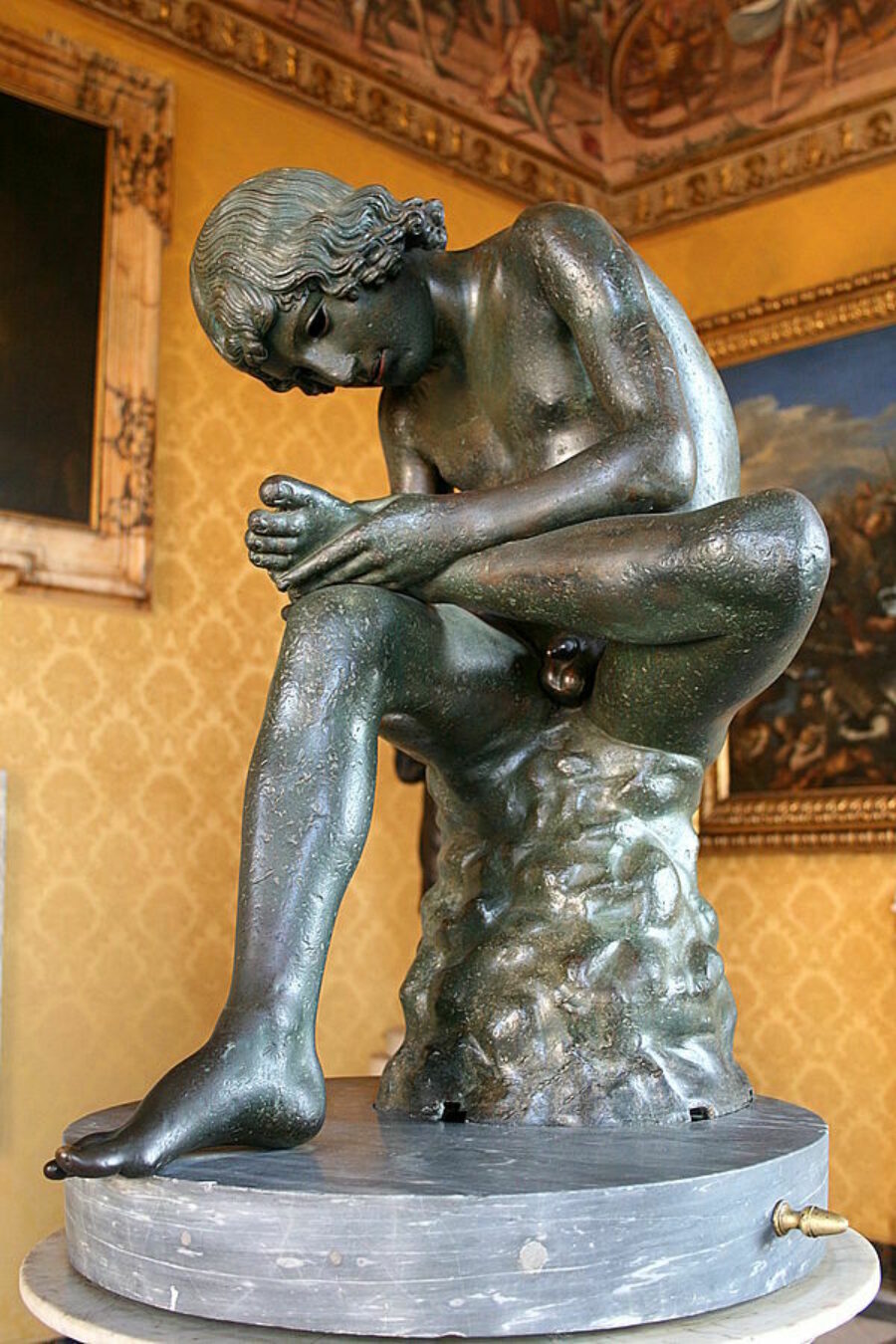
There is another bronze statue, a rather laughable one, which they call Priapus. He looks as though he is in severe pain, with his head bent down as if to remove from his foot a thorn that he had stepped on. If you lean forward and look up to see what he's doing, you discover genitals of extraordinary size.
Genitals of extraordinary size? I don't think they exist.

Just to confirm, in Latin.
Est etiam aliud eneum simulacrum ualde ridiculosum quod Priapum dicunt. Qui demisso capite uelud spinam calcatam educturus de pede, asperamlesionem pacientis speciem representat. Cui si demisso capite uelut quid agat exploraturus suspexeris, mire magnitudinis uirilia uidebis.
-Magister Gregorius de Mirabilibus Urbis Romae: A New Description of Rome in the Twelfth Century, G. McN. Rushforth, 1919
The statue in question is the Spinario, which does not, as far as I can tell, have the... attribute described by Magister Gregorius. I've spent more time than I think is wise (i.e. any time at all) trying to find low-angle shots. Perhaps it was very cold in 12th century England? Perhaps there’s an angle where it looks bigger? Perhaps it's a little joke to mislead future statue-ogglers; a rickroll, but with one letter changed? "Ha ha, made you look?"

It's a pretty good joke, actually. Someone in the 12th century reads the manuscript, travels all the way to Rome, finds the statue, looks up at it, realizes the description is inaccurate, travels all the way back to England, and complains. "Why were you looking anyway, Stephanos?," comes the reply. "Eh? Eeeeh?"

Additional Wonders

Gregorius then describes the Salvatio Romae and the Iron Statue of Belerophon, closely following the text of De Septem Mundi Miraculis. See the discussion of that text below. But the next wonder has a personal touch.

Also much to be admired is the bath of Apollo Bianeus, which still exists in Rome. This bath was made with great skill in a bronze vat from a certain formula of sulphur, black salt, and tartar. When it had been prepared, Apollo Bianeus lit it with one consecrated candle, and it was thereafter kept hot by a continuous fire. I saw this bath myself and I dipped my hand into it, but although I had paid the fee I declined to bath because of the foul stench of the sulphur.
"Apollo Bianeus" is a corruption of the reference text, scribal error, or just poor memory, as the refernce should be to Apollonius of Tyana.

Digression: Apollonius of Tyana and 7 Faces of Dr. Lao

7 Faces of Dr. Lao (1964) influenced early Dungeons and Dragons. According to Rob Kuntz,

As a young chap I was part of the Gygax family, virtually adopted at one point, and always in attendance at their house on a daily basis. I ate, drank. and sometimes slept there, gamed (of course) helped with the garden, adopted their religion, and most definitely watched movies there!

That I was influenced by EGG's tastes is to say the least. He would later comment upon several that held deep fascination for him and inspired him in writing many of D&D's spells, particularly, 7 Faces of Dr. Lao; and of course, The Raven, a Roger Corman film.
The Raven is not a great film by any means, but 7 Faces of Dr. Lao is better than it has any right to be. I wouldn't say it's aged well, or that it's a brillaint film, but it has some redeeming qualities. It's gloomy, philosophical piece disguised as a special-effects heavy kids film. You don't get scenes like this in your standard Disney production:

The character, by the way, doesn't get a redemption arc or change their ways. Apollonius of Tyre predicts the future.

Judging by comments on youtube and elsewhere, the film was highly influential and memorable to young minds, for reasons they may not have understood at the time. The book is considerably weirder.

Anyway, back to the Narracio.

Marble Statues

Now I shall turn my attention to the marble statues, almost all of which were destroyed or toppled by blessed Gregory. I shall begin with one in particular because of its exceptional beauty.

[…]

The image is made from Parian marble with such wonderful and intricate skill, that she seems more like a living creature than a statue; indeed she seems to blush in her nakedness, a reddish tinge colouring her face, and it appears to those who take a close look that blood flows in her snowy complexion. Because of this wonderful image, and perhaps some magic spell that I’m unaware of, I was drawn back three times to look at it despite the fact that it was two stades distant from my inn.
I love Gregorius. In an endnote, Osborne speculates he also had tiny feet. I think he's just great.
Close by there are two marble horses of incredible size and skillful composition. It is said that they represent the first mathematicians, to whom horses were assigned because of the quickness of their intellects. 

These are the Horse Tamers, who get a much longer tale in the Mirabila.

In this account of the city’s monuments, I mustn’t forget to mention the Palace of Diocletian, although words are not adequate to describe its vast size and most skillful and admirable construction. It’s so large in fact that I couldn’t get an accurate impression of the whole structure despite spending the best part of a day there. I discovered columns so large that no one can throw a pebble as high as their capitals, and the cardinals say that a hundred men could scarcely cut, polish, and finish one of these in the space of a year. I shan’t say any more about it, since if I tell you the truth you won’t believe me.
Gregorius 100% threw pebbles at these columns. You cannot convince me otherwise.
But who really cares whether I describe at length all the palaces in the city of Rome, since I’m sure that no one could ever see them all? Therefore I shall skip the enormous structure which was the palace of Tiberius, and leave aside the palace of Nero, the wonderful building of the divine Nerva, and the palace of Octavian. I shall not even speak of the seven thrones, skillfully constructed at great height, about which, they say, Ovid wrote:
“The palace of the sun towered on lofty columns, made bright by gleaming gold and flame-like bronze.”
Concerning the palace of the sixty emperors: Who could describe the palace of the sixty emperors? Although much of it has crumbled, they still say that all the Romans of this day and age couldn’t destroy what’s left.

Now I shall add a few words about the pyramids, the tombs of the mighty, of enormous size and height, rising to a point in the manner of a cone. The first of these which I encountered was the tomb of Romulus, which stands by the castle of Cresentius near the church of St. Peter’s. The pilgrims erroneously claim that this is the grain heap of the apostle Peter, which was transformed into a stone hill of the same size when Nero confiscated it. It’s an utterly worthless tale, typical of those told by pilgrims. Hidden inside every pyramid is a marble sarcophagus, with carved reliefs on all sides, in which the body of the deceased was placed.

The pyramids in question are the Meta Romuli and the Meta Remi. According to Osborne, this tale is not known from any other sources. 

Gregorius then relates some facts about Julius Caesar’s tomb / St. Peter's needle, now known better as the Vatican Obelisk.

The pilgrims call this pyramid “St. Peter’s needle” and they make great efforts to crawl underneath it, where the stone rests on four bronze lions, claiming falsely that those who manage to do so are cleansed from their sins for having made a true penance.
Osborne relates that this is an “interesting insight into the mentality of the medieval pilgrim”.

Looking at the Vatican Obelisk, it’s obviously supported by lions. But these are not the original lions. These are 16th century lions.
Gregory reports that the space between the obelisk and its base was created by four bronze lions. This is also curious, because the original bronze support pieces, or astragals, which are still in use today, are clearly not in the form of lions nor of any animal. The error is by no means unique to Gregory. It may be found in the writings of no less worthy an observer than Petrarch, who refers to the bronze lions in a letter written to cardinal Giovanmi Colonna in 1377, and two lions actually appear in a thirteenth century mural illustrating the Crucifixtion of St. Peter in the Church of S. Piero a Grado (near Pisa).

-Osborne

The internet is amazing. It only took me a few minutes to find the mural.

There can be no question of a switch having been made at some point between the fourteenth century and 1586, as this would have involved lifting the obelisk from its base. Moreover, the original curved astragals are shown in illustrations contained in the Modena and Princeton manuscripts of Johannes Marcanova’s Quaedam antiquitatum fragmenta of 1465, and again in a sixteenth-century drawing of the obelisk by Guiliano di Sangallo.

-The Marvels of Rome, John Osborne, 1987.

Johannes Marcanova

It is possible their shape suggested an animal foot to medieval observers, who were accustomed to the sight of lions supporting monuments and furnishings of all sorts, and that they simply assumed that the astragals were meant to represent lions.

As the Vatican obelisk stands today, there are indeed four lions at the corners, concealing the original astragals which are still in place), but these were added in the time of Pope Sixtus V and are the work of the artist Prospero Bresciano.

-The Marvels of Rome, John Osborne, 1987.

I vaguely recognized the name "Prospero Bresciano" as “the sculptor who made a Moses so bad that he died", so I did some digging.

The Fountain of Moses

But looking into the story, I was surprised to learn that it’s an “utterly worthless tale”. While it’s true that the statue was widely criticized after its unveiling, and over the intervening centuries, it did not lead to the poetic death of the sculptor from a broken heart. I was duped by the tales of credulous guides and pilgrims, just like Gregorius!

However appealing this story is, it simply is not true. In early 1591, almost two and one-half years after the final payment for the Moses, Bresciano was still very much alive, collaborating with Pietro Bordone on a copper angel and the stemma (coat of arms) of Gregory XIV for the Castel Sant'Angelo.124 He was still alive in August 1591, when he modeled the figures of the Virtues for the catafalque of Sixtus V erected in S. Maria Maggiore. Five months after the catafalque was erected, in January 1592, Bresciano filed a legal suit against Orlando Landi, his procurer of materials, for stealing a large quantity of wax from his home.

-Steven F. Ostrow, The Discourse of Failure in Seventeenth-Century Rome: Prospero Bresciano's "Moses"

Which is charmingly mundane. Back to the Narracio (again). 

Historically Accurate Giant Crabs

Osborne proposes that the lions of the obelisk suggested, to the mind of Gregory, the crabs supporting the lighthouse of Alexandria. Gregory uses “cancros / cancri”, and Osborne chose to translate this literally, as “crabs”, rather than architecturally, as “arches”. It’s possible that Gregory used the “crab” as architectural jargon, understood to him and to his colleagues. It’s also possible he envisioned giant crabs supporting the structure, as lions support the obelisk.

Another great wonder is the Alexandrian lighthouse, which stands in the sea on four crabs made of glass. One wonders how such enormous crabs could have been manufactured of glass, how they could be placed in the sea without being broken, and how the cement foundations supported by the crabs could survive underwater. It is also puzzling how the cement hardened underwater, why the crabs are not broken in the sea, and why the foundation doesn’t slip under the great weight of cement. Isidore describes a type of sand which had this property: if it is mixed with water, subjected to sun or to fire, reduced to its original sandy state, and then plunged into water, it solidifies and turns to stone. But it’s not my task to explain miracles.
This sort of thing could easily confuse later illustrators.


The Death of Handwriting

In front of [the statue] there is a bronze tablet, which is called the tablet “prohibiting sin”, on which are written the principal statutes of the law. On this tablet I read much, but understood little, for they were aphorisms, and the reader has to supply most of the words.
Osborne explains:
It seems strange to us in the twentieth century that these elegant capital letters can have posed any difficulty to a medieval viewer, but such was evidently indeed the case. An interesting parallel is provided by a Carolingian Aratea manuscript (Leiden, University Library, Cod. lat. Voss. 79), where the rustic capitals of the ninth century were transliterated into readable script by a thirteenth-century scribe. Erwin Panofsky, noting this odd occurrence, suggests that it can only have been done “because he evidently thought that the Carolingian ‘Rustic Capital’ would stump his contemporaries, as well as future generations.” One can also compare the comment of the fourteenth-century humanist physician, Giovanni Dondi, on the inscription carved on the Arch of Constantine; “multe litere sculpte, sed difficiliter leguntur.
-The Marvels of Rome, John Osborne, 1987.

Martin van Heemskerck

Some interesting light has been shed on Gregory’s use of this medieval account of the seven wonders of the world as a result of Margarete Demus-Quatember’s recent study of a sixteenth century painting by Martin van Heemskerck. The work in question, now in the collection of the Walters Art Gallery in Baltimore, consists principally of a fantastic view of the city of Rome, in which a number of these seven wonders can be identified. Since it seems unlikely that Heemskerck can have based his painting on Gregory’s Narracio, it would appear that there must have existed a version of the De septem miraculus mundi in which the wonders were associated with the city of Rome. If such a version did exist, and it is otherwise rather difficult to account for the Baltimore painting), and if Gregory knew it, then his inclusion in the Narracio of six of the seven wonders is more readily explained.
-The Marvels of Rome, John Osborne, 1987.
I’d like to read the citation (Margarete Demus-Quatember, Ricordo di Roma. Mirabilia urbis Romae und Miracula mundi auf einem Gemälde von Martin van Heemskerck … 203-223). Unfortunately, it’s paywalled. But the painting is worth examining. It's a mishmash of wonders, artifacts, and characters. It's the Narracio in a nutshell. It's a mytho-historical Where's Wally?

Of the Seven Wonders of the World from The Complete Works of the Venerable Bede, trans. Rev. J.A. Giles

This text is in the public domain. As one of Gregorius' main sources, it's worth quoting in full.


The first of the seven wonders of the world, made by the hand of man, is the Capitol at Rome, the very salvation of the inhabitants, and greater than a whole city. In it were statues of the nations subdued by the Romans, or images of their gods, and on the breasts of the statues were inscribed the names of the nations which had been conquered, with bells hanging from their necks. Priests or watchmen attended on these by turns, day and night, and showed much care in watching them. If either of them should move, the bell made a noise, and so they knew what nation was rebelling against the Romans. When they knew this, they communicated the information by word of mouth or by writing to the Roman princes, that they might know against what nation they were next to turn the Roman arms.

The second is the Light-house of Alexandria, which was founded on four glass arches, twenty paces deep beneath the sea. The wonder is, how such large arches could be made, or how they could be conveyed without breaking; how the foundations, which are cemented together above, could adhere to them, or how the cement could stand firm under the water; and why the arches are not broken, and why the foundations cast in above do not slip off.

The third is the figure of the Colossus in the island of Rhodes, a hundred and thirty-six feet long, and cast of melted metal. The wonder is how such an immense mass could be cast, or how it could be set up and not fall.

The fourth wonder is the iron figure of Bellerophon on horseback, which hangs suspended in the air over the city, and has neither chains nor any thing else to support it; but great magnetic stones are placed in vaults, and so it is retained in assumption (position), and remains in balanced measure. Now the calculation of its weight is about five thousand pounds of iron.

The fifth wonder is the Theatre of Heraclea, carved out of one piece of marble, so that all the cells and rooms of the wall, and the dens of the beasts, are made out of one solid stone. It is supported on four arches carved out of the same stone; and no one can whisper in the whole circle so low, either to himself or to another, without being heard by every one who is in the circle of the building.

The sixth wonder is the Bath, which is such, that when Apollotaneus has lighted it with one candle of consecration, it keeps the hot baths continually burning without being attended to.

The seventh wonder is the Temple of Diana, on four pillars. Its first foundations are arched drains; then it increases gradually, upper stones being placed on the former arches. Thus: upon these four are placed eight pillars and eight arches; then in the third row it increases in a like proportion, and stones still higher are placed thereon. On the eight are placed sixteen, and on the sixteen thirty-two; the fourth row of stones is on the fifth row of arches, and sixty-four pillars complete the plan of this remarkable building.
It must have been a thrill for Gregorius to see one of these wonders firsthand.