2017/09/22

OSR: Class: Exorcist

The Body and the Soul

In my setting, spells and souls belong in the same category. If someone curses you, they stick a parasite-thing on your soul. If you are enchanted, your soul might be altered or edited. The soul drives the body and not the other way around. Very powerful and willful creatures like dragons don't need a body the same way more fragile creatures do.

Angels, demons, summoned entities, creatures created by spells, and some other spirits are pure spell-stuff. Their bodies are just an extension or aspect of their souls.

Elementals are slightly different. As far as anyone can tell, their matter is their soul.

Brom

Abominations

An abomination is defined as "that which offends the Authority". The Church recognizes three major categories Abomination as particularly dangerous and, over the centuries, has created special orders and rites to combat them. Not all the examples listed below are abominated by the Church; anything listed as "Also Affects" is just incidental stuff that behaves in the same way, effectively, but which the Church has not specifically abominated. These edge cases might lead to some very weird interactions between Exorcist abilities and the things they encounter. This is intentional.

Embodied Undead: Skeletons, zombies, wights, liches, and vampires. Creatures whose bodies died, but whose souls lived on, driving the body. Corpses possessed by a spell or spirit. Also Affects: enchanted weapons, wands, armour, spellbooks, golems and constructs.

Incorporeal Undead: Ghosts, banshees, spectres, and shadows. Creatures whose bodies died, but whose souls lived on and roam freely. Also Affects: spells, angels, summoned demons, summoned entities.

Possessive Undead: Demons, powerful ghosts, and some diseases. Creatures whose  original bodies died but whose souls live on in the body of other living creatures. Two souls in the same flesh. Also Affects: persistent spells that affect a living target, curses.


Mademoiselle Charlotte, Maxim Verehin

Class: Exorcist

Starting Equipment: traveling robes, ceremonial robes. Other equipment varies by Role.
Starting Skill: Religion.

You gain +1 Save vs Fear for each Exorcist template you possess.

You are either a member of the First Estate or an Outlaw. In either case, you need to think like a member of the First Estate. You are part of an elite order, a very small group of men and women outside the usual demands of the Church. Your profession is so dangerous and so necessary that dogmatic rules are bent or broken for you. You roam Creation seeking neither fame nor riches nor glory, but only to do your duty, or to perish in the attempt. And if, along the way, you should acquire wealth and help the poor or live comfortably for a time, who could blame you?

And if you fall...


Role:

1. Bell
2. Book
3. Sword

Your templates vary by your Role. You can only choose templates from one Role. Effectively, the Exorcist class is three classes in one, similar to how Wizards have schools.

If you are using the Estate system, Bell Exorcists are commonly monastic members of the First Estate, Book exorcists are commonly ordained members of the First Estate, and Sword exorcists are commonly Outlaws.


Source Unknown
Mechanical Notes on the Exorcist
This is a very mechanics-heavy class. It's for advanced players who like that sort of thing. The class has a very powerful set of tools, but the tools do not nessesarily work on all enemies. This is not a healing, buffing, miracle-working cleric class. Each of the Exorcist roles is a toolkit made of very strange parts. It is up to the player to use them effectively. I wouldn't recommend this class to new or inexperienced players. The class also uses HP as fuel for many abilities.

And it's also a work in progress, so, you know, be careful with it.

Most campaigns include stuff the Exorcist can interact with at their full potential, or can trivially be adapted to include undead of some description.

OSR: 1d50 Goblin Warlords

Apparently these are supposed to be action figure names, but they are much better as goblin warlords. Post in the comments how far you made it without laughing. These might also work as post-apocalyptic warlords... but the goblin mental images are much funnier to me.


Goblins by Scrap Princess.
1. Stanker
2. Action Bun
3. Sanesaur
4. Bull-Bat
5. Stenky
6. Slorp
7. Stan Bad
8. Bluck-ing Ding Tark
9. Slimetrat
10. Princess Backing Punch
11. Flarg
12. Princess Pow
13. Shy Moat
14. Stank Spenker
15. Pumble Cat
16. Catrain
17. Fracken
18. Narkle
19. Alter Pant
20. Danky
21. Stalking Spanking Narlo-tie Dere
22. Shark Troll
23. Storm Shrek
24. Treed Trooper
25. Arnon Prombot
26. Rotercomming Pingaling
27. Mama
28. Mindlick
29. Claw Wind
30. Strong Boot
31. Potter Stank
32. Sharkstorm
33. Head Snarp
34. Blue Man
35. Casthean Cuttlebat
36. Disky Thik Topping Toth Ottamus Prime
37. Sewer Man with Slagg Light
38. Battle Command Master Cramp
39. Viperlord
40. Crustillar
41. Blaster with Man Dreads
42. Rench Beast
43. Cobra Funk
44. Headstank
45. Burble Beast
46. Battle Battle Action Master Growl Teom
47. Strawberry Shorttake with Burdball
48. Battle Bong
49. Snack Blast
50. Spocky Man


I considered writing little descriptions and even doing art, but the names alone are enough., 

2017/09/21

OSR: Dear Abbey, my sister has this habit...

(For those of you who don't get the reference.)

In my games, being a member of an Estate is important. Anyone* can start the game as a member of the First Estate. Being a priest or a monk or a nun isn't a class, really**. It's just a thing you can do on top of being something else. It doesn't give you any special skills or options. It's more like picking a political affiliation or career advancement track. This post covers some details about being a monk or a nun. To learn how to think like one, read these posts.

Not very useful specialized terms (can be ignored)
Cathedrals were served by canons secular, who were sort of like monks, but not quite.
Convents housed mendicant nuns but the term was also used for a house of friars, except...
Friaries house friars.
Monasteries house monks.
Nunneries house monastic nuns.
Priories were small satellite communities attached to a main monastery.
Cloisters are just another term for this type of community in general.
It's all very complicated and highly variable and, from a gaming point of view, not very useful. Let's move on at top speed.

Useful Terms


Abbey
A religious community, isolated from the rest of the world. Usually walled, often built on a regular plan, and controlled by a set of rules. I'm going to use "monastery" and "monastic" interchangeably with "abbey", mostly because there's no good adjective form of "abbey".

Abbot/Abbess
The leader of this religious community. Sometimes equivalent in rank and prestige to a Bishop, but not an ordained member of the Church. Also has limited religious authority, and usually defers to the local Bishop in most matters. They are elected by members of the monastery rather than being appointed from above. Some abbots were ordained and could perform services, but most of the time, the community relied on the local priest.

Monk/Nun
A respected member of a monastic community. There might be dozens of degrees of monk-ness within one order. We're not going to cover them. Monks and nuns refer to each other, and are referred to, as "Brother" or "Sister", to emphasize the nature of the community and to deliberately show their lack of concern for familial bonds or the vanity of rank.

Initiate
A provisional member of a monastic community. Usually there's a waiting and training period of several years between entering the community and becoming a monk or a nun. Initiates have different tasks and fewer restrictions.

Holy Orders
Rather than the near-feudal obligation a parish priest owes his bishop, members of a monastic community instead take solemn vows to the divine presence alone. The vows almost always included celibacy, isolation and immobility, a renunciation of worldly things (wealth, vanity, comfort, etc.), and a strict duty to obey. Over and over monastic rules stress the duty to obey both God, the Church, and other monks. Monastic saints tales always stress their obedience (especially in Russia, where obedience to the duties of monastic life is contrasted with disobedience to duties to your parents). This obedience could sometimes go to supernatural lengths. 
I was told a story of Father Bede Jarrett, the great Dominican provincial who died not very long ago, which illustrates that. I have been told that when he fell into his last illness, Father Bernard Delany went to see him, and said, "Well, Father, of course you know that you've got to get well; we can't possibly spare you". And about a fortnight later, when Father Bernard went to see him again, Father Bede said, "Oh, Father, I'm so dreadfully tired; do you think you could let me want to die after all, or must I go on under obedience wanting to live?" And he naturally said, "Oh, of course I never meant to put you under obedience". And Father Bede said, "Thank you so much", and died about half an hour afterwards. 
-The Creed in Slow Motion, Ronald Knox
Yet it was an obedience without authority. You didn't obey your peers because of their rank. You obeyed them because it was a joy to obey. The usual order of the feudal world was inverted; to seek authority was a sin, and to glorify in your power was a very dangerous sin indeed. Most tales of saintly abbots and abbesses have them reject the choice of their peers several times. Abbots who were sent away to become bishops often fled back in tears.
Holy orders also stressed humility, poverty, and simplicity. Some orders required manual labour, others focused solely on the spiritual labour of prayer. Everyone had a daily routine.

Tonsure
The distinctive haircut of a monk, meant to be deliberately weird-looking and unfashionable.

Habit
The distinctive clothing of a member of a monastic order. Varied widely between orders and centuries. For men, usually a black or brown robe with a hood. The hood is not always worn. For women, a black and white robe with a hood or head-covering, sometimes quite elaborate, which is almost always worn. All the different parts have specialized names. It's not relevant here.

*Except Knights and Wizards and obviously unsuitable people.
**I've written an official Monk class if you want to play a character who is only monastic. The First Estate is open to most characters.


Initiate Options for Level 1 Characters

If you want to start as a monk or a nun, start as a monk or a nun, adapting the background from your class as needed. Here are a few ideas.

Fighter: A former soldier, seeking to escape their past. A persecuted mercenary, hiding from their enemies. A secret order, devoted to fighting a mortal threat. A bloodthirsty warrior-monk.


Thief: A spy for the Church. A penitent trying to mend their ways. A dissolute noble, forcibly imprisoned. A sanctioned relic-stealer (if you can steal a relic, that means the saint wanted it stolen).

Barbarian: A distant monk from Foreign Parts, sent to instruct the locals. Someone fleeing persecution. A new convert, fanatical and naive.

Summoner: A secret cultist with a holy facade. A holy order, kept secret and deployed for emergencies. Someone who read the wrong kind of book.

Paladins: N/A. With a direct connection to the Authority, Paladins are Outcasts; the structure of medieval society is like a stage set made from twigs and wax paper.

Knights: N/A, part of the Second Estate

Wizards: N/A, being a Wizard prevents you from taking Holy Orders.


Cats. Assholes then, assholes now.
The Narrow Path 
Aside from the spiritual labour of prayer, monks and nuns often worked to copy manuscripts, write new commentaries, maintain hospitals (which were both places of healing and houses of rest for travelers and the poor), grow herbs, translate manuscripts, advise kings, and generally "do good works." Some orders were required to maintain schools. Education in the middle ages was dominated by the monastic orders, and their ideas, drawn from ancient books of law, lore, and poetry, informed countless generations. Many monks and nuns were a comfort to the sick and the dying, counselors in disordered times, sharp critics of the powerful, and true to their vows.

There was also some joy in monastic life. Monks and nuns belonged to community with minimal opportunity for strife and trouble compared to the outside world. An abbey could also serve as a shelter for the persecuted, the widowed, the orphaned, or people simply unsuited for life elsewhere. 


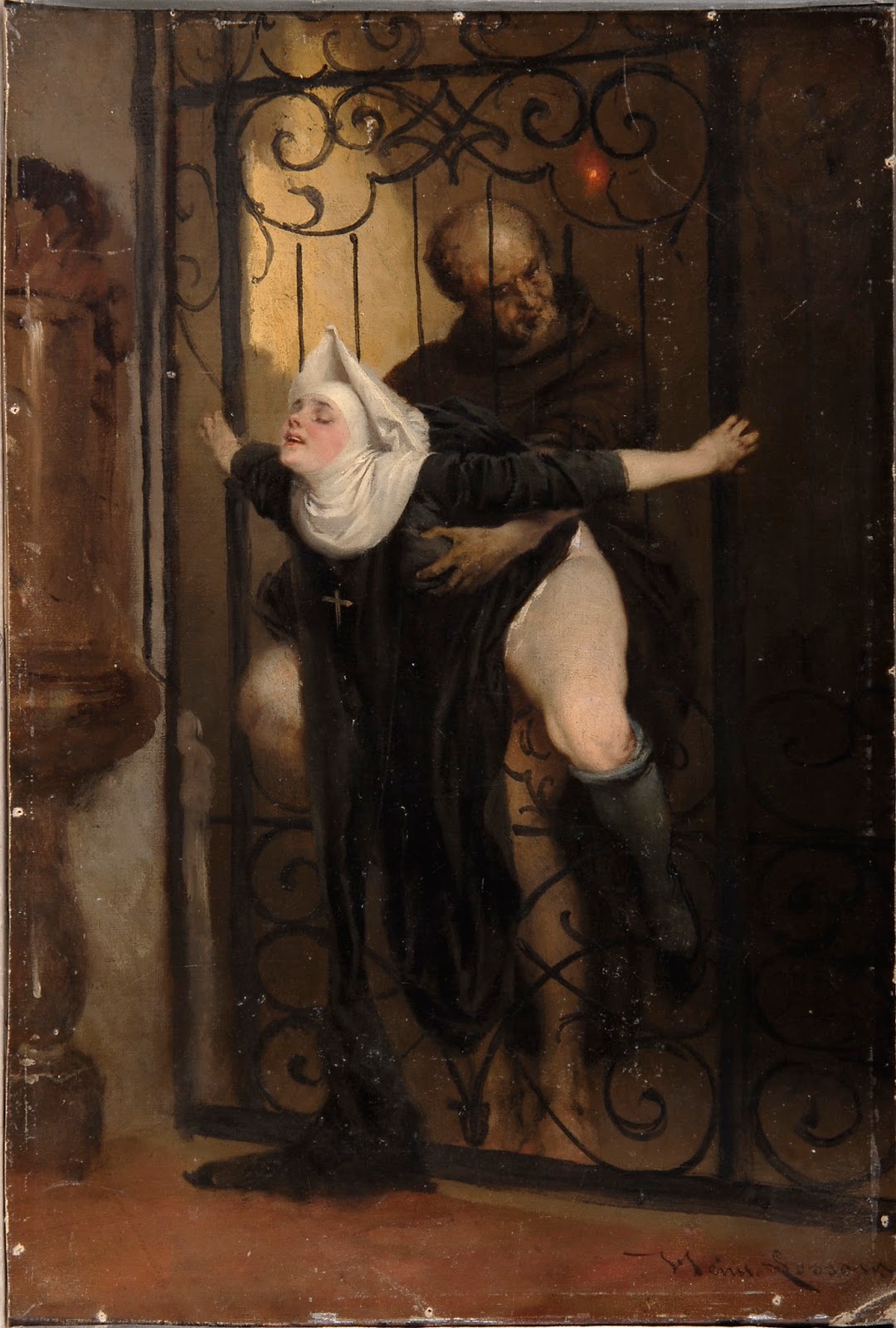
The Sin, Heinrich Lossow.
 The image isn't NSFW. That helpful man is just assisting a poor nun stuck in a gate. Shame on you.
The Other Path
Monastic orders follow a very predictable arc. They are founded by a visionary leader disgusted by other monastic orders, the Church, or the world in general. The visionary acquires a small group of followers, all of whom live in peace and equality. Then more people arrive, and some kind of structure is needed. The visionary introduces one and then dies. The successors try to keep the tradition going.

By this point, the order's fame has spread. Nobles donate vast sums, because the order is so humble and pure and therefore much better than  the other, older, and more corrupt orders. The Church interferes and tweaks the less dogmatically sound rules. The order expands, creates new branches, invents new rules, acquires a few less scrupulous followers, and gradually becomes no better or worse than the other orders. The appearance of new orders alone would be testament to the less-than-devout state of many monasteries. Peasants and Popes constantly complained of drunken, lecherous, ignorant, and idle monks - idleness being the main concern. If the monks weren't performing spiritual labour, they weren't much use. Abbots became as proud as princes. If the First Estate, the moral guides of the other Estates, failed to act properly, of what use was the entire system?|

Monastic life was not easy, and not all initiates were willing. Unwanted children, marriageable daughters, wilful, spiteful, or mad heirs, or potentially dangerous claimants were shipped off to abbeys wholesale. They could not leave; breaking a sacred vow meant excommunication and pursuit by both Church and State. Under the circumstances it is hardly surprising that many men and women rebelled against vows they did not choose to take, and a life whose monotony, isolation, and discomfort could crush the soul rather than purify it.
The whole monastic ideal is, however, bound up with the vow of chastity, and had only women with a vocation entered the nunneries, the danger of the situation would have been small. Unfortunately, a large number of the girls who became nuns had no vocation at all. They were given over to the life by their family, sometimes from childhood, because it was a reputable career for daughters who could not be dowered for marriage in a manner befitting their estate. They were often totally unsuited for it, by the weakness of their religious as well as the strength of their sexual  impulses.
[...]
The ancient house of Amesbury fell into evil ways in the 12th century. In 1177 its abbess was said to have borne three children and its nuns were notorious for their evil lives, whereupon the convent was dissolved... Later still the papal benevolence was exerted on behalf of Margaret Greenfield, nun of Amesbury, who had borne a child after her profession (1398) and Cecil Marmyll, who "after having lived laudably for some time in the said monastery, allowed herself to be carnally known by two secular priests and had offspring with each of them." (1424).
-Nuns and Nunneries: Sketches Compiled Entirely from Romish Authorities, Lewis Tonna
We don't know much about the specific details of many alleged offenses because the Church, to protect its own interests, always fought to hide any scandals.


Structure of an Abbey

This article covers the basics. An abbey is a simple, enclosed structure. Most had outbuildings, farms, and secondary structures, but the core of the complex was a closed and walled community. Draw a square and stick a church on one side.

Abbeys could sometimes serve as minor fortresses and shelters for local villages during times of war, but they were rarely designed as defensive structures. They relied on isolation, the power of the Church, and the protection of local feudal overlords and sponsors. In disordered times, many monasteries were plundered by enemies and allies alike. They were also very vulnerable to raids. An isolated location meant protection from passing armies, but small forces from the sea, rivers, or overland could easily surprise and ransack an essentially defenseless community.


The elaborate Mont Saint-Michel
The imposing and ancient Sacra di San Michel


Further Reading

This website covers everything I've left out, ignored, or simplified. It's well worth a look.

OSR: Class: Monk

Not these guys.


 These guys.
Noted Breviary, Getty Museum, MS 24. ~1500

This class is brought to you by Trappist Rochefort (which is delicious) and Aleksei German's Hard to be a God (which is...less appetizing).

This class is kind of a joke. Taking holy orders is something any character can do, at any time. Making a specific class does allow a character to be a monk or a nun and nothing else, undiluted by the demands of the world. Arnold K. described the base adventurer as "Indiana Jones without the archeology skill". This class is a significant downgrade in that sense.

The Exorcist class I'm working on should fill a different niche. A post on abbeys will be along shortly.


Class: Monk (or Nun)

Starting Equipment: robes, holy book
Starting Skill: see below

A: Unarmed Strike, Literacy, Restrictions of Your Order
B: Stunning Fist
C: Evasion, Obscure Knowledge
D: Pronouncement, Improved Dodge

Unarmed Strike

You are not trained in the use of weapons. Even a cudgel is foreign to you. On a successful Attack roll you deal a maximum of 1 damage.
If you want to play a warrior-monk, go with a Fighter and start in the First Estate.

Literacy

You can read and write. A surprising number of people could do both in the middle ages, but you can really write. Your letters can allow for Charisma tests at a distance. You can roll to see the intentions of an author, the delicate themes of a poem, and the inconsistencies in a complex text. To most people this is a kind of sorcery.

Restrictions of Your Order

You do not start trained in the use of any weapons (-4 to Attack until you land 8 successful hits in combat). You can wear armour, but its encumbrance is doubled for you. You are also expected to avoid the use of magic, from wands to enchantments to spell cast on you for your own protection. In practice, do what you want, but expect angry letters from your Abbot or Abbess if word gets around that you've broken your vows or publicly disgraced your Order. You also have a -2 to Save vs Fear. Make up at least 3 other restrictions or demands.

Stunning Fist

If you strike someone (even with a weapon) and they weren't expecting it, you deal normal damage (1+Strength Bonus for a punch, 1d6+Strength Bonus for a dagger, etc.) on the first round of combat. If the target really wasn't expecting it, and had total trust in your non-violent ways, they must also Save or be stunned for 1 round.

Evasion

You can never be pinned in a corner by difficult theological topics or arguments. You can always retreat to authority, throw up textual obstacles, or deploy dogma. No one can make you admit something in conversation that you did not intend to admit;  any accidental disclosures are retroactively fixed, if possible.

Obscure Knowledge

Once per session, you can declare something is to be true because you read it in a book. The base chance of the thing actually being true is 50%. There has to be a plausible way you could know about it from reading books (new discoveries, minor details, and personal secrets are unlikely). You don't know whether or not it is true right away; the GM will roll when it matters. You might only be partially correct, but you will never be catastrophically wrong. If you declare that bugbears fear albino goats, they will either fear albino goats or be indifferent to albino goats. They won't be driven into a murderous rage by them. If you have access to a library of 50 books, the base chance increases to 80%.

Pronouncement
You can speak for up to 3 hours without pause on a given topic. No tests required. Peasants, nobles, and other sensible people will hear you out politely, unless they've got something better to do. Monsters will still devour you, dragons might argue with you, and you don't impose a supernatural charm effect on anyone. Still, your audience might take up a cause or change their ways.

Improved Dodge

Once per session, you can declare that an attack that hit you missed instead. You can do this after damage has been rolled but before anything else happened. This won't save you from falling off a cliff or a collapsing cavern, but spells will turn away, sword thrusts will miss, and traps will mysteriously fail.

Monk sneaking a drink, source unknown.

Mechanical Notes on the Monk

This class is astoundingly weak in combat. It's not a glass cannon, it's a glass thimble. But it also has access to some very powerful and very broad out-of-combat abilities. You can invent truths to save the party, write letters to important people, support a cause, calm or raise a mob, and generally meddle with the course of history. You can also get filthy rich by several methods.

Romance of Alexander, ~1400. Yes, you are interpreting this image correctly. It is an illustration of medieval monks and nuns playing baseball (as a humorous parody, but still!) Who said the middle ages were grim all the time?


Who Are You?

You can be either male or female. You are a member of the First Estate and you must think like a member of the First Estate. You start at the rank of Initiate. You answer to an Abbot or Abbess, and they answer to a Bishop or Archbishop. You don't have to be pious or devout to be a monk or a nun. You don't even need much religious knowledge. However, you are expected to retreat from the world to a life of spiritual labour. Prayer, devotion, instruction, and solitude are your only goals. For some reason you have left your holy retreat, perhaps permanently, and now wander the rest of the world. You are not ordained, and cannot sell indulgences, perform services, hear confession, or preach. You can become ordained (if you are male) without too much difficulty, if you are in the good graces of your overlord the Bishop.

Starting Skill

1. History, 2. Literature, 3. Medicine, 4. Religion.

History

1. You have read about fallen empires, lost kingdoms, and ancient cultures long extinct. Things were much better in the past. You are able to speak 2 extra languages, but you also have a sense of nostalgia.
2. You keenly understand the recent history of the local area, as your abbey was persecuted by the current rulers' ancestors. Start with a wildly inaccurate map (draw it yourself) and a distrust of the Second Estate.
3. You read a book from Foreign Parts, translated badly, but with many interesting comments. The desire to travel gnaws at you. Start with a leather bag full of dried peas.
4. You read about an ancient hero of the Church and modeled your life after theirs. Once per session, you can reroll a critical failure if you tell a story about your patron saint, martyr, or theologian, and how they were once in a similar situation. The story can be allegorical.

5. Your study of the history's endless churn has left you melancholy. You know all about famous local defeats, deaths, and tragedies. Start with a stout walking stick (as a quarterstaff).
6. You paid very close attention to the accounts of treasure-hauls and plunder in your book. You can evaluate the approximate value of treasure and loot (as a Thief).

Literature
1. You memorized large chunks of beautiful prose. You are poetic and sentimental. Start with a basket of flowers.

2. You memorized endless passages of invective, abuse, and slander. You are sarcastic and bitter. Start with a wheelbarrow.
3. You memorized large chunks of poetry. Start with 1 Camp Follower. They are a reminder of you embarrassing love (directly or indirectly).
4. You read a very controversial piece of courtly literature. You either hate it completely and will denounce it at every opportunity, or you will defend it as a work of unrivaled genius and beauty. Either way,  you can make easily find common ground with people who share your view.
5. You have remarkable handwriting. Your script is used as the model for other initiates in your order. Start with 1sp, a quill, and a small pot of ink.
6. You have aspirations to write a great book, poem, commentary, or letter. You have been practicing. Start with 2d10 unfinished drafts on small parchment scraps, stored in a leather bag.

Medicine
Note: you cannot use this skill to remove Fatal Wounds. This skill is more suited to long-term care and the treatment of disease. You cannot perform surgery, but you might be able to advise a barber-surgeon or a butcher.
1. You tended to the mad. Start with unshakable patience and an iron bell.
2. You were often at the bedside of the dying, ready with words of comfort. You always know the right thing to say to someone in pain or in the last moments of life. Start with a white cloth.

3. You studied herbs, poultices, and infusions. Few of your remedies have any measurable effect by modern standards, but they are (sometimes) better than nothing. You can name most plants.
4. You have read all the books of medicine written by the ancient authorities. Your treatments might be dangerous or impossible under the circumstances, but you will never fail to recommend a treatment or supply a diagnosis (even if you fail a skill test).

5. Your abbey sheltered many wounded soldiers during the last War. You can determine the number of Fatal Wounds and Current Injuries any person has just by looking at them, and triage appropriately.
6. You have read books of unorthodox medicine from Foreign Parts. If you roll an unmodified 20 on your Medicine skill check, your treatment is instantly and profoundly successful. If you roll an unmodified 1, your treatment makes you a laughingstock and possibly a criminal, provided it is publicized.

Religion

1. You have absolutely unshakable faith. You might be a monomaniacal fanatic or a humble and devout teacher. You gain a +10 to Save vs Demons, mind-altering effects, and despair (but not fear). If you ever lose faith or commit an act you cannot reconcile, you instead take a -10 penalty to Save (not just vs. demons, all Saves) until you atone or find peace.
2. You are an expert on doctrine and ritual. Start with a gold icon worth 1gp.

3. You studied the lives of the Saints extensively, and have gained some of their natural fortitude and patience. You start with +2 HP and bare feet.
4. You know where to find the most obscure information or greatest living experts, and have spent years cultivating your contacts. You can write a letter to them asking for guidance and receive an answer in 10+1d6 days, exploding on a 6 (if you roll a 6, add another d6, etc.). The answer may not be accurate, but it will be an answer.
5. You personally experienced a miracle. If you recount the miracle in a serious and moving way, you automatically succeed on your next Charisma test, provided your target would appreciate the story.
6. You either cannot abide luxury and vanity or you are utterly profligate and dissolute. You must Save each day if you have over 10gp or spend all but 10gp on luxuries, alms, etc. Remember, money spent on purely frivolous things nets a +10% XP bonus. If you have no way to spend the money without giving it to another PC, you don't need to Save.

Source unknown


Special Secret Note: When you reach level 5, instead of retiring your character or continuing to adventure, you can perform a miracle. You must be in absolutely untarnished standing with the Authority. You may have sinned, but you must be properly, fully, and faithfully atoned. Your GM will only inform you of this option if it is relevant. Under some circumstances, this option may be available earlier. Once the miracle is performed, your character becomes an NPC.

Further Reading

More on Nuns
The Rule of St. Benedict (and source text).

2017/09/20

OSR: 1d50 Discount Spells

The names of these spells were generated by Janelle Shane's very strange neural network. They are bargain-basement spells, the masterpieces of failed apprentices, or spells designed for one particular purpose and abandoned halfway through development. They use the Goblin Punch spell format. You can convert these spells to other systems by replacing [dice] and [sum] with integers of your choice.
1. Call to the Daring
R: [dice] miles T: area D: 1 minute
All people within the radius of the spell feel a faint tugging at their heart. If they are pure of heart, noble of purpose, and fit of body, the spell functions as a command spell and calls them to the caster's location. Since virtually nobody fits the spell's criteria (it's very picky), it usually does nothing.

2. Charm of the Cods
R: 30' T: [sum] codfish D: 10 minutes
Target codfishes are charmed and will obey simple commands. Does not work on other fish.

3. Chilled Arrow
R: touch T: arrow D: until used
An arrow you touch gains +[dice] cold damage when it is next used.

4. Claming Blow
R: touch T: weapon or target creature D: 0
Target creature struck by a weapon you enchant or by your hand is moistened and chilled. Usually, no other effect. If you invest 4 [dice] or more the effect is permanent.

5. Clinging Blade
R: 20' T: [sum] weapons D: 5 rounds
Weapons you target become slightly magnetic or sticky, and cling to anything they strike. It takes an opposed Strength test against Strength 8 + [dice] to pull a weapon free.

6. Conjure Bark
R: touch T: object D: permanent
You summon a bunch of bark. The amount summoned depends on the [dice] you invest: 1 [die]: a handful, 2 [dice]: an armful, 3 [dice]: a cartload, 4 [dice] a roomful.

7. Conjure Mare
R: 5' T: point D: [dice] rounds
You summon a glowing celestial mare. This would be really cool if the mare wasn't confused and extremely temporary. It vanishes with a puff of glitter when the spell ends. It will bite you if you try to ride it and it won't obey your commands.

8. Crusading Disk
R: touch T: point D: [sum] rounds
A glowing disc of solid force 5' in diameter appears where you point. It moves at your direction a walking pace unless heathens, unbelievers, or heretics are in view. Then, it moves as fast as galloping horse and tries to smash them. It does no damage on impact. It can be pushed with an opposed Strength test against Strength 8 + [dice].

9. Curse Clam

R: touch T: clam D: permanent
You inflict a horrible curse on a clam. For a minor curse, you must invest 2 [dice]. For a major curse, you must invest 4 [dice]. Dice used to cast this spell are automatically exhausted. You cannot dispel your own curses.

10. Cursing Wink
R: 50' T: mortal creature D: permanent
You wink at a creature. If it winks back, you inflict a horrible curse on it. For a minor curse, you must invest 2 [dice]. For a major curse, you must invest 4 [dice]. Dice used to cast this spell are automatically exhausted, even if the target does not wink back. You cannot dispel your own curses.

11. Darkworm Colt
R: 10' T: point D: [dice] hours
You summon a grey-black worm the size of a pony. It has a silver saddle on its back and way too many teeth in the front. It moves 1/2 a normal walking pace. It cannot climb walls and the teeth are too soft to do any damage. Maybe if you summoned the adult version you'd have a proper mount.

12. Date Ward
R: touch T: self D: [sum] days
You designate a date up to [sum] days in the future. You cannot die until that date. You can be hideously mangled, burned, mashed, spread across the cobbles, or torn apart, but your soul will still remain in your body (or its remains) until the date designated. On that date, you automatically fail all Saves.

13. Death of the Sun
R: touch T: self D: 0
You know the date of the next solar eclipse. If you invest 3 or more [dice], you also know approximately where the path of totality will cross Creation.

14. Divine Boom
R: [dice]x100' T: area D: 0
A thunderous boom shakes the area, as if the Authority Himself was readying a divine pronouncement. Loose objects shake, clouds roil, water ripples, etc.

15. Find Strike
R: 30' T: creature or object D: 20 mintues
You can clearly see the last place target creature or object was struck. The area glows red. If you invest 2 [dice] or more, you can tell approximately how long ago the creature or object was struck.

16. Forceful Boor
R: 10' T: creature of [dice]x2 HD or less D: [sum] minutes
Target creature's Charisma becomes 4 for the purposes of polite conversation, diplomacy, or storytelling. Target's confidence massively increases. Save to negate.

17. Forceful Force
R: [dice]x10' T: creature or object D: concentration
Target is struck by a blow of invisible force and pushed away from the caster. As long as the caster maintains concentration, the force persists. Moving directly towards the caster requires an opposed Strength test. The effective Strength of the force depends on the dice invested. 1 [die]: 10, 2 [dice]: 14, 3 [dice]: 18, 4 [dice] 20. The caster is required to yell, grunt, and wave their arms for the spell to work.

18. Frames of Death
R: touch T: point D: [sum] minutes
An empty picture frame [dice]' long by [dice]' wide appears in your hand. Any mortal creature who passes through the frame must Save or be convinced they have died. They are utterly certain they are a zombie, a ghost, an embodied undead, or something stranger. No evidence can convince them otherwise. Passing through the frame a second time negates the effect. The effect also ends when the spell's duration expires.

19. Gate Sail
R: line of sight T: [sum] doors or gates D: 0
You designate up to [sum] doors or gates that you can clearly see without moving from your current position. You can turn your head but you cannot lift your feet. You then fly from door to door, in the order you designated, passing through each one in turn along the shortest possible route. You move at the speed of a galloping horse. Unlocked doors will be flung open. If you encounter a locked door, you slam into it instead and the spell ends.

20. Grasping Light

R: 50' T: point D: [sum] minutes
A feeble, flopping, utterly useless jellyfish-like light appears. It moves at 5' per round in a random direction. It cannot fly. If it touches a living creature it becomes stuck to it. It is impossible to remove until the spell ends. The light is as bright as a candle.

21. Greater Flick
R: 100' T: creature or object D: 0
Target creature or object is knocked [dice]x10' away from the caster, as if flicked by an invisible finger. It takes [dice] damage.

22. Healing of Bat
R: touch T: bat D: 0
Target bat is healed for [sum] HP.

23. Icon of Thorns
R: touch T: self D: [dice] hours
An icon of twisted vines and barbed thorns appears in your hand. You can part underbrush or shrubs with a wave of your hand, and move freely through a dense forest. Trees won't move, but most smaller plants will.

24. Mister of Light
R: touch T: self D: [sum] minutes
A small bottle with a rubber bulb appears in your hand. By squeezing the bulb, you can spray a fine mist of light into the air. The light behaves like water. A single puff is as bright as a candle; furious puffing makes the light as bright as a torch.

25. Mordenkainen’s Lucubrabibiboricic Angion
R: a brace of dist-sticks, T: ensoulified organelle, D: [cubit] nega-deci-days
The recipitor of this bewizardment must Repulse or versifculate and wordiflect in a promulgatory yet quizingly learn-prehensile way for the logitimunalness of the bewizardment.

26. Plant of Peace
R: touch T: plant D: [sum] minutes
Target plant must Save with a -2x[dice] penalty or be calmed by your spell. This spell also affects dryads, treants, etc.

27. Primal Prayer Bear
R: 10' T: point D: [sum] rounds
You culturally appropriate a tribal spirit. Stats as a giant glowing blue bear, except that it cannot take damage. It will try and kill you if it can, but it will also kill anyone nearby, or in its way, or anyone who tries to harm it. If you invest 3 [dice] or more the bear can fly. If you invest 4 [dice] or more the bear can cast 1 appropriate spell per round and also attack.

28. Primal Rear

R: touch T: self (own buttocks) D: [sum] hours, if [sum] > 12, permanent.
Your rear and hips reform in ancient proportions of fertility. These might not meet the local standards of beauty, but it does make sitting down very comfortable. You could also use this spell to escape constricting trousers or a snake that is trying to eat you.

29. Remorse?
R: 50' T: person D: 0
Target must Save or remember some shameful deed they have committed. They are stunned for at least 1 round, but if the deed was particularly awful, they could be stunned for more or take a morale check. If they pass their Save, they can choose to embrace the deed instead, and gain +1d6 HP. If you invest 3 [dice] or more, you know what the target regrets if they fail their Save.

30. Soul of the Bill
R: touch T: invoice or bill D: 5 minutes
You draw the soul or essence of an invoice, bill, or receipt from the document and into the air. It looks like a tiny blue slip of paper. By evaluating the colour and texture, you can see if the person who gave you the bill is honest or dishonest, fair or unfair, and truthful or untruthful. If you invest 4 [dice], you can transfer the soul of the bill to any other bill, invoice, or receipt, forcing that person to pay your debts.

31. Spirit Boating
R: 20' T: water or other liquid D: [sum] minutes
You summon a small glowing green boat with eerie tattered sail. The boat can hold 5 people but it is completely incorporeal. If you step in it you'll just fall through, unless you are also incorporeal. Ghosts can use it just fine.

32. Star Warper
R: 50' T: object no larger than an apple D:0
A botched attempt at a teleport spell. Target must Save or be sucked into the upper air, far above the clouds. It will fall down in 1d10 hours, burnt to a crisp, d100 miles from its original position. There is a 1-in-6 chance the portal will remain open for a few extra seconds and suck all the air out of the room. This isn't fatal, but it is noisy and very inconvenient.

33. Stone of Death
R: touch T: self D: [sum] minutes
A grey stone skull the size of a walnut appears in your hand. If anyone voluntarily accepts the stone from you into their outstretched hand, they die. No Save. The stone will try and prevent this by any or all of the following methods:
1. Shouting "I am the Stone of Death. If you touch me you will die!" and other similar statements. The stone speaks all languages and can make animal alarm cries. It will contradict the caster's lies.
2. Shaking violently, glowing an ominous red colour, pulsing, hissing, or twitching.
3. Emitting a noxious smell or a bone-chilling gust of air.
4. Any other amusing method the GM decides the stone can perform. It cannot fly, move significantly, or transform.

34. Summon Ass
R: 20' T: point D: [dice] hours
You summon a donkey. It's a perfectly ordinary donkey, and therefore, it's very difficult to steer, ride, or convince. Easily bribed; impossible to bully.

35. Tunesrite
R: touch T: [dice] musical instruments D: 0
You tune target instruments. This spell cannot repair major defects or missing components, but it will bring the instrument into tune instantly.

36. Wall of Distraction
R: 20' T: wall or sphere D: 10 minutes
You conjure either (a) a hemisphere [dice]x5’ in diameter, or (b) a 10' by 10' panel per [dice], which can be arranged in any contiguous formation joined by their edges. The wall is intangible. Any sighted creature, including the caster, who sees the wall must Save each round or be stunned. The wall shows a wonderfully distracting scene, customized to each viewer.

37. War Cape
R: touch T: self D: [sum] minutes
You summon a scarlet cape with a gold trim. Any person wearing the came firmly believes they are a great warrior, leader, and tactician. They aren't, but you really believe they are. The effect ends if the wearer takes damage.

38. Ward of Snade the Pood Beast
R: [dice]x10' radius T: point D: [sum] hours
Snade the Pood Beast cannot enter or leave the are of this spell. Regular Pood Beasts can pass the ward without any issues, but to Snade, it appears as a transparent barrier. Since no one is sure what a Pood Beast is, this spell is considered a curiosity at best and a liability at worst.

39. Summon Storm Bear
R: 20' T: point D: [sum] rounds
You summon a [dice] HD giant bear with blue-white fur. Its attacks deal lighting damage. It won't obey you, but it doesn't really care about you either. It's not hostile and won't attack anyone unless provoked. Morale 6. Wants to eat cloudberries.

40. Storm of the Gifling
R: self T: [dice]x2' cone D: [sum] rounds
The Giflings were a mighty warrior race. Their empire lasted a thousand years. All their enemies were brought to kneel before the Basalt Throne of the Gifling Lords. Their armies ranged over countless square feet, for the Giflings were only a sixteenth of an inch high. This was one of their most devastating spells. It summons a light breeze. If you invest 4 [dice] or more, the breeze is also slightly cold.

The Song Spells
Magic songs have a long tradition. Most sensible wizards don't bother; the spells take too long to cast and usually require a silly dance or set of gestures. Even among an unpopular class of spells, these 5 stand out as exceptionally useless.

41. Song of Blord
R: touch T: self D: [sum] rounds
You sing a song of the life of Blord, a noble warrior, wise judge, fine craftsman, and extraordinary lover. The entire song is banal praise and empty flattery. If Blord is present, he is healed for [sum] HP and gains +1 to all Stats for the duration of the spell. Blord has been dead for 300 years.

42. Song of Distraction
R: touch T: self D: [sum] rounds
Each round, everyone within 100' of the caster must Save vs Wisdom to remember what they were doing. If the action is obvious (fighting the guy who is trying to claw your throat out), no Save is required. The caster must also Save or forget they are singing the spell-song. They can't cast other spells, but they will have no idea why, or what is going on, or where they are.

43. Song of the Ball
R: touch/50' T: person D: [sum] rounds
The designated target of this spell must Save or begin dancing with the caster. The dance resembles a waltz. Each round, the caster and the target must either move towards each other or 10' in a random direction. Normal melee attacks can be performed during the dance, but require a Save vs Dexterity in addition to a successful attack roll (as they need to be graceful and integrated into the waltz.) The caster sings an accompaniment for the duration of the spell.

44. Song of the Door
R: 10' T: door D: [sum] rounds
You sing a plaintive song to the door, trying to convince it to spring open for you. The song involves lots of wailing and shouting and pleading. The door must Save with a -2x[dice] penalty. The default Save value for a door is 18, but some doors are particularly sympathetic and emotional, and might have a lower value.

45. Song of the Unworthy
R: touch T: self D: [sum] rounds
While you are singing this spell-song, creatures who can hear must Save to attack you. If they fail, they will not attack you for the spell's duration. They find you utterly disgusting, completely worthless, inedible, pathetic, or a dishonorable target. The song lists your many faults and weaknesses, shameful acts (real or invented), diseases, injuries, and general hopeless failures. You are also required to roll around on the ground.

The Dave Spells
Dave was once a wizard's apprentice. The wizard in question accidentally inflicted a summoning spell of extraordinary power on his hapless apprentice, and though the wizard is long dead, Dave lives on, immortal, invulnerable, and extremely confused. He is perpetually being dragged from his pocket dimension (a tiny stone cottage buried deep underground) into combat, danger, dismemberment, and extremely awkward situations. Dave looks like a bedraggled teenage human with brown hair and a dull brown robe.

46. Charm of the Dave
R: 20' T: creature D: [sum] rounds
Dave appears and, at your command, tries to charm, placate, or seduce the target. He's absolutely terrible at it. He's awkward, under-dressed, inexperienced, and extremely tired. Likely as not he'll give up halfway through, shrug, and stand back. If you invest 3 [dice] or more, Dave's efforts are accompanied by awkward and out-of-tune flute music.

47. Chorus of the Dave

R: 20' T: point D: [sum] rounds
Dave appears and sings a song of your choice. He finds this very demeaning. He also can't sing. He knows the words to all songs in all languages but he can't pronounce most of them. If you invest 3 [dice] or more, Dave's singing is accompanied by a magical kazoo.

48. Hail to the Dave
R: 20' T: point D [sum] rounds
Dave appears in a puff of smoke. He tries his best to look impressive and regal. He struts around, swishing his robes, turning up his nose at things, and awkwardly finding faults. If you invest 3 [dice] or more, Dave's preening is accompanied by a lone and faltering trumpet.

49. Storm of the Dave
R: 20' T: point D: [sum] rounds
Dave appears and immediately starts running around and knocking things over. He's not very strong, but he will tip desks, throw papers, grab things out of your hands and throw them away, and generally cause a ruckus. He gets winded after 5 rounds and needs to take a 1-round break. If you invest 3 [dice] or more, Dave's frantic efforts are accompanied by a squeaky violin (like Flight of the Bumblebee, but played by an utter amateur).

50. Daving Fire
R: 20' T: object D: [sum] rounds
Dave appears with a lit taper. Dave will try to light the object you have targeted on fire using the taper. He's not very persistent and will give up after 5 rounds. If the object is obviously dangerous (a giant pool of solvent, a petroleum troll, etc.), Dave will hesitate for 1 round, then chuck the taper and run as fast as he can towards the caster while screaming. Dave can also light candles, torches, etc. If you invest 3 [dice] or more, Dave's procession is accompanied by a wheezing harmonica.


EDIT

Hi folks! If you liked this post and you like RPGs, consider checking out Kidnap the Archpriest, a system-less adventure about stealing the Pope. Every copy sold goes to support more posts like this one.